
[Paper Review] Did we hear the sound of the Universe boiling? Analysis using the full fluid velocity profiles and NANOGrav 15-year data
This paper proposes that sound waves from a strong first-order cosmic phase transition, modeled using full fluid velocity profiles rather than a simplified broken power law, provide a better fit to the NANOGrav 15-year gravitational wave data than conventional models. The improved fit yields a more realistic phase transition timescale and offers a viable cosmological explanation for the observed blue-tilted spectrum, with complementary probes in CMB, neutrino, and dark sector experiments.
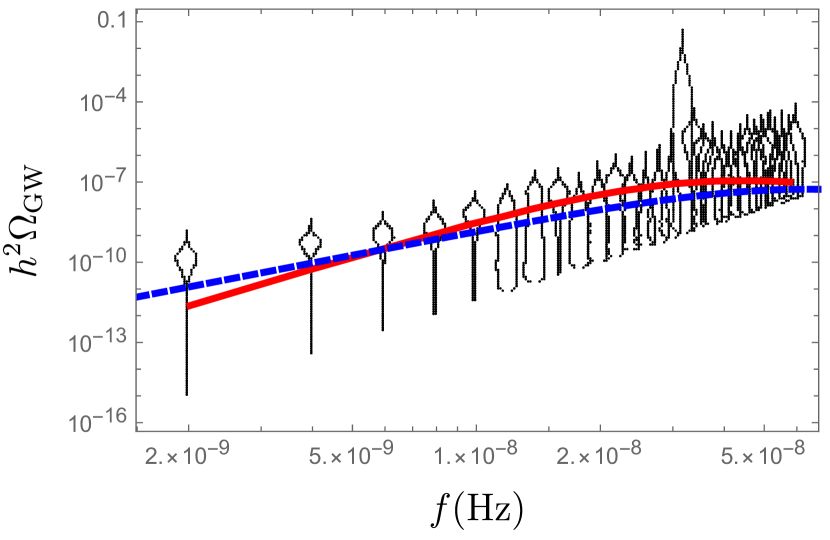
In this paper, we analyse sound waves arising from a cosmic phase transition where the full velocity profile is taken into account as an explanation for the gravitational wave spectrum observed by multiple pulsar timing array groups. Unlike the broken power law used in the literature, in this scenario the power law after the peak depends on the macroscopic properties of the phase transition, allowing for a better fit with pulsar timing array (PTA) data. We compare the best fit with that obtained using the usual broken power law and, unsurprisingly, find a better fit with the gravitational wave (GW) spectrum that utilizes the full velocity profile. We then discuss models that can produce the best-fit point and complementary probes using CMB experiments and searches for light particles in DUNE, IceCUBE-Gen2, neutrinoless double beta decay, and forward physics facilities at the LHC like FASER nu, etc.
Motivation & Objective
- To improve the fit of gravitational wave spectra to NANOGrav 15-year data by replacing the standard broken power law with a physically motivated full fluid velocity profile.
- To assess whether the observed blue-tilted gravitational wave spectrum (ΩGW ∝ f^(1.3–2.4)) can be explained by sound waves from a first-order phase transition.
- To identify viable dark sector models that can produce such a phase transition and its associated gravitational wave signal.
- To explore complementary constraints from CMB experiments (CMB-S4, CMB-HD, etc.) and terrestrial probes (DUNE, IceCube-Gen2, FPF at LHC, neutrinoless double beta decay).
Proposed method
- Model the gravitational wave spectrum from sound waves during a first-order phase transition using the full velocity profile of the fluid, rather than assuming a broken power law.
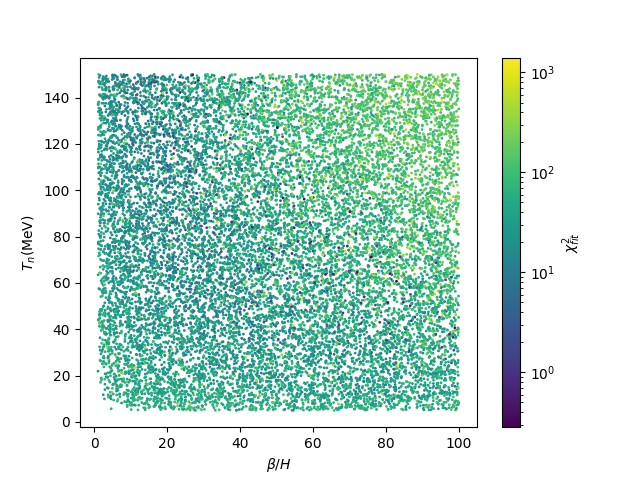
- Use the NANOGrav 15-year data to constrain the phase transition parameters, including the bubble wall velocity, plasma temperature, and transition strength.
- Compare the goodness of fit of the full velocity profile model against the standard broken power law model using statistical criteria.
- Derive the effective operator for neutrino portal interactions (ϕN¯N¯) to connect the dark sector to the SM, enabling phenomenological constraints.
- Map existing and projected experimental bounds on the coupling gαβ and mediator mass mϕ from meson decays, neutrinoless double beta decay, DUNE, IceCube-Gen2, and FPF at the LHC.
- Assess UV-completeness of the effective theory via models such as massive Majoron, inverse seesaw, and U(1)B−L models.
Experimental results
Research questions
- RQ1Can the full fluid velocity profile in a cosmic phase transition better explain the blue-tilted gravitational wave spectrum observed in the NANOGrav 15-year data compared to the broken power law?
- RQ2What are the physical parameters (e.g., phase transition time scale, wall velocity) that emerge from the full velocity profile fit, and how do they compare to those from the broken power law?
- RQ3Which dark sector models can produce a phase transition consistent with the best-fit gravitational wave spectrum and satisfy cosmological and particle physics constraints?
- RQ4How do future CMB experiments and terrestrial neutrino/dark matter searches complement gravitational wave observations in probing the phase transition parameter space?
- RQ5What are the implications of the neutrino portal operator for the detection of light mediators in DUNE, IceCube-Gen2, and FPF at the LHC?
Key findings
- The full fluid velocity profile model provides a significantly better fit to the NANOGrav 15-year data than the standard broken power law, particularly in capturing the blue-tilted spectrum (ΩGW ∝ f^(1.3–2.4)).
- The best-fit phase transition parameters from the full velocity model yield a shorter timescale relative to the Hubble time, making them more physically plausible than those from the broken power law.
- The model predicts a gravitational wave amplitude consistent with the observed Hellings-Downs angular correlation pattern, supporting a cosmological origin over astrophysical SMBHBs.
- Complementary constraints on the neutrino portal coupling gαβ and mediator mass mϕ are derived from existing and projected experiments, including DUNE, IceCube-Gen2, and FPF at the LHC.
- Future CMB experiments such as CMB-S4, CMB-HD, CMB-Bharat, and LiteBIRD will provide strong complementary probes of the phase transition parameter space.
- UV-complete models such as the massive Majoron, inverse seesaw, and U(1)B−L models can realize the effective neutrino portal interaction and support the proposed phase transition mechanism.
Read this paper
Open the full text in the Nubint reader and ask about any passage as you read.
Read this paper on NubintThis review was generated by AI from the original paper. Please check the paper before citing it.