
[Paper Review] DiffHopp: A Graph Diffusion Model for Novel Drug Design via Scaffold Hopping
DiffHopp is a novel E(3)-equivariant graph diffusion model designed for scaffold hopping in drug design, conditioned on protein-ligand complexes to generate novel, diverse molecular scaffolds while preserving pharmacophoric features. It outperforms general pocket-conditioned diffusion models used via inpainting, especially when enhanced with powerful geometric graph networks to address low connectivity issues.
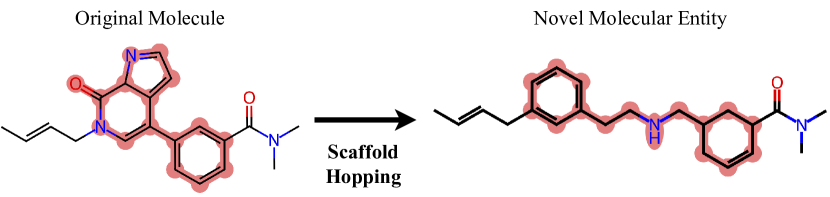
Scaffold hopping is a drug discovery strategy to generate new chemical entities by modifying the core structure, the \emph{scaffold}, of a known active compound. This approach preserves the essential molecular features of the original scaffold while introducing novel chemical elements or structural features to enhance potency, selectivity, or bioavailability. However, there is currently a lack of generative models specifically tailored for this task, especially in the pocket-conditioned context. In this work, we present DiffHopp, a conditional E(3)-equivariant graph diffusion model tailored for scaffold hopping given a known protein-ligand complex.
Motivation & Objective
- To address the lack of generative models specifically tailored for scaffold hopping in structure-based drug design.
- To improve molecular generation in low-connectivity regions of protein pockets, a known limitation in current diffusion models.
- To condition scaffold generation on both the protein pocket and pharmacophoric features, ensuring functional group retention.
- To evaluate whether a model specifically trained for scaffold hopping outperforms general diffusion models used via inpainting.
Proposed method
- Uses a 3D geometric graph representation of protein-ligand complexes, with nodes as atoms and edges as normalized vectors and distances.
- Employs an E(3)-equivariant message-passing architecture based on GVPs (Gated Vector Networks) to model 3D molecular geometry and enforce rotational/translation invariance.
- Applies a denoising diffusion process to gradually denoise a perturbed scaffold, conditioned on the protein pocket and functional groups.
- Introduces a residual GNN architecture with attention-based edge weighting to improve message passing in sparse or low-connectivity regions.
- Trains on 19,378 PDBBind complexes with Murcko-Bemis scaffolds, using RDKit for scaffold extraction and topological fingerprints for evaluation.
- Repurposes general pocket-conditioned diffusion models (e.g., DiffSBDD) via inpainting for comparative ablation studies.
Experimental results
Research questions
- RQ1Can a diffusion model specifically trained for scaffold hopping outperform general pocket-conditioned diffusion models used in an inpainting setup?
- RQ2How does the use of more powerful geometric graph neural networks affect scaffold generation in low-connectivity regions of protein pockets?
- RQ3To what extent can the model generate structurally diverse and drug-like scaffolds while preserving pharmacophoric features?
- RQ4Does conditioning on the full protein pocket, rather than just shape, lead to more biologically relevant scaffold hops?
Key findings
- DiffHopp outperforms general pocket-conditioned diffusion models (e.g., DiffSBDD) used via inpainting in scaffold hopping generation, particularly in generating diverse and drug-like molecules.
- The use of powerful geometric GNNs significantly mitigates the low-connectivity problem in protein pocket regions, improving generation quality in sparse areas.
- UMAP visualization shows that DiffHopp generates a wide diversity of scaffolds across different chemotypes, even when conditioned on varied functional groups.
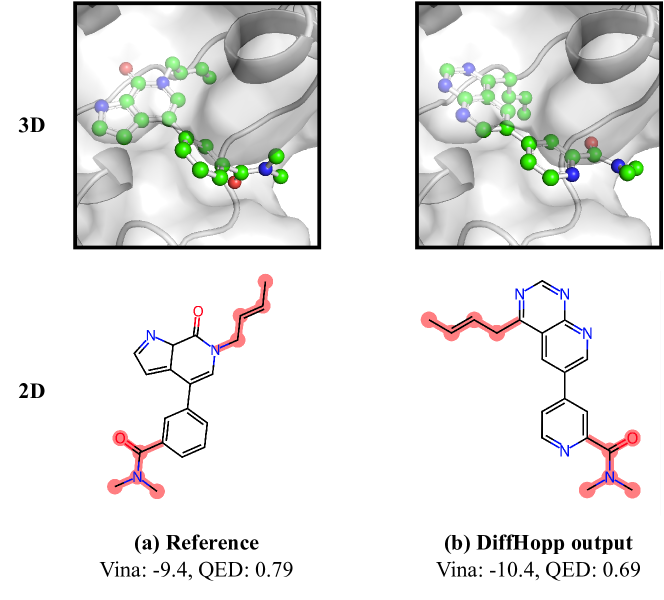
- Cherry-picked samples demonstrate that generated scaffolds often achieve better Vina binding scores (e.g., -8.5 vs. -8.0) and QED values (e.g., 0.69 vs. 0.65) than the original ligands.
- Despite improvements, some generated scaffolds are unconnected, indicating a need for further refinement in topological consistency.
- The model successfully preserves pharmacophoric features (highlighted in red) while redesigning the core scaffold, confirming its scaffold-hopping capability.
Read this paper
Open the full text in the Nubint reader and ask about any passage as you read.
Read this paper on NubintThis review was generated by AI from the original paper. Please check the paper before citing it.