
[Paper Review] DiffRF: Rendering-Guided 3D Radiance Field Diffusion
DiffRF introduces the first diffusion model for direct 3D radiance field synthesis, using a 3D denoising U-Net on voxel grids guided by a volumetric rendering loss to learn multi-view consistent priors. It enables high-fidelity, view-consistent 3D generation and novel masked completion without task-specific training, outperforming GANs on FID (15.95 vs. 16.54) and MMD (4.42 vs. 5.62).
We introduce DiffRF, a novel approach for 3D radiance field synthesis based on denoising diffusion probabilistic models. While existing diffusion-based methods operate on images, latent codes, or point cloud data, we are the first to directly generate volumetric radiance fields. To this end, we propose a 3D denoising model which directly operates on an explicit voxel grid representation. However, as radiance fields generated from a set of posed images can be ambiguous and contain artifacts, obtaining ground truth radiance field samples is non-trivial. We address this challenge by pairing the denoising formulation with a rendering loss, enabling our model to learn a deviated prior that favours good image quality instead of trying to replicate fitting errors like floating artifacts. In contrast to 2D-diffusion models, our model learns multi-view consistent priors, enabling free-view synthesis and accurate shape generation. Compared to 3D GANs, our diffusion-based approach naturally enables conditional generation such as masked completion or single-view 3D synthesis at inference time.
Motivation & Objective
- To develop a generative model that synthesizes 3D radiance fields directly from posed 2D images, enabling high-fidelity 3D asset creation.
- To address the challenge of ambiguous and artifact-ridden radiance field supervision by introducing a rendering-guided denoising loss.
- To enable conditional 3D generation tasks such as masked completion and single-view 3D synthesis without task-specific fine-tuning.
- To learn multi-view consistent priors that support free-view synthesis and accurate geometric reconstruction.
- To outperform existing GAN-based methods in both image quality and geometric fidelity on benchmark datasets.
Proposed method
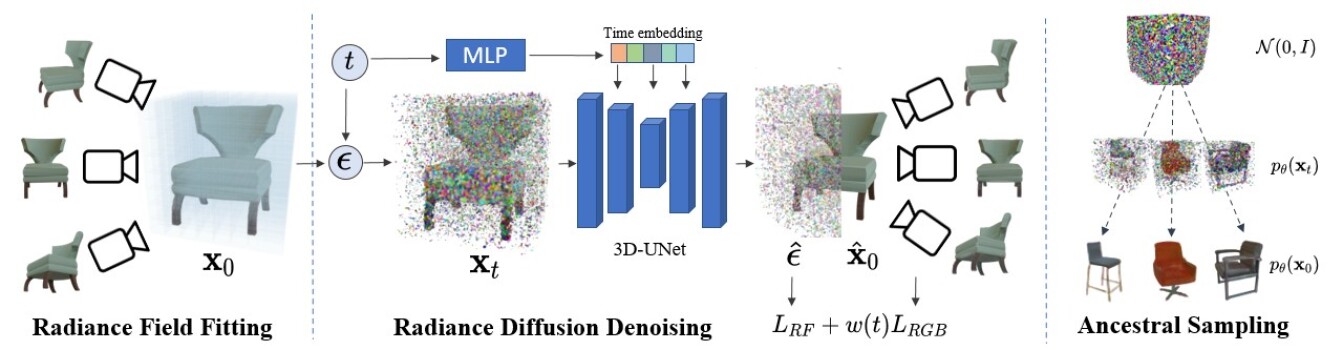
- Proposes a 3D denoising diffusion model operating directly on explicit voxel grid representations of radiance fields.
- Introduces a rendering-guided loss that biases the denoising process toward high-quality image synthesis, reducing fitting of artifacts.
- Uses a denoising U-Net architecture to predict noise in the voxel grid, with noise schedule and reverse diffusion sampling.
- Applies a volumetric rendering loss during training to align predicted radiance fields with rendered 2D images from multiple views.
- Enables conditional generation via classifier guidance, where the denoising process is steered toward minimizing rendering error against input images.
- Performs masked radiance field completion by iteratively fusing known regions with denoised estimates using a masked diffusion process: $ f_{0}^{t-1} = \sqrt{\bar{\alpha}_{t}}(m \odot \tilde{f}^{t}_{0} + (1-m) \odot f^{in}) $, with $ m $ as a binary mask.
Experimental results
Research questions
- RQ1Can a diffusion model be effectively trained to generate 3D radiance fields directly from posed 2D images, bypassing intermediate representations?
- RQ2How can a rendering-guided loss improve the quality of generated radiance fields by reducing fitting to artifacts and noise?
- RQ3Can diffusion-based 3D generation learn multi-view consistent priors that support free-view synthesis and accurate geometry?
- RQ4Can the diffusion framework be adapted for novel conditional tasks like masked radiance field completion without task-specific fine-tuning?
- RQ5How does the performance of a diffusion-based 3D radiance field model compare to state-of-the-art GAN-based methods in image quality and geometric accuracy?
Key findings
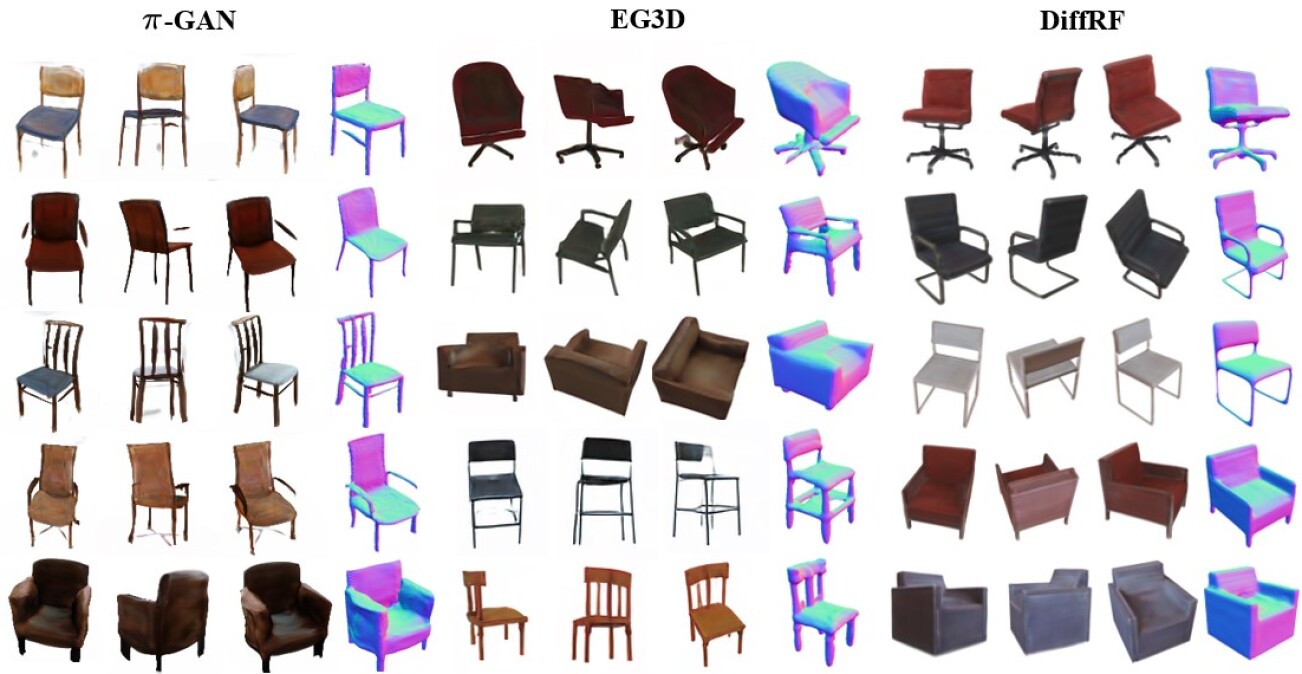
- DiffRF achieves a Fréchet Inception Distance (FID) of 15.95 on the PhotoShape Chairs dataset, improving over the GAN-based EG3D baseline of 16.54.
- The model reduces the Multi-scale Structural Similarity (MMD) score from 5.62 (EG3D) to 4.42, indicating improved geometric fidelity.
- In masked completion, DiffRF generates more diverse and harmonized completions than EG3D, preserving the original unmasked regions better.
- Quantitative evaluation shows that DiffRF maintains higher photo-metric accuracy (mPSNR) on unmasked regions compared to EG3D under the same masking levels.
- The method enables single-view 3D synthesis by guiding the diffusion process using classifier guidance with a posed image and foreground mask.
- DiffRF demonstrates the feasibility of training a diffusion model directly on 3D radiance fields, overcoming the lack of ground truth data via rendering supervision.
Read this paper
Open the full text in the Nubint reader and ask about any passage as you read.
Read this paper on NubintThis review was generated by AI from the original paper. Please check the paper before citing it.