
[論文レビュー] Dilaton and Massive Hadrons in a Conformal Phase
本稿は、スケール対称性の自発的破れがダイラトン・ゴールドストーン粒子を生じさせることで、質量のあるハドロンが存在するにもかかわらず conformal Ward 恒等式が成立する、新しい 'conformal dilaton phase' を提案する。ユークリッド空間における renormalization group 手法を用いて、物理状態上でのエネルギー運動量テンソルのトレースが消えることを示し、グルーオン凝集量が消えること、およびスケール対称性の破れの原因がクォーク凝集量であることを特定する。ダイラトン質量はクォーク質量にハイパースケーリング的に比例し、$ m_D \to \text{const} \cdot m_q^{1/(1+\tilde{\nu})} $ となる。これはラティス計算による明確な探索シグネチャを提供する。
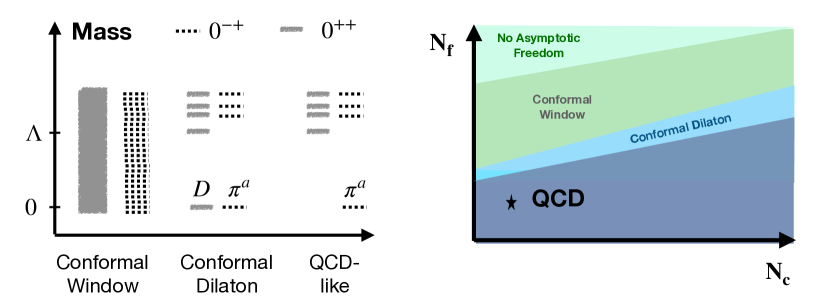
As the number of fermion fields is increased, gauge theories are expected to undergo a transition from a QCD-like phase, characterised by confinement and chiral symmetry breaking, to a conformal phase, where the theory becomes scale-invariant at large distances. In this paper, we discuss some properties of a third phase, where spontaneously broken conformal symmetry is characterised by its Goldstone boson, the dilaton. In this phase, which we refer to as conformal dilaton phase, the massless pole corresponding to the Goldstone boson guarantees that the conformal Ward identities are satisfied in the infrared despite the other hadrons carrying mass. In particular, using renormalisation group arguments in Euclidean space, we show that for massless quarks the trace of the energy momentum tensor vanishes on all physical states as a result of the fixed point. This implies the vanishing of the gluon condensate and suggests that the scale breaking is driven by the quark condensate which has implications for the cosmological constant. In addition form factors obey an exact constraint for every hadron and are thus suitable probes to identify this phase in the context of lattice Monte Carlo studies. For this purpose we examine how the system behaves under explicit symmetry breaking, via quark-mass and finite-volume deformations. The dilaton mass shows hyperscaling under mass deformation, viz. $m_{D} = {\cal O}(m_q^{1/(1+γ^*)})$. This provides another clean search pattern.
研究の動機と目的
- ゲージ理論における新しい相、すなわち 'conformal dilaton phase' を特定・特徴づけること。この相では、 conformal 対称性が自発的に破れ、ダイラトン・ゴールドストーン粒子が生じる。
- 質量のあるハドロンが存在するにもかかわらず、物理状態上でのエネルギー運動量テンソルのトレースが消えることにより、インフラレッド領域における conformal Ward 恒等式が満たされることを確立すること。
- 固定点挙動に起因してグルーオン凝集量が消えることから、スケール対称性の破れがゲージ相互作用ではなく、クォーク凝集量によって駆動されることを示すこと。
- フォーム因子がこの相を正確に探査する手段であることを特定すること、特にフェルミオン行列要素における $ g_3 $ フォーム因子を重点的に扱うこと。
- クォーク質量の摂動的変形におけるダイラトン質量のハイパースケーリング関係を導出する:$ m_D = \mathcal{O}(m_q^{1/(1+\tilde{\nu})}) $、これによりラティス検出が可能になる。
提案手法
- ユークリッド空間における renormalization group (RG) 論拠を用いて、conformal dilaton phase におけるすべての物理状態上でのエネルギー運動量テンソルのトレースが消えることを証明する。
- ダイラトンの conformal Ward 恒等式を、拡大カレントの発散 $ \partial \cdot J^D = T^\mu_\mu = \frac{\beta}{2g}G^2 + m_q(1+\gamma)\bar{q}q $ を用いて分析し、$ m_q \to 0 $ の極限でそれが消えることを示す。
- 重力フォーム因子、特に $ g_3(q^2) $ に対する正確な制約を導出し、ダイラトン極に整合するためには $ g_3(0) = \frac{4}{d-1} $ でなければならないことを示す。
- LSZ 減少を適用して $ g_{ffD} $ カップリングと $ g_3 $ フォーム因子を関係づけ、ダイラトン崩壊定数 $ F_D $ を用いて制約 $ g_3(0) = \frac{4}{d-1} $ が確認されることを確認する。
- クォーク質量による明示的対称性破れおよび有限体積の歪みを用いて、この相の構造を調べる。
- ハイパースケーリング解析を用いて、ダイラトン質量が $ m_D \propto m_q^{1/(1+\tilde{\nu})} $ のようにスケーリングすることを導出し、ここで $ \tilde{\nu} $ は固定点における異常次元である。
実験結果
リサーチクエスチョン
- RQ1ゲージ理論において、conformal 対称性が自発的に破れ、ダイラトン・ゴールドストーン粒子が生じるが、インフラレッド領域でも conformal Ward 恒等式が満たされるような相が存在しうるか?
- RQ2このような相において、物理状態上でのエネルギー運動量テンソルのトレースが消えるか? そしてグルーオン凝集量にどのような意味があるか?
- RQ3重力フォーム因子、特に $ g_3 $ が、conformal dilaton phase の正確なプローブとしてどのように機能するか?
- RQ4明示的クォーク質量の摂動的変形におけるダイラトン質量のスケーリング挙動は何か? そして、これはラティス検出の明確なシグネチャとして利用可能か?
- RQ5異常なスケール対称性の破れがあるにもかかわらず、なぜダイラトンは真のゴールドストーン粒子であるのか? $ \eta' $ メソンとは何が異なるのか?
主な発見
- conformal dilaton phase において、すべての物理状態上でのエネルギー運動量テンソルのトレースが消える。これは固定点挙動と質量ゼロのダイラトン極の存在に起因する直接的結果である。
- この相ではグルーオン凝集量が消える。これはスケール対称性の破れがゲージ系ではなく、クォーク凝集量によって駆動されていることを示唆する。
- フェルミオンの $ g_3 $ フォーム因子は、ダイラトン極と整合するためには $ g_3(0) = \frac{4}{d-1} $ を満たさなければならない。これはラティス研究における正確な制約を提供する。
- ダイラトン質量はクォーク質量にハイパースケーリング的に比例し、$ m_D = \mathcal{O}(m_q^{1/(1+\tilde{\nu})}) $ と表され、ここで $ \tilde{\nu} $ は固定点における異常次元である。
- 異常なスケール対称性の破れがあるにもかかわらず、ダイラトンは $ \eta' $ とは異なり、$ 1/N_c $ の抑制がないため真のゴールドストーン粒子である。
- フォーム因子の制約とハイパースケーリング挙動は、ラティス・モンテカルロ計算において conformal dilaton phase を特定するための、明確で相補的な二つのシグネチャを提供する。
より良い研究を、今すぐ始めましょう
論文の読解から最終レビューまで、研究時間を劇的に削減しましょう。
クレジットカード登録不要
このレビューはAIが作成し、人間の編集者が確認しました。