
[論文レビュー] Discovery of the local counterpart of disc galaxies at z > 4: The oldest thin disc of the Milky Way using Gaia-RVS
本研究では、高精度なGaia-RVSデータとStarHorse星の年齢モデルを用いて、ビッグバン後10億年以内に形成された、銀河の最も古い薄い円盤を発見した。金属不足の星が冷たい薄い円盤軌道にあることは、130億年以上も古く、縦方向速度分散(σ_Vz)が約20–25 km s⁻¹であることが確認された。これは、JWST や ALMA が観測した高赤方偏移円盤銀河と一致しており、初期の円盤形成と継続的な内側から外側への成長を示している。
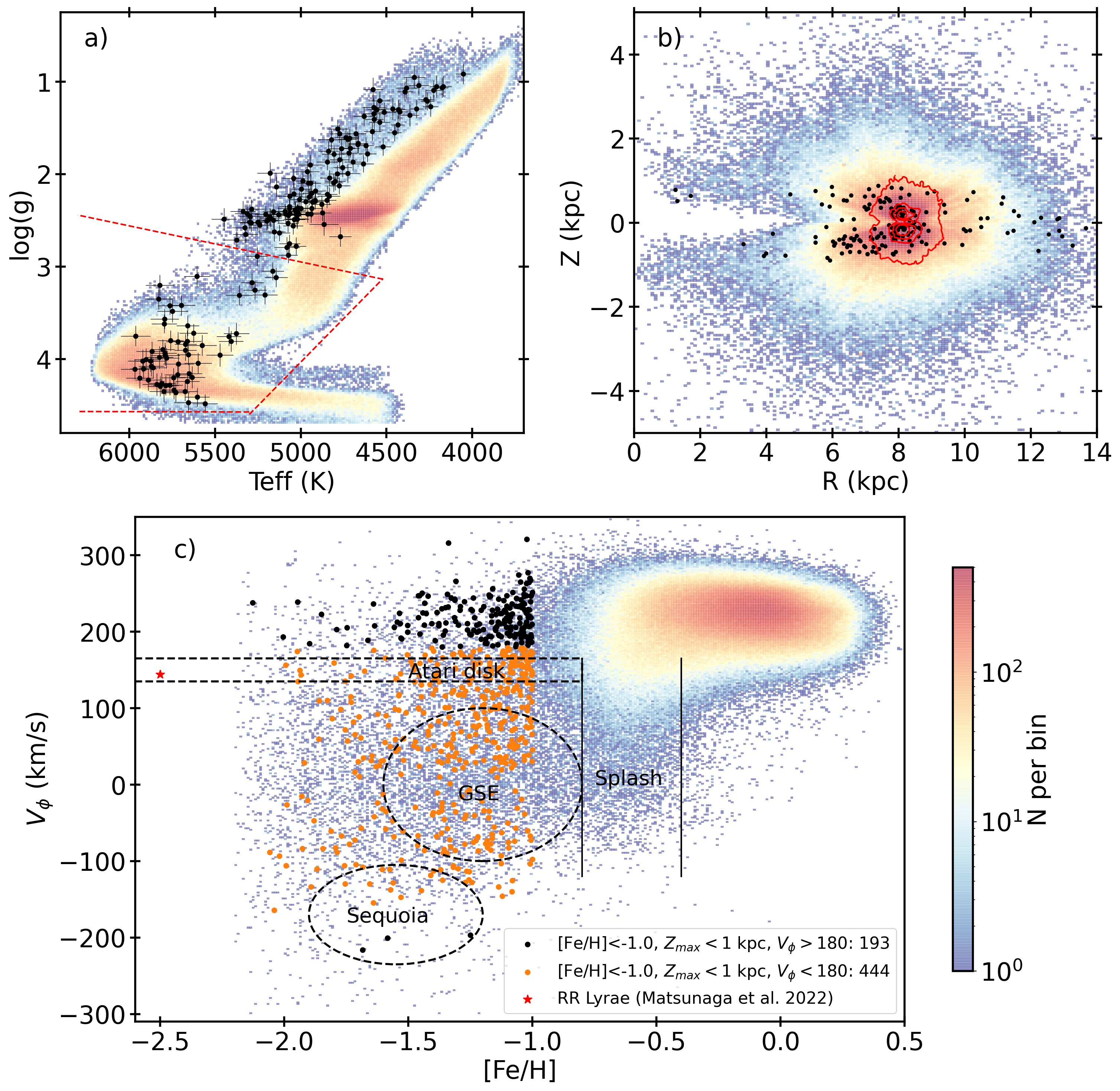
JWST has recently detected numerous disc galaxies at high-redshifts and there have been observations of cold disc galaxies at z > 4 with ALMA. In the Milky Way, recent studies find metal-poor stars in cold disc orbits, suggesting an ancient disc. We investigated a sample of 565,606 stars from the hybrid-CNN analysis of the Gaia-DR3 RVS stars. The sample contains 8,500 stars with [Fe/H]<-1. For a subset of ~200,000 MSTO and subgiant stars we computed distances and ages using the StarHorse code with a mean precision of 1% and 12%, respectively. First, we confirm the existence of metal-poor stars in thin disc orbits - over 50% are older than 13 Gyr. Second, we report the discovery of the oldest thin disc of the Milky Way(MW), which extends across a wide range of metallicities, from metal-poor to super-solar stars. The metal-poor stars in disc orbits manifest as a readily visible tail of the metallicity distribution. The high-[α/Fe] thick disc exhibits a vertical velocity dispersion of 35 km/s, while the thin disc shows 10 to 15 km/s lower at similar ages. Our old thin disc $σ_{V_z}$ appears similar to those estimated for the high-z disc galaxies. Third, we extend the [Y/Mg] chemical clock to the oldest ages and estimate a slope of -0.038 dex/Gyr. Finally, we confirm our discovery by showing that the splash includes high- and low-[α/Fe] populations that are both old and extends to super-solar [Fe/H]. We find about 6 to 10% of the old thin disc was heated to thick disc orbits with the youngest splashed stars being 9 to 10 Gyrs. We conclude the MW thin disc forms <1 billion years from Big Bang, building up inside-out, preceding earlier estimates by about 4-5 billion years. Considering a massive merger event such as the GSE, a Splash is expected - we find a portion of the old thin disc is heated to thick disc velocities and the Splash extends to super-solar [Fe/H] regimes.
研究の動機と目的
- 銀河の薄い円盤の形成時期を解明し、以前の推定値(約8–9 Gyr)に挑戦すること。
- 冷たい円盤軌道にある金属不足の星が、原始的な薄い円盤に属するのか、あるいはハロー/準構造に属するのかを特定すること。
- ガイヤ・エンセルラスのような大規模な合体が、星を薄い円盤の運動学的性質から厚い円盤の性質へと加熱する役割を果たすかを調査すること。
- 最も古い年齢領域において、[Y/Mg]の化学的時計を用いて星の年齢推定値を検証すること。
- 古くからある薄い円盤の全金属量範囲をマッピングし、超太陽系金属量を含むこと。
提案手法
- Gaia DR3 RVSの202,384個の主系列回折点および準巨星分類星を用い、6次元位相空間と高品質な星のパラメータを取得した。
- 星の距離と年齢を、それぞれ1%および12%の精度で推定するために、StarHorseコードを適用した。光度および分光的データを用いた。
- GALAH調査の化学成分とGaia-RVSデータを統合し、運動学的および化学的・運動学的分析のための[α/Fe]および[Fe/H]を計算した。
- [Y/Mg]の比を化学的時計として用い、年齢推定値を検証した。その勾配は−0.038 dex Gyr⁻¹であった。
- 縦方向速度分散(σ_Vz)を分析し、薄い円盤(σ_Vzが低い)と厚い円盤(σ_Vzが高い)の群を区別した。
- 合体イベントによって薄い円盤軌道から厚い円盤軌道へと加熱された星を特定するために、SPLASH群の年齢と金属量を追跡した。
実験結果
リサーチクエスチョン
- RQ1銀河の薄い円盤はいつ形成されたのか?GSE合体より前か?
- RQ2冷たい円盤軌道にある金属不足の星は、原始的な薄い円盤に属するのか、それともハロー/準構造に属するのか?
- RQ3古くからある薄い円盤の縦方向速度分散は何か?高赤方偏移円盤銀河と比べてどうか?
- RQ4GSE合体によって、古くからある薄い円盤が厚い円盤の運動学的性質へどの程度加熱されたのか?
- RQ5SPLASH群は超太陽系金属量まで延びており、これは初期の円盤形成に何を示唆するか?
主な発見
- 銀河の薄い円盤は、ビッグバン後10億年以内に形成された。これは、以前の推定値より40–50億年も前である。
- Z_max < 1 kpc、V_φ > 180 km s⁻¹の条件を満たす金属不足の星の50%以上が130億年以上も古く、その古代的起源が確認された。
- 古くからある薄い円盤の縦方向速度分散(σ_Vz)は20–25 km s⁻¹であり、高[α/Fe]の厚い円盤(σ_Vz ≈ 35 km s⁻¹)よりも10–15 km s⁻¹低い。
- [Y/Mg]の化学的時計は、最も古い年齢領域まで延長され、勾配が−0.038 dex Gyr⁻¹であった。これにより、StarHorseによる年齢推定値が検証された。
- 古くからある薄い円盤のおよそ6–10%が、厚い円盤の運動学的性質へ加熱された。これに該当する若い低[α/Fe]の星は存在せず、加熱は90–100億年前以前に発生したことが示唆された。
- SPLASH群には、90億年以上も古く、高・低[α/Fe]の星が含まれており、[Fe/H] ≈ 0.25の超太陽系金属量まで延びており、冷たい円盤における初期で持続的な星形成を示している。
![Figure 2 : Toomre diagrams ( $\sqrt{V^{2}_{R}+V^{2}_{\phi}}$ vs. $V_{\phi}$ ) for the age sample stars in bins of age and [ Fe / H ] . The plots are color-coded by logarithm of stellar density. Older to younger ages from top to bottom and metal-poor to metal-rich [ Fe / H ] from left to right. The a](https://ar5iv.labs.arxiv.org/html/2402.00561/assets/plots/mp_sample_age_toomre_age_mh_bins_1.png)
より良い研究を、今すぐ始めましょう
論文の読解から最終レビューまで、研究時間を劇的に削減しましょう。
クレジットカード登録不要
このレビューはAIが作成し、人間の編集者が確認しました。