
[Paper Review] Distilling Knowledge from Ensembles of Acoustic Models for Joint CTC-Attention End-to-End Speech Recognition
This paper proposes three novel error rate (ER)-based distillation strategies for joint CTC-attention end-to-end ASR systems, using ensembles of acoustic models to improve student performance by prioritizing teachers based on transcription quality rather than loss alone. The methods achieve state-of-the-art WERs of 13.11% on TIMIT, 15.57% on Common Voice Italian, and 17.04% on Common Voice French, outperforming individual teachers and standard distillation baselines.
Knowledge distillation has been widely used to compress existing deep learning models while preserving the performance on a wide range of applications. In the specific context of Automatic Speech Recognition (ASR), distillation from ensembles of acoustic models has recently shown promising results in increasing recognition performance. In this paper, we propose an extension of multi-teacher distillation methods to joint CTC-attention end-to-end ASR systems. We also introduce three novel distillation strategies. The core intuition behind them is to integrate the error rate metric to the teacher selection rather than solely focusing on the observed losses. In this way, we directly distill and optimize the student toward the relevant metric for speech recognition. We evaluate these strategies under a selection of training procedures on different datasets (TIMIT, Librispeech, Common Voice) and various languages (English, French, Italian). In particular, state-of-the-art error rates are reported on the Common Voice French, Italian and TIMIT datasets.
Motivation & Objective
- To improve end-to-end ASR performance by leveraging ensembles of pre-trained acoustic models through knowledge distillation.
- To address the limitation of standard distillation that relies solely on loss for teacher selection, which may favor poorly performing teachers.
- To directly optimize the student model toward transcription quality (measured by WER) rather than loss minimization.
- To explore and validate novel distillation strategies that dynamically weight or select teachers based on sequence-level error rates.
- To demonstrate that reusing already-trained models via ER-based distillation minimizes compute waste and boosts performance.
Proposed method
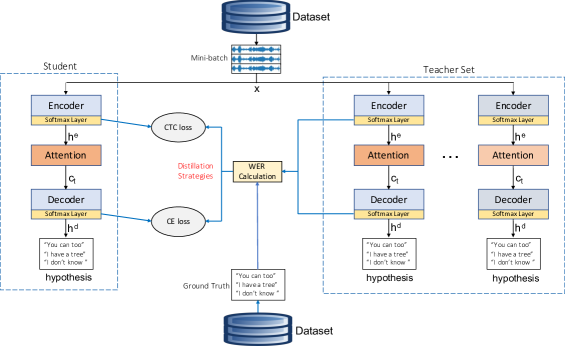
- Proposes a multi-teacher distillation framework for joint CTC-attention ASR systems, where soft targets are derived from multiple teacher models.
- Introduces the 'Weighted' strategy, which dynamically assigns training weights to teachers based on their average WER over a mini-batch.
- Introduces the 'Top-1' strategy, where the student selects only the single best-performing teacher per mini-batch based on sentence-level WER.
- Introduces the 'Top-k' strategy, which allows the student to learn from a set of top-performing teachers with similar WERs, increasing label diversity.
- Uses the student model's loss to minimize cross-entropy between its predictions and the soft targets from the selected teachers.
- Employs a joint CTC-attention training objective, where the student is trained to minimize both CTC and attention-based cross-entropy losses using distilled targets.
Experimental results
Research questions
- RQ1Can knowledge distillation from ensembles of acoustic models improve WER in joint CTC-attention end-to-end ASR systems beyond what individual teachers achieve?
- RQ2Does selecting teachers based on error rate (WER) rather than loss lead to better generalization and lower WER in the student model?
- RQ3How do different teacher selection strategies—'Weighted', 'Top-1', and 'Top-k'—affect the final WER and training stability across diverse datasets?
- RQ4Can ER-based distillation effectively utilize already-trained models without retraining, reducing compute waste while improving performance?
- RQ5How does the diversity of teacher outputs, especially in terms of transcription errors, affect the student's robustness and accuracy?
Key findings
- The proposed ER-based distillation strategies significantly outperform standard distillation baselines, reducing WER by 0.74% on average across four datasets compared to the best individual teacher.
- On the Common Voice French dataset, the method achieves a state-of-the-art WER of 17.04%, surpassing previous results.
- On the Common Voice Italian dataset, the method achieves a state-of-the-art WER of 15.57%, demonstrating strong generalization across languages.
- On TIMIT, the method achieves a state-of-the-art WER of 13.11%, confirming its effectiveness on standard benchmarks.
- The 'Top-k' and 'Weighted' strategies achieve near-identical performance on Librispeech (1.04% WER difference), validating the robustness of ER as a proxy for distillation quality.
- The 'Average' baseline, which assigns equal weights to all teachers, consistently underperforms, proving that naive ensemble averaging is ineffective when poor teachers are included.

Read this paper
Open the full text in the Nubint reader and ask about any passage as you read.
Read this paper on NubintThis review was generated by AI from the original paper. Please check the paper before citing it.