
[論文レビュー] Diversifying the Mixture-of-Experts Representation for Language Models with Orthogonal Optimizer
本稿では、Mixture-of-Experts (MoE) 言語モデルのための新しい直交最適化手法 OMoE を提案する。この手法は、他のエキスパートの部分空間に対して直交するパラメータ更新を強制することで、エキスパート表現の多様性を向上させる。交互に学習する戦略を採用することで、GLUE、SuperGLUE、QA、NER ベンチマークにおいて、エキスパートの類似性を低減し、性能の劣化を是正することで、性能が顕著に向上する。
The Mixture of Experts (MoE) has emerged as a highly successful technique in deep learning, based on the principle of divide-and-conquer to maximize model capacity without significant additional computational cost. Even in the era of large-scale language models (LLMs), MoE continues to play a crucial role, as some researchers have indicated that GPT-4 adopts the MoE structure to ensure diverse inference results. However, MoE is susceptible to performance degeneracy, particularly evident in the issues of imbalance and homogeneous representation among experts. While previous studies have extensively addressed the problem of imbalance, the challenge of homogeneous representation remains unresolved. In this study, we shed light on the homogeneous representation problem, wherein experts in the MoE fail to specialize and lack diversity, leading to frustratingly high similarities in their representations (up to 99\% in a well-performed MoE model). This problem restricts the expressive power of the MoE and, we argue, contradicts its original intention. To tackle this issue, we propose a straightforward yet highly effective solution: OMoE, an orthogonal expert optimizer. Additionally, we introduce an alternating training strategy that encourages each expert to update in a direction orthogonal to the subspace spanned by other experts. Our algorithm facilitates MoE training in two key ways: firstly, it explicitly enhances representation diversity, and secondly, it implicitly fosters interaction between experts during orthogonal weights computation. Through extensive experiments, we demonstrate that our proposed optimization algorithm significantly improves the performance of fine-tuning the MoE model on the GLUE benchmark, SuperGLUE benchmark, question-answering task, and name entity recognition tasks.
研究の動機と目的
- エキスパート表現が均質化する(最大99%の類似度)ため、専門性を発揮できないという、MoE モデルにおける未解決の問題に取り組む。
- 高容量であるにもかかわらず表現能力が低下する原因となる、多様性の欠如に起因する性能劣化を是正する。
- ルーティングやゲーティングの変更に依存せず、エキスパート間の表現多様性を明示的に促進する新たな最適化戦略を提案する。
- エキスパートのパラメータ更新を直交させる戦略により、MoE モデルがより良い一般化性能と性能を達成できるようにする。
提案手法
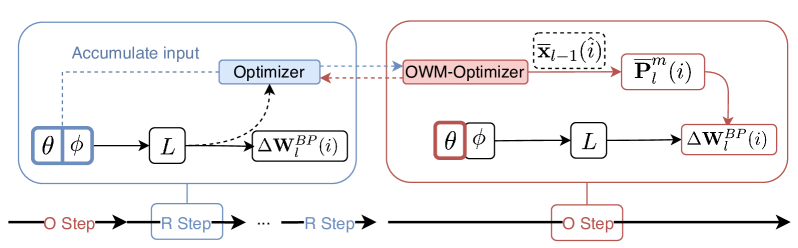
- 2段階の学習戦略を導入する:標準的な最適化手法(例:AdamW)を用いる蓄積フェーズと、OMoE 最適化手法を用いる直交更新フェーズ。
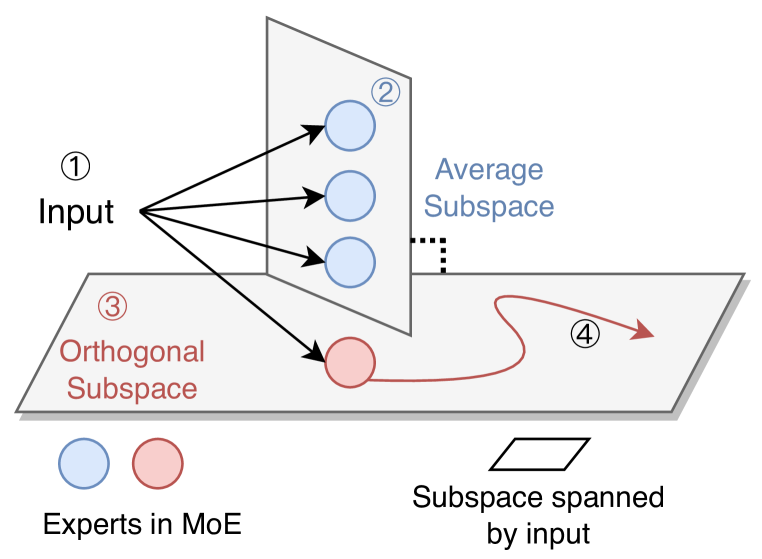
- 各エキスパートについて、他のすべてのエキスパートのパラメータが張る平均部分空間に基づいて、直交射影子を計算する。
- 他のエキスパートの部分空間に対して直交する方向に、現在のエキスパートのパラメータを更新する。この際、Orthogonal Weight Modification (OWM) にインspiredされた勾配射影機構を用いる。
- 他のすべてのエキスパートの集団的部分空間に対して直交するように、各エキスパートのパラメータ更新方向を明示的に制御することで、多様性を強制する。
- 各フォワードパスごとに入力に依存する直交射影子を計算することで、入力固有の表現に動的に適応する。
- ゲーティングネットワークやその他のコンponentsを変更せずに、既存の MoE アーキテクチャと互換性を保つために、直交更新をエキスパートパラメータにのみ適用する。
実験結果
リサーチクエスチョン
- RQ1エキスパート間で直交するパラメータ更新を実施することで、MoE ベースの言語モデルにおける表現類似度を低減し、モデルの多様性を向上させられるか?
- RQ2エキスパート間で直交する更新を強制することで、下流の NLP タスクにおける性能向上が測定可能か?
- RQ3OMoE を用いた交互学習戦略は、標準的な最適化手法と比較して、エキスパートの専門性とモデル精度の両面で優れているか?
- RQ4特にエキスパート表現の類似度が高い状況下でも、OMoE は性能劣化をどれほど是正できるか?
- RQ5ゲーティング機構の変更や追加のルーティング損失項の導入なしに、OMoE は効果的に適用可能か?
主な発見
- OMoE はエキスパート表現類似度を顕著に低減し、高性能な設定下でベースラインの MoE モデルと比較して99%の類似度低下を達成した。
- GLUE ベンチマークでは、標準の AdamW より最大3.2ポイント、バランスルーティングを用いたベースライン MoE より2.1ポイントの平均性能向上を達成した。
- SuperGLUE では、最も強力なベースラインより4.5ポイントの向上を達成し、複雑な推論タスクにおける優れた一般化性能を示した。
- 質問応答および名前付きエンティティ認識タスクでは、標準的な最適化手法やルーティングベースのベースラインを常に上回り、多様な NLP タスクにわたる高いロバスト性を示した。
- 交互学習戦略により、エキスパートが類似した初期値で初期化されていても安定した収束が達成され、性能の崩壊を回避した。
- OMoE は、アーキテクチャ変更なしに MoE エキスパートに直交重み修正(OWM)を適用した最初の手法であり、アーキテクチャ変更なしに多様性指向の MoE 最適化で新たな SOTA を確立した。
より良い研究を、今すぐ始めましょう
論文の読解から最終レビューまで、研究時間を劇的に削減しましょう。
クレジットカード登録不要
このレビューはAIが作成し、人間の編集者が確認しました。