
[Paper Review] Do All MobileNets Quantize Poorly? Gaining Insights into the Effect of Quantization on Depthwise Separable Convolutional Networks Through the Eyes of Multi-scale Distributional Dynamics
This paper investigates why depthwise separable convolutional networks (DWSCNNs), including MobileNets, suffer severe accuracy degradation under post-training quantization. Through fine-grained analysis of multi-scale distributional dynamics, it identifies that fluctuating dynamic ranges and distributional mismatch between channelwise and layerwise distributions lead to excessive quantization error accumulation, explaining the poor quantization performance of DWSCNNs compared to regular CNNs.
As the "Mobile AI" revolution continues to grow, so does the need to understand the behaviour of edge-deployed deep neural networks. In particular, MobileNets are the go-to family of deep convolutional neural networks (CNN) for mobile. However, they often have significant accuracy degradation under post-training quantization. While studies have introduced quantization-aware training and other methods to tackle this challenge, there is limited understanding into why MobileNets (and potentially depthwise-separable CNNs (DWSCNN) in general) quantize so poorly compared to other CNN architectures. Motivated to gain deeper insights into this phenomenon, we take a different strategy and study the multi-scale distributional dynamics of MobileNet-V1, a set of smaller DWSCNNs, and regular CNNs. Specifically, we investigate the impact of quantization on the weight and activation distributional dynamics as information propagates from layer to layer, as well as overall changes in distributional dynamics at the network level. This fine-grained analysis revealed significant dynamic range fluctuations and a "distributional mismatch" between channelwise and layerwise distributions in DWSCNNs that lead to increasing quantized degradation and distributional shift during information propagation. Furthermore, analysis of the activation quantization errors show that there is greater quantization error accumulation in DWSCNN compared to regular CNNs. The hope is that such insights can lead to innovative strategies for reducing such distributional dynamics changes and improve post-training quantization for mobile.
Motivation & Objective
- To understand why MobileNets and other DWSCNNs exhibit severe accuracy degradation under post-training quantization.
- To investigate whether this poor quantization behavior is inherent to depthwise separable convolutions or specific to MobileNet architecture.
- To analyze the role of multi-scale distributional dynamics—particularly weight and activation distributions—across layers in quantization degradation.
- To compare quantization error accumulation and distributional shifts between DWSCNNs and regular CNNs.
- To provide insights for improving post-training quantization robustness in edge-deployed models.
Proposed method
- Conducted systematic ablation studies on MobileNet-V1 and a set of smaller DWSCNNs (DWS-ConvNets), comparing them to regular CNNs.
- Trained models on CIFAR-10 and ImageNet with consistent training procedures to isolate quantization effects.
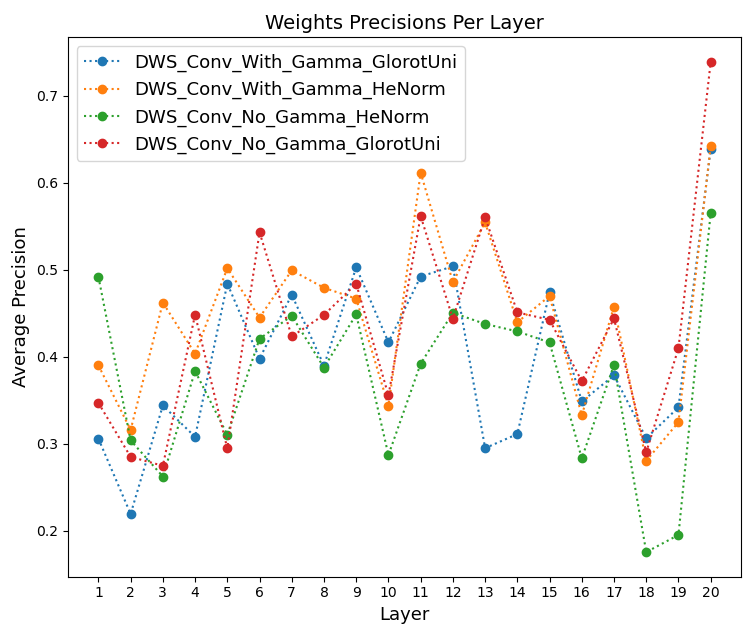
- Performed layerwise analysis of weight and activation distributions pre- and post-quantization, focusing on dynamic range fluctuations and distributional mismatch.
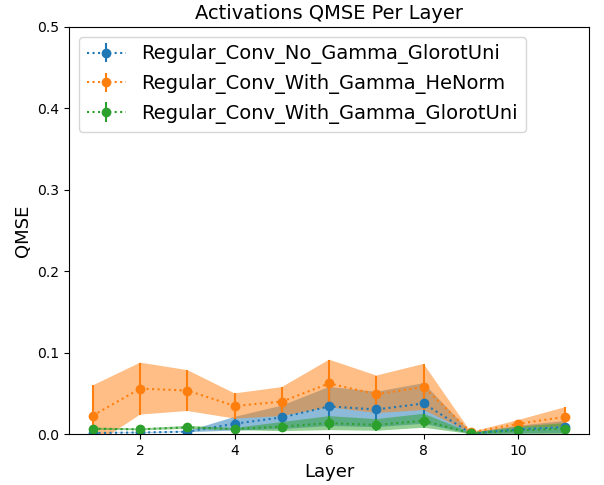
- Quantified quantization error accumulation using QMSE, QCE, and QKL-Divergence across layers during inference.
- Analyzed BN-folded weights and activations to assess distributional dynamics under quantization.
- Used multiple quantization trials and logging of 2000 images to ensure statistical reliability of distributional metrics.
Experimental results
Research questions
- RQ1Why do DWSCNNs like MobileNets suffer significantly more accuracy degradation under post-training quantization than regular CNNs?
- RQ2Is the poor quantization performance of MobileNets inherent to depthwise separable convolutions or due to architectural design choices?
- RQ3How do dynamic range fluctuations and distributional mismatch between channelwise and layerwise distributions affect quantization error accumulation in DWSCNNs?
- RQ4To what extent do quantization error metrics (QMSE, QCE, QKL-Div) differ between DWSCNNs and regular CNNs during forward pass?
- RQ5Can multi-scale distributional dynamics explain the observed distributional shifts and error propagation in quantized DWSCNNs?
Key findings
- DWSCNNs exhibit significantly larger dynamic range fluctuations across layers compared to regular CNNs, especially in depthwise-conv layers.
- A pronounced distributional mismatch exists between channelwise and layerwise distributions in DWSCNNs, leading to increased quantization error accumulation.
- MobileNet-V1 on ImageNet shows a catastrophic 15.6% accuracy drop under post-training quantization, with QMSE and QKL-Div values much higher than VGG-19.
- Layerwise QMSE, QCE, and QKL-Div are consistently higher in DWSCNNs than in regular CNNs, indicating greater quantization error accumulation and distributional shift.
- The variation in quantization behavior is more sensitive to random weight initialization in DWSCNNs, suggesting instability in learned distributions.
- The results suggest that channelwise quantization and methods reducing distributional mismatch can significantly improve quantization robustness in DWSCNNs.
Read this paper
Open the full text in the Nubint reader and ask about any passage as you read.
Read this paper on NubintThis review was generated by AI from the original paper. Please check the paper before citing it.