
[Paper Review] Dynamic Graph Message Passing Networks
This paper proposes Dynamic Graph Message Passing Networks (DGMN), a novel method that dynamically samples relevant nodes and learns position-specific filter weights and affinity matrices for efficient long-range message passing in vision tasks. It achieves state-of-the-art performance on semantic segmentation, object detection, and instance segmentation with 9.4% of the FLOPs and 25.3% of the parameters of the fully-connected Non-local network.
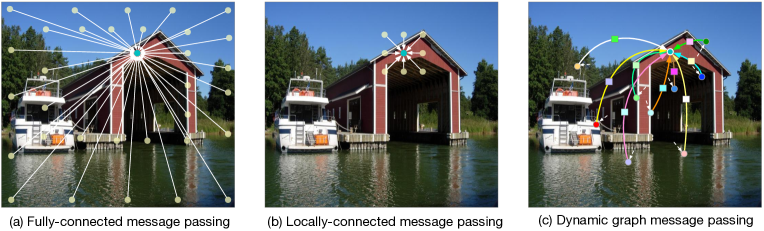
Modelling long-range dependencies is critical for scene understanding tasks in computer vision. Although CNNs have excelled in many vision tasks, they are still limited in capturing long-range structured relationships as they typically consist of layers of local kernels. A fully-connected graph is beneficial for such modelling, however, its computational overhead is prohibitive. We propose a dynamic graph message passing network, that significantly reduces the computational complexity compared to related works modelling a fully-connected graph. This is achieved by adaptively sampling nodes in the graph, conditioned on the input, for message passing. Based on the sampled nodes, we dynamically predict node-dependent filter weights and the affinity matrix for propagating information between them. Using this model, we show significant improvements with respect to strong, state-of-the-art baselines on three different tasks and backbone architectures. Our approach also outperforms fully-connected graphs while using substantially fewer floating-point operations and parameters. The project website is http://www.robots.ox.ac.uk/~lz/dgmn/
Motivation & Objective
- To address the high computational cost of fully-connected graph models in capturing long-range dependencies for scene understanding.
- To overcome the limitations of fixed local receptive fields in CNNs and static sampling in GraphSAGE for modeling long-range contextual relationships.
- To enable efficient and effective message passing by dynamically selecting relevant nodes based on input-dependent features.
- To jointly optimize dynamic node sampling, adaptive filter weights, and affinity matrices for improved representation learning.
- To integrate the DGMN module into existing backbone networks with minimal modification for broad applicability.
Proposed method
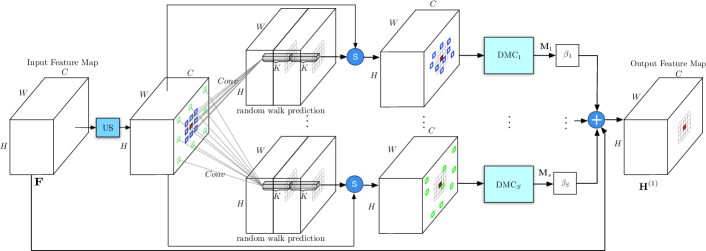
- Dynamically sample a subset of nodes from the feature graph based on input-dependent node features, using a learned position-specific random walk mechanism.
- Learn node-dependent filter weights and affinity matrices conditioned on the sampled nodes to enable adaptive message passing.
- Formulate message passing as a differentiable process where information is aggregated using learned, dynamic filters and affinities.
- Integrate the DGMN module as a plug-in layer after convolutional blocks in ResNet and ResNeXt backbones.
- Use a multi-head mechanism to predict multiple groups of filters and affinities, enabling richer feature modeling.
- Optimize the entire model end-to-end using standard backpropagation with cross-entropy and box/mask loss for detection and segmentation.
Experimental results
Research questions
- RQ1Can dynamic node sampling reduce computational cost while preserving long-range contextual modeling in vision tasks?
- RQ2Does learning position-specific filter weights and affinities improve message passing efficiency and representation quality?
- RQ3Can DGMN outperform fully-connected Non-local networks in performance while using significantly fewer FLOPs and parameters?
- RQ4How effective is DGMN when integrated into strong backbones like ResNet-101 and ResNeXt-101 across multiple tasks?
- RQ5What is the impact of varying sampling rates and filter group numbers on DGMN's performance and efficiency?
Key findings
- DGMN with dynamic filters and affinities achieves 40.2 AP on Cityscapes and 44.3 AP on COCO, outperforming the Non-local network while using only 9.4% of its FLOPs and 25.3% of its parameters.
- On COCO, DGMN improves Mask R-CNN with ResNeXt-101-FPN by 1.7 points in AP box and 1.2 points in AP mask, surpassing state-of-the-art one-stage detectors like CornerNet by 2.1 points in AP box.
- When applied to ResNet-101, DGMN boosts AP box by 1.6 points and AP mask by 1.2 points, demonstrating strong transferability to stronger backbones.
- Ablation studies show that both dynamic sampling and dynamic weights/affinities contribute significantly to performance, with the full DGMN model achieving the best results.
- Qualitative results on Cityscapes and COCO show DGMN produces fewer false positives and negatives, with sharper and more accurate instance segmentation masks.
- The model achieves state-of-the-art performance on COCO test-dev with a single-scale, single-model inference, without using additional data or training tricks.
Read this paper
Open the full text in the Nubint reader and ask about any passage as you read.
Read this paper on NubintThis review was generated by AI from the original paper. Please check the paper before citing it.