
[Paper Review] Dynamical properties and mechanisms of metastability: a perspective in neuroscience
This paper proposes a unified, context-independent framework for neural metastability by defining it as transient but long-lived states in brain dynamics, grounded in nonlinear dynamical systems theory. It identifies the coexistence of attracting and repelling directions in phase space as the general dynamical principle enabling metastability, unifying diverse experimental observations and revealing new mechanisms through theoretical analysis and simulations.
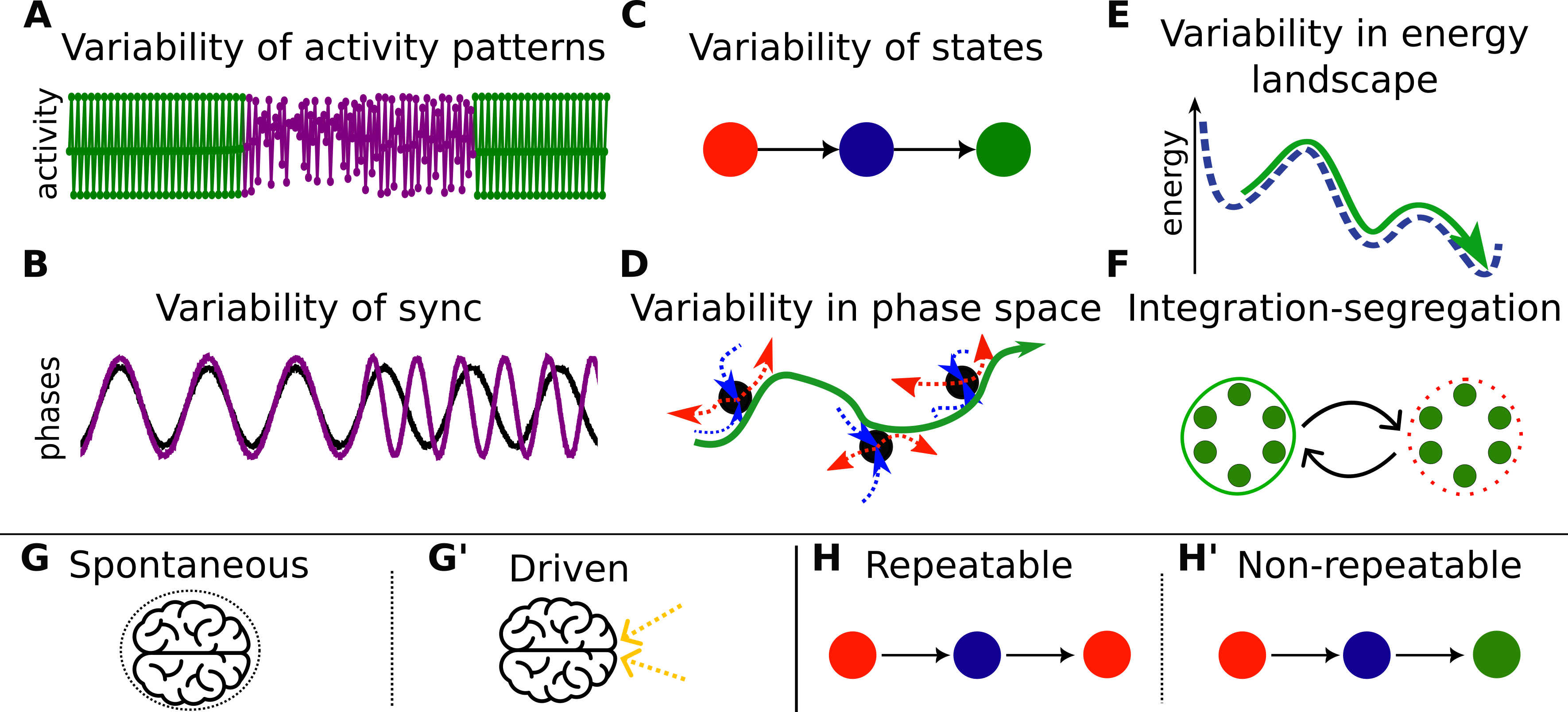
Metastability, characterized by a variability of regimes in time, is a ubiquitous type of neural dynamics. It has been formulated in many different ways in the neuroscience literature, however, which may cause some confusion. In this Perspective, we discuss metastability from the point of view of dynamical systems theory. We extract from the literature a very simple but general definition through the concept of metastable regimes as long-lived but transient epochs of activity with unique dynamical properties. This definition serves as an umbrella term that encompasses formulations from other works, and readily connects to concepts from dynamical systems theory. This allows us to examine general dynamical properties of metastable regimes, propose in a didactic manner several dynamics-based mechanisms that generate them, and discuss a theoretical tool to characterize them quantitatively. This perspective leads to insights that help to address issues debated in the literature and also suggest pathways for future research.
Motivation & Objective
- To address the lack of a unified definition of metastability in neuroscience, which currently relies on context-specific formulations.
- To establish a general, context-independent definition of metastability as transient but long-lived states in neural activity.
- To derive a universal dynamical principle underlying metastability using nonlinear systems theory.
- To identify and classify known and novel mechanisms that implement metastability through this principle.
- To enable the development of predictive and control tools for brain dynamics based on this framework.
Proposed method
- Defining metastability as the presence of transient but long-lived states in neural activity, applicable to diverse experimental data.
- Using nonlinear dynamical systems theory to identify the core principle: coexistence of attracting and repelling directions in phase space.
- Analyzing five distinct dynamical mechanisms—noisy bistable systems, heteroclinic cycles, attractor-merging crises, type I intermittency, and chaotic saddles—using numerical simulations.
- Employing computational tools in Julia with DifferentialEquations.jl, DynamicalSystems.jl, and Makie.jl for simulation and visualization.
- Validating the framework by mapping known neural phenomena (e.g., EEG microstates, UP/DOWN states) to specific mechanisms within the unified structure.
- Deriving new mechanisms by extending known dynamical systems behaviors to explain metastable transitions.

Experimental results
Research questions
- RQ1What is the general dynamical principle that underlies metastability across diverse neural systems?
- RQ2How can metastability be defined in a context-independent way that unifies existing experimental observations?
- RQ3Which known dynamical mechanisms can be mapped to neural metastable states, and what new mechanisms can be derived from the general principle?
- RQ4Can the proposed framework generate experimentally testable and falsifiable hypotheses about brain dynamics?
- RQ5How do transient but long-lived states emerge from the interplay of attraction and repulsion in phase space?
Key findings
- The framework defines metastability as transient but long-lived states, unifying diverse neural phenomena such as EEG microstates, UP/DOWN states, and cortical waves under a single definition.
- The core dynamical principle is the coexistence of attracting and repelling directions in phase space, which enables the system to remain in a state for a long time before transitioning.
- The noisy bistable system (Duffing oscillator with noise) successfully reproduces metastable switching between two states, with transitions occurring due to noise-induced escape from potential wells.
- Heteroclinic cycles in rate models of neural populations generate sequential state transitions that match observed neural dynamics, such as in cortical wave propagation.
- Attractor-merging crises and type I intermittency were shown to produce metastable behavior through bifurcation-induced transitions, with clear phase-space signatures.
- Chaotic saddles were identified as a novel mechanism for metastability, where trajectories remain near unstable manifolds for extended periods before escaping, explaining long-lived transient states.
Read this paper
Open the full text in the Nubint reader and ask about any passage as you read.
Read this paper on NubintThis review was generated by AI from the original paper. Please check the paper before citing it.