
[Paper Review] Dynamics of Finite Width Kernel and Prediction Fluctuations in Mean Field Neural Networks
This paper develops a dynamical mean field theory (DMFT) framework to characterize finite-width fluctuations in wide, feature-learning neural networks, showing that kernel and prediction variances scale as $\mathcal{O}(1/\sqrt{\text{width}})$ and are dynamically coupled during training. In rich, nonlinear regimes, feature learning reduces prediction variance and improves signal-to-noise ratios, while initialization variance can slow online learning, with predictions validated on CIFAR-10 CNNs.
We analyze the dynamics of finite width effects in wide but finite feature learning neural networks. Starting from a dynamical mean field theory description of infinite width deep neural network kernel and prediction dynamics, we provide a characterization of the $O(1/\sqrt{ ext{width}})$ fluctuations of the DMFT order parameters over random initializations of the network weights. Our results, while perturbative in width, unlike prior analyses, are non-perturbative in the strength of feature learning. In the lazy limit of network training, all kernels are random but static in time and the prediction variance has a universal form. However, in the rich, feature learning regime, the fluctuations of the kernels and predictions are dynamically coupled with a variance that can be computed self-consistently. In two layer networks, we show how feature learning can dynamically reduce the variance of the final tangent kernel and final network predictions. We also show how initialization variance can slow down online learning in wide but finite networks. In deeper networks, kernel variance can dramatically accumulate through subsequent layers at large feature learning strengths, but feature learning continues to improve the signal-to-noise ratio of the feature kernels. In discrete time, we demonstrate that large learning rate phenomena such as edge of stability effects can be well captured by infinite width dynamics and that initialization variance can decrease dynamically. For CNNs trained on CIFAR-10, we empirically find significant corrections to both the bias and variance of network dynamics due to finite width.
Motivation & Objective
- To understand finite-width corrections in wide neural networks where feature learning occurs, beyond the lazy or NTK regime.
- To characterize the $\mathcal{O}(1/\sqrt{\text{width}})$ fluctuations of DMFT order parameters—such as kernel and prediction variances—over random weight initializations.
- To show that richer feature learning dynamics can reduce variance and improve signal-to-noise ratios in finite-width networks, countering detrimental finite-size effects.
- To extend infinite-width dynamics to capture large learning rate phenomena like edge-of-stability, including dynamic changes in initialization variance.
- To validate theoretical predictions empirically on CNNs trained on CIFAR-10, showing finite-width corrections to bias and variance in training dynamics.
Proposed method
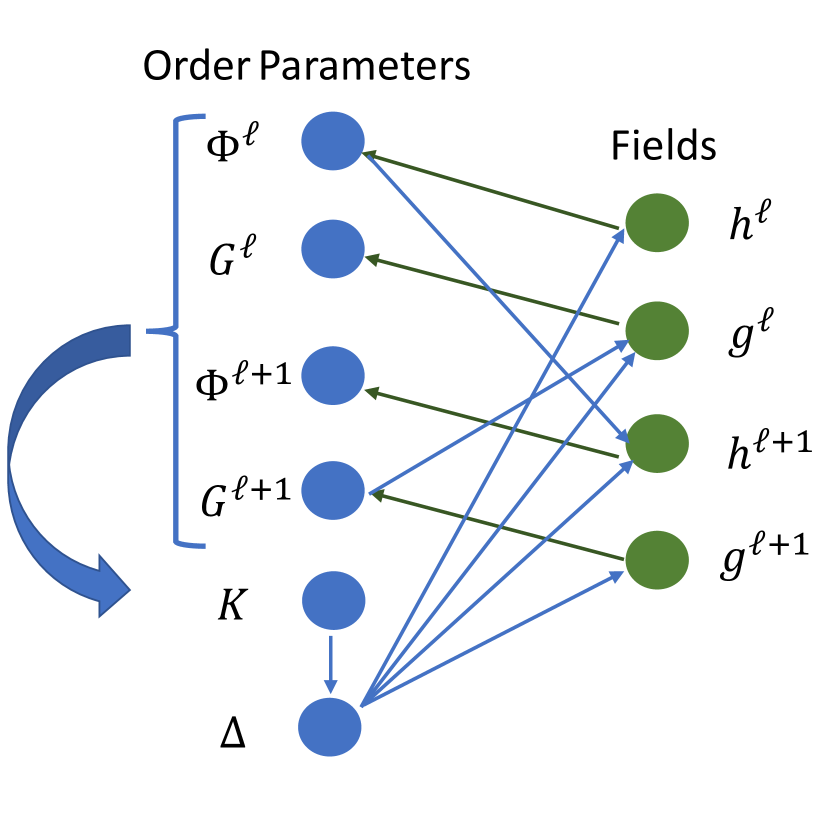
- Derives a perturbative framework based on dynamical mean field theory (DMFT) to compute fluctuations in kernel and prediction dynamics during training in wide, finite-width networks.
- Solves the DMFT equations for both the lazy limit (no feature learning) and the rich, nonlinear feature learning regime in two-layer and deep linear networks.
- Introduces a self-consistent formalism to compute the variance of the tangent kernel and network predictions, accounting for dynamic coupling between kernel fluctuations and feature learning.
- Applies the framework to discrete-time training dynamics, enabling analysis of large learning rate effects such as edge-of-stability phenomena.
- Uses a change of variables to decouple the dynamics of $v_+(t)$ and $v_-(t)$, enabling analytical computation of kernel variance $\kappa(t,s)$ and sensitivity $D(t,s)$ to initialization.
- Validates predictions via experiments on ResNet-like CNNs trained on CIFAR-10, comparing width and training depth effects on logit variance and training dynamics.
Experimental results
Research questions
- RQ1How do $\mathcal{O}(1/\sqrt{\text{width}})$ fluctuations in kernel and prediction variances evolve during training in wide, feature-learning neural networks?
- RQ2To what extent does feature learning reduce the variance of the final tangent kernel and network predictions in finite-width networks?
- RQ3How does initialization variance affect online learning speed in wide but finite networks, and can this be captured by infinite-width dynamics?
- RQ4Can infinite-width DMFT dynamics accurately predict finite-size effects such as edge-of-stability behavior under large learning rates?
- RQ5What are the empirical corrections to bias and variance in training dynamics due to finite width in real CNNs like those trained on CIFAR-10?
Key findings
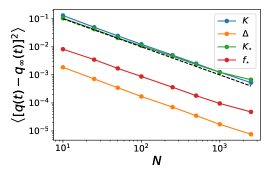
- In the lazy limit, prediction variance evolves according to a simple differential equation, with universal $\mathcal{O}(1/\sqrt{\text{width}})$ scaling.
- In two-layer networks, feature learning dynamically reduces the variance of the final tangent kernel and network predictions, improving alignment with infinite-width behavior.
- Larger initialization variance slows down online learning in wide but finite networks, indicating a detrimental finite-size effect.
- In deeper networks, kernel variance accumulates through layers at strong feature learning strengths, but the signal-to-noise ratio of feature kernels still improves.
- Large learning rate effects such as edge-of-stability are well captured by infinite-width DMFT, with finite-size variance accurately predicted by the theory.
- Empirical results on CIFAR-10 CNNs confirm that wider and richer networks exhibit lower logit variance, but finite width still alters training dynamics even after ensembling due to a detrimental correction to the mean dynamical NTK.
Read this paper
Open the full text in the Nubint reader and ask about any passage as you read.
Read this paper on NubintThis review was generated by AI from the original paper. Please check the paper before citing it.