
[Paper Review] Dynamics of Long-lived Axion Domain Walls and Its Cosmological Implications
This paper presents a 3D lattice simulation of long-lived axion domain walls (DWs) with a bias term, revealing that energy loss via axion radiation dominates DW evolution. It develops a velocity-dependent one-scale (VOS) model to describe DW dynamics and finds a revised prediction for axion dark matter abundance that differs significantly from prior work, with implications for axion phenomenology and cosmological constraints.
We perform an updated analysis on a long-lived axion domain wall (DW) network. By simulating the axion field on a 3D lattice and fitting an analytical model for the DW evolution, we identify the leading energy loss mechanisms of the DWs and compute the spectrum of axions emitted from the network. The contribution from the DWs to axion dark matter (DM) density is derived, with viable parameter space given. The application to both QCD axions and general axion-like particles (ALPs) are considered. Due to the new approaches taken, while our results bear consistency with earlier literature, notable discrepancies are also revealed, such as the prediction for DM abundance, which may have a profound impact on axion phenomenology at large.
Motivation & Objective
- To understand the dynamics of long-lived axion domain walls (DWs) in the early universe, particularly their energy loss mechanisms and axion emission.
- To resolve discrepancies in prior literature regarding axion dark matter (DM) relic abundance from DWs, especially in models with N_DW > 1.
- To develop and calibrate a velocity-dependent one-scale (VOS) model for metastable DW evolution, extending its use beyond cosmic strings and stable DWs.
- To provide updated predictions for axion DM production from DWs, applicable to both QCD axions and axion-like particles (ALPs), under cosmological constraints.
- To clarify the role of domain wall substructure and radiation spectra in shaping the final axion relic density and observational signatures.
Proposed method
- Performs 3D finite-temperature field theory lattice simulations of the axion field with a grid size of 1536³ in a radiation-dominated universe.
- Incorporates a small bias term ε in the axion potential to model metastable DWs that decay before Big Bang Nucleosynthesis (BBN).
- Solves the axion field equation of motion exactly, avoiding approximations used in prior studies (e.g., PRS approximation in 3D Higgs DW simulations).
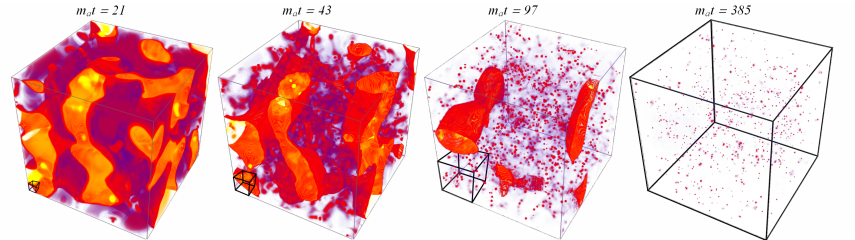
- Analyzes time-resolved snapshots and axion energy density spectra to identify dominant radiation mechanisms and DW substructure evolution.
- Fits simulation data to analytical models, including a modified VOS model with velocity-dependent parameters to describe DW network scaling and decay.
- Uses Gaussian fitting functions to model axion energy density components (ρ₂, ρ₃) and derives energy loss rates from the time evolution of DW area and velocity.
Experimental results
Research questions
- RQ1What are the dominant energy loss mechanisms driving the decay of long-lived axion domain walls?
- RQ2How does the axion spectrum emitted from the DW network depend on the bias parameter ε and the DW evolution dynamics?
- RQ3To what extent does the VOS model, extended to include velocity dependence, accurately describe the scaling and decay phases of metastable DW networks?
- RQ4What is the revised prediction for the axion dark matter relic density produced from DW decay, and how does it compare to previous estimates?
- RQ5What constraints does the DW decay time impose on the viable parameter space for axion models, particularly in light of BBN and CMB observations?
Key findings
- The dominant energy loss mechanism for long-lived axion domain walls is axion radiation, not gravitational wave emission or string-mediated decay.
- The simulation reveals that DWs flatten their surface curvature over time, indicating a transition to a scaling regime where the network evolves self-similarly.
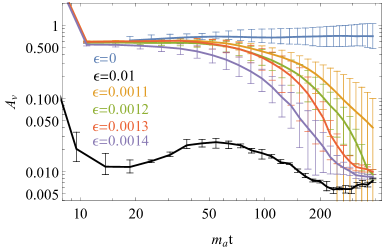
- The VOS model is successfully extended to include velocity dependence, with the average DW velocity ⟨γv⟩ approaching a constant in the scaling regime, consistent with A_v ≈ 0.009 ± 0.0012.
- The axion energy density spectrum shows distinct peaks corresponding to different radiation components, with the third Gaussian component (ρ₃) dominating at late times and fitting well to the energy loss model.
- The predicted axion dark matter abundance from DW decay scales as Ω_a^DW ∝ ε^(-1/2) for small ε, but the normalization is significantly lower than in previous 2D simulations, indicating a revised and more conservative estimate.
- The parameter space where DWs decay before BBN is constrained: ε ≲ 0.005 ensures sufficient time to enter the scaling regime before decay, while larger ε leads to premature collapse without full scaling.
Read this paper
Open the full text in the Nubint reader and ask about any passage as you read.
Read this paper on NubintThis review was generated by AI from the original paper. Please check the paper before citing it.