
[Paper Review] Ecovisor: A Virtual Energy System for Carbon-Efficient Applications
This paper proposes Ecovisor, a software-defined virtual energy system that exposes real-time grid carbon intensity and renewable energy availability to applications, enabling them to optimize carbon efficiency through dynamic power and battery control. By virtualizing energy infrastructure and providing application-level visibility and control, Ecovisor allows diverse workloads to independently adapt to energy supply variability, significantly improving carbon efficiency beyond system-wide policies.
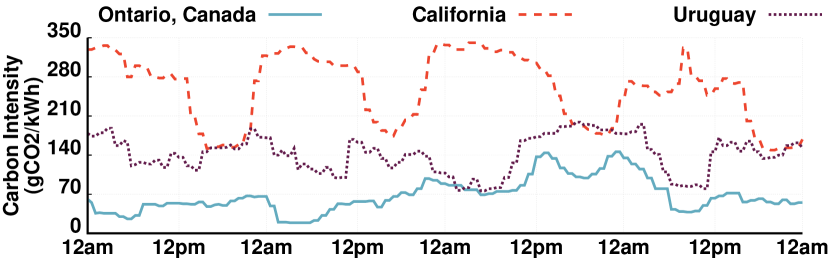
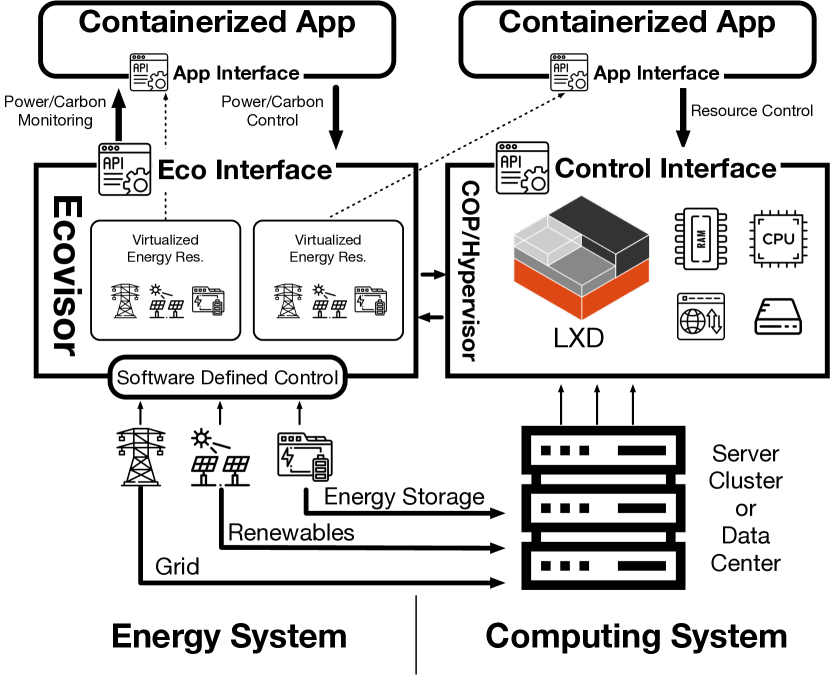
Cloud platforms' rapid growth is raising significant concerns about their carbon emissions. To reduce emissions, future cloud platforms will need to increase their reliance on renewable energy sources, such as solar and wind, which have zero emissions but are highly unreliable. Unfortunately, today's energy systems effectively mask this unreliability in hardware, which prevents applications from optimizing their carbon-efficiency, or work done per kilogram of carbon emitted. To address this problem, we design an "ecovisor", which virtualizes the energy system and exposes software-defined control of it to applications. An ecovisor enables each application to handle clean energy's unreliability in software based on its own specific requirements. We implement a small-scale ecovisor prototype that virtualizes a physical energy system to enable software-based application-level i) visibility into variable grid carbon-intensity and renewable generation and ii) control of server power usage and battery charging/discharging. We evaluate the ecovisor approach by showing how multiple applications can concurrently exercise their virtual energy system in different ways to better optimize carbon-efficiency based on their specific requirements compared to a general system-wide policy.
Motivation & Objective
- To address the growing carbon emissions from hyperscale cloud platforms driven by increasing energy demand.
- To solve the problem that current energy systems hide renewable energy volatility and grid carbon intensity from applications, preventing carbon-efficiency optimization.
- To enable applications to independently manage their carbon footprint by exposing visibility into and control over energy supply characteristics.
- To design and implement a prototype ecovisor that virtualizes physical energy systems, including grid, renewables, and batteries, for application-level control.
- To demonstrate that application-specific carbon-efficiency optimizations are possible and superior to monolithic system-wide policies.
Proposed method
- Design and implement a virtual energy system (ecovisor) that abstracts physical energy infrastructure, including grid power, on-site renewables, and battery storage.
- Expose real-time carbon intensity data (e.g., from electricityMap) and renewable generation levels to applications via a software-defined interface.
- Implement virtual power capping and battery charging/discharging control per application, enabling dynamic adaptation to energy supply conditions.
- Use existing virtualization and resource control techniques (e.g., power containers, capping) to attribute and regulate energy usage at the application level.
- Integrate application-level policies that respond to carbon intensity and renewable availability, allowing work to be shifted or throttled based on sustainability goals.
- Evaluate the ecovisor prototype with multiple applications to compare carbon-efficiency under application-specific policies versus system-wide policies.
Experimental results
Research questions
- RQ1Can application-level visibility into real-time grid carbon intensity and renewable energy availability improve carbon-efficiency beyond system-wide energy management policies?
- RQ2How can software-defined control of virtualized energy resources (e.g., power capping, battery charging) be exposed to applications to enable carbon-aware workload scheduling?
- RQ3What are the performance and carbon-efficiency trade-offs when multiple applications with different priorities use the same virtual energy system?
- RQ4Can ecovisor support concurrent, diverse carbon-efficiency optimizations across heterogeneous workloads on a shared infrastructure?
- RQ5How does virtualizing the energy system enable new classes of carbon-aware optimizations not feasible with current hardware-abstraction models?
Key findings
- The ecovisor prototype successfully virtualizes a physical energy system, providing applications with real-time visibility into grid carbon intensity and renewable energy availability.
- Applications using ecovisor can independently optimize for carbon-efficiency by adapting power usage and battery interaction based on their own requirements and sustainability goals.
- The ecovisor enables concurrent, diverse carbon-efficiency strategies—such as shifting work to low-carbon periods or throttling during high-carbon phases—without conflicting with one another.
- Compared to a system-wide policy, ecovisor allows applications to achieve higher carbon-efficiency by tailoring behavior to their unique flexibility in time, performance, and energy use.
- The prototype demonstrates that software-based control of energy systems can effectively expose and manage clean energy’s inherent volatility, enabling fine-grained carbon-aware scheduling.
- Ecovisor provides a foundation for future coordination across distributed ecovisor clusters, enabling geo-distributed carbon-optimized workloads.
Read this paper
Open the full text in the Nubint reader and ask about any passage as you read.
Read this paper on NubintThis review was generated by AI from the original paper. Please check the paper before citing it.