
[Paper Review] Edge Learning for 6G-enabled Internet of Things: A Comprehensive Survey of Vulnerabilities, Datasets, and Defenses
This paper presents a comprehensive survey on edge learning for 6G-enabled IoT, analyzing vulnerabilities such as backdoor, adversarial, and poisoning attacks across centralized, federated, and distributed learning modes. It classifies eight threat models, reviews state-of-the-art defense mechanisms, and outlines future research directions for securing AI-driven 6G-IoT systems.
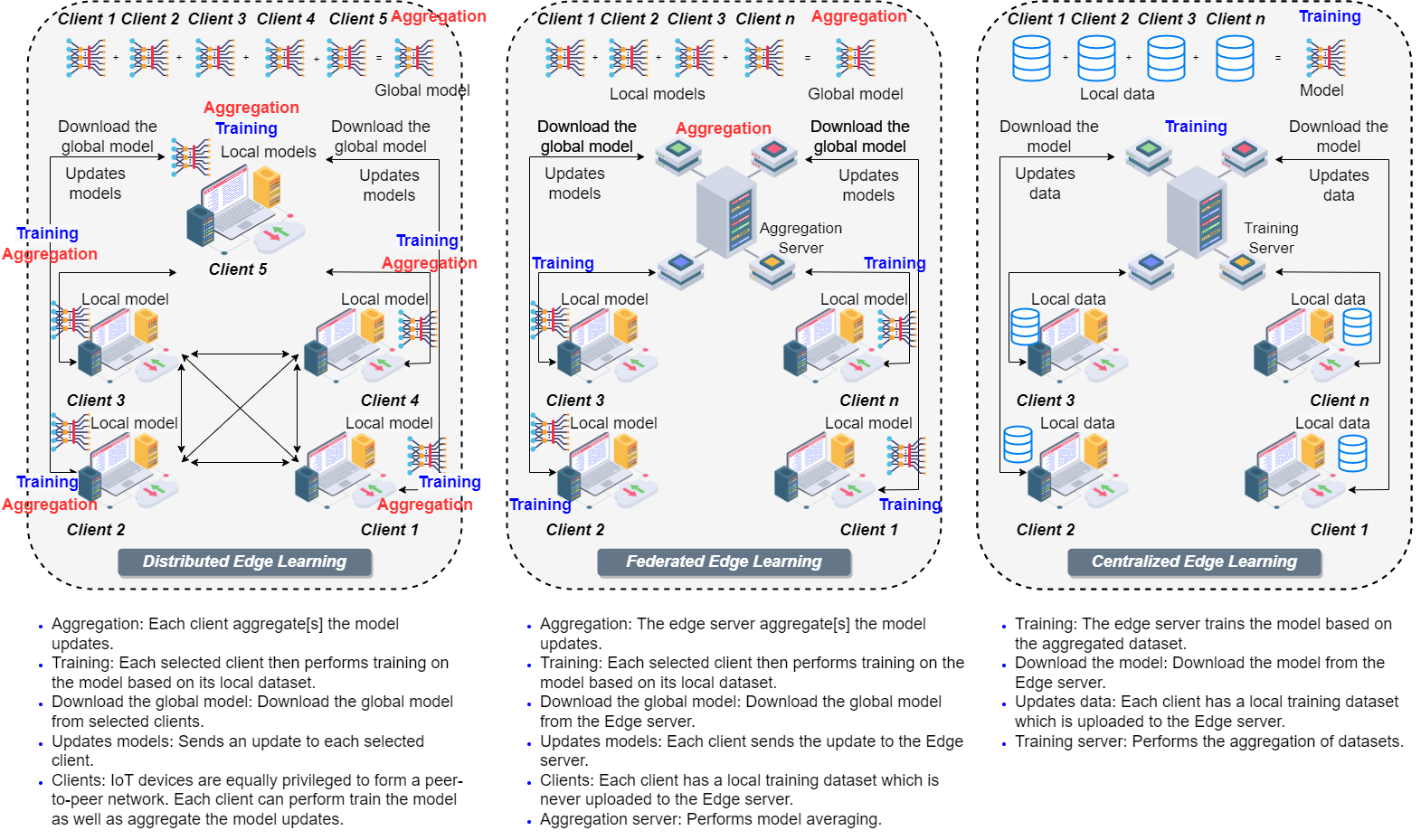
The ongoing deployment of the fifth generation (5G) wireless networks constantly reveals limitations concerning its original concept as a key driver of Internet of Everything (IoE) applications. These 5G challenges are behind worldwide efforts to enable future networks, such as sixth generation (6G) networks, to efficiently support sophisticated applications ranging from autonomous driving capabilities to the Metaverse. Edge learning is a new and powerful approach to training models across distributed clients while protecting the privacy of their data. This approach is expected to be embedded within future network infrastructures, including 6G, to solve challenging problems such as resource management and behavior prediction. This survey article provides a holistic review of the most recent research focused on edge learning vulnerabilities and defenses for 6G-enabled IoT. We summarize the existing surveys on machine learning for 6G IoT security and machine learning-associated threats in three different learning modes: centralized, federated, and distributed. Then, we provide an overview of enabling emerging technologies for 6G IoT intelligence. Moreover, we provide a holistic survey of existing research on attacks against machine learning and classify threat models into eight categories, including backdoor attacks, adversarial examples, combined attacks, poisoning attacks, Sybil attacks, byzantine attacks, inference attacks, and dropping attacks. In addition, we provide a comprehensive and detailed taxonomy and a side-by-side comparison of the state-of-the-art defense methods against edge learning vulnerabilities. Finally, as new attacks and defense technologies are realized, new research and future overall prospects for 6G-enabled IoT are discussed.
Motivation & Objective
- To identify and categorize security vulnerabilities in edge learning for 6G-enabled IoT systems.
- To analyze the impact of emerging AI threats—such as backdoor and adversarial attacks—on federated and distributed learning in 6G-IoT environments.
- To provide a comprehensive taxonomy and comparative analysis of existing defense mechanisms against machine learning-based attacks.
- To examine the challenges of deploying large language models at the edge in 6G-IoT, including privacy, resource constraints, and model consistency.
- To explore future research directions in securing AI-driven 6G networks through robust defense strategies and adaptive threat mitigation.
Proposed method
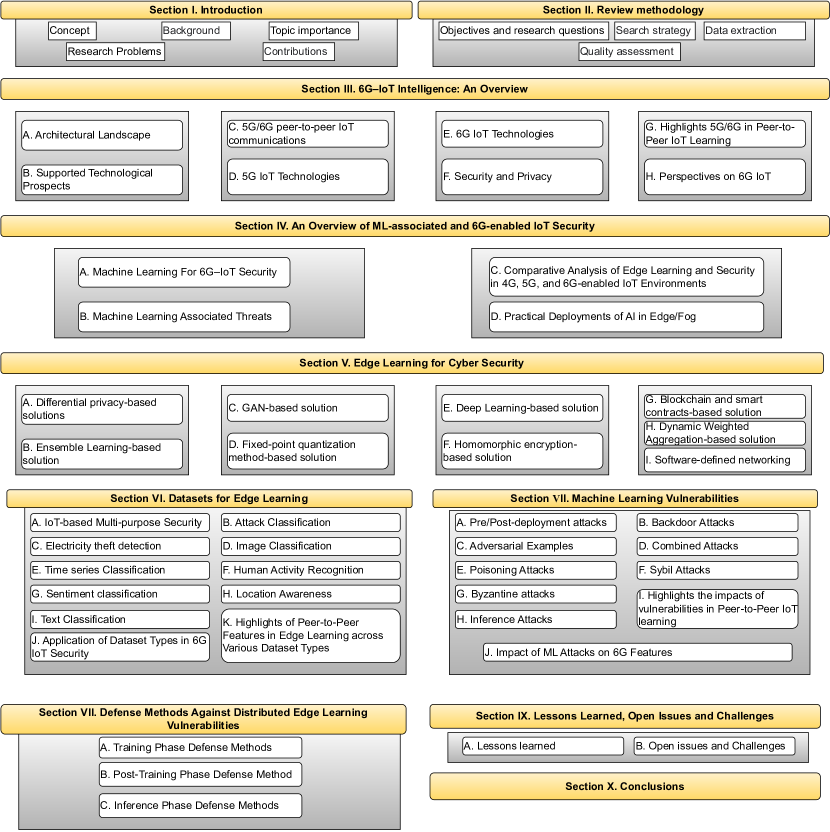
- Systematically categorizes machine learning threats in 6G-IoT into eight threat models: backdoor, adversarial examples, combined, poisoning, Sybil, Byzantine, inference, and dropping attacks.
- Reviews enabling technologies for 6G–IoT intelligence, including multi-access edge computing (MEC), reconfigurable intelligent surfaces (RIS), and software-defined networking (SDN).
- Analyzes defense strategies such as differential privacy (DP), federated distillation (FD), homomorphic encryption (HE), and verifiable random functions (VRF) for model integrity.
- Evaluates the effectiveness of explainable AI (XAI) and moving target defense (MTD) in enhancing transparency and resilience against model manipulation.
- Examines the use of generative adversarial networks (GANs) and autoencoders (e.g., CVAE, AEA) for anomaly detection and data reconstruction in edge learning.
- Proposes a comparative framework for evaluating defense techniques based on security, efficiency, and compatibility with 6G-IoT constraints.
Experimental results
Research questions
- RQ1What are the primary vulnerabilities in edge learning systems deployed in 6G-enabled IoT environments?
- RQ2How do different threat models—such as backdoor and adversarial attacks—impact the integrity and reliability of federated learning in 6G-IoT?
- RQ3What are the most effective defense mechanisms for mitigating machine learning-based attacks in distributed edge learning architectures?
- RQ4What challenges arise in deploying large language models at the edge of 6G-IoT networks, and how can they be addressed?
- RQ5What future research directions are critical for securing AI-driven 6G networks against evolving cyber threats?
Key findings
- The paper identifies eight distinct threat models in edge learning for 6G-IoT, including backdoor, adversarial examples, and Byzantine attacks, each posing unique risks to model integrity.
- Adversarial attacks on large language models (LLMs) are particularly challenging due to the discrete nature of text, with recent methods using gradient-based suffix generation achieving high transferability across models like GPT and Claude.
- Defenses such as differential privacy and federated distillation significantly reduce the risk of model inversion and membership inference attacks in federated learning settings.
- The integration of homomorphic encryption and verifiable random functions enhances model security and enables trustless collaboration in distributed edge learning.
- Large language models at the edge face major challenges due to resource constraints, data sensitivity, and model consistency across heterogeneous IoT devices.
- Future research must prioritize adaptive, lightweight, and explainable defense mechanisms to balance security, efficiency, and backward compatibility in 6G-IoT ecosystems.
Read this paper
Open the full text in the Nubint reader and ask about any passage as you read.
Read this paper on NubintThis review was generated by AI from the original paper. Please check the paper before citing it.