
[Paper Review] Effect of Rare-earth Element Substitution in Superconducting R$_3$Ni$_2$O$_7$ Under Pressure
This study investigates rare-earth (RE) element substitution in superconducting R₃Ni₂O₇ under pressure using a strong-coupling bilayer t-J∥-J⊥ model focused on the 3dₓ²⁻ʸ² orbital. It finds that substituting La with Sm enhances the inter-layer spin exchange J⊥, leading to a nearly doubled superconducting transition temperature (Tc ≈ 160 K), while preserving inter-layer s-wave pairing, suggesting a viable route to higher-Tc superconductors in this family.
Recently, high temperature ($T_c\approx 80$K) superconductivity (SC) has been discovered in La$_3$Ni$_2$O$_7$ (LNO) under pressure. Question arises whether the transition temperature $T_c$ could be further enhanced under suitable conditions. A possible route for realizing higher $T_c$ is element substitution. Similar SC could appear in rare-earth (RE) R$_3$Ni$_2$O$_7$ (RNO, R=RE element) material series under pressure. The electronic properties in the RNO materials are dominated by the Ni $3d$ orbitals in the bilayer NiO$_2$ plane. In the strong coupling limit, the SC could be fully characterized by a bilayer single $3d_{x^2-y^2}$-orbital $t$-$J_{\parallel}$-$J_{\perp}$ model. Under RE element substitution from La to RE element, the lattice constant decreases and the electronic hopping increases, leading to stronger superexchanges between the $3d_{x^2-y^2}$ orbitals. Based on the slave-boson mean-field theory, we explore the pairing nature and the evolution of $T_c$ in RNO materials. Consequently, it is found that the element substitution does not alter the pairing nature, i.e. the inter-layer $s$-wave pairing is always favored in RNO. However, the $T_c$ increases from La to Sm and a nearly doubled $T_c$ is achieved for SmNO. This work provides evidence for possible higher $T_c$ R$_3$Ni$_2$O$_7$ materials, which may be realized in further experiments.
Motivation & Objective
- To investigate the effect of rare-earth (RE) element substitution on superconducting transition temperature (Tc) in R₃Ni₂O₇ under high pressure.
- To determine whether element substitution can enhance Tc beyond the ~80 K observed in La₃Ni₂O₇ (LNO).
- To explore the pairing symmetry and evolution of Tc in the strong-coupling regime using a minimal effective model.
- To reconcile discrepancies between weak-coupling (RPA) predictions and strong-coupling expectations for Tc enhancement.
Proposed method
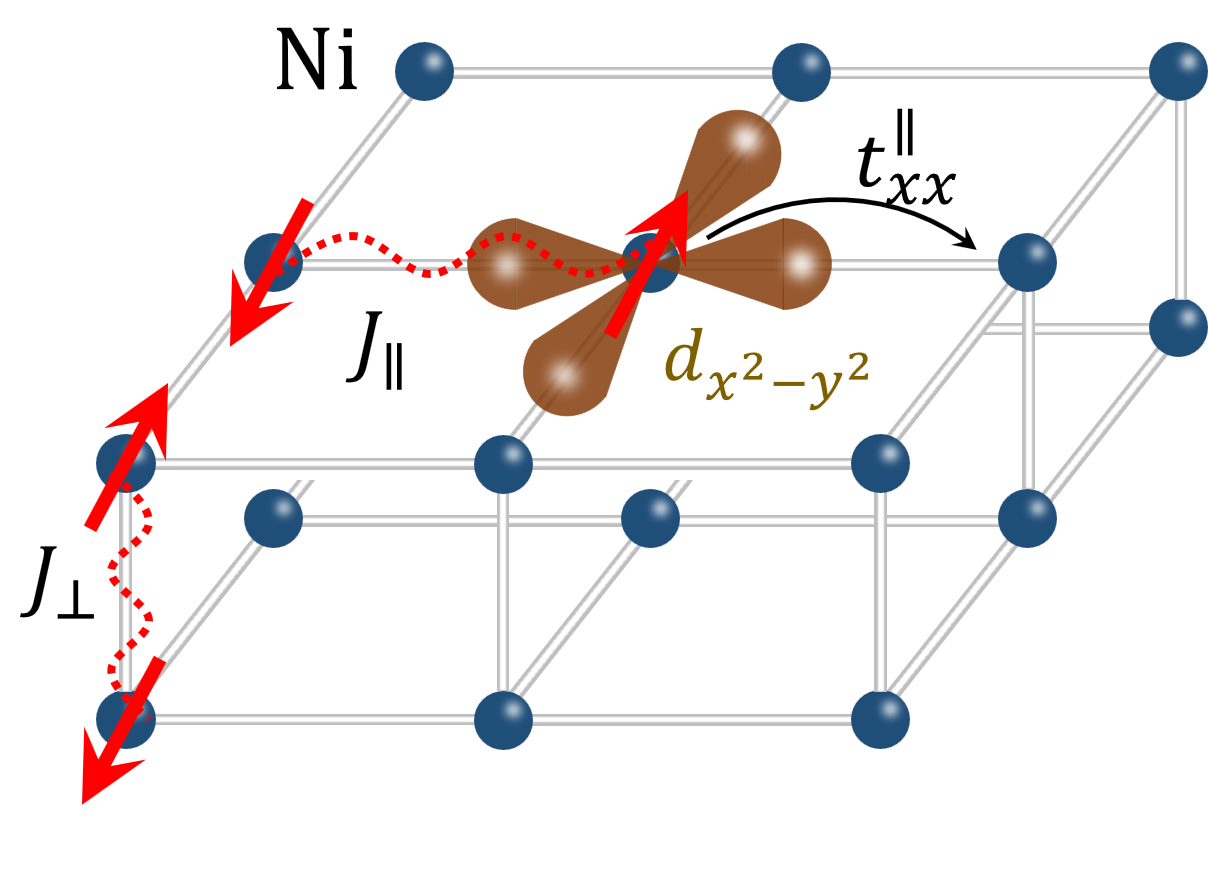
- Adopting a bilayer single-3dₓ²⁻ʸ²-orbital t-J∥-J⊥ model as the minimal effective Hamiltonian for superconductivity in R₃Ni₂O₇.
- Using slave-boson mean-field theory to study superconducting pairing and Tc evolution under RE substitution.
- Incorporating RE-dependent lattice and electronic parameters from prior DFT calculations to scale J∥ and J⊥.
- Focusing on the role of strong Hund’s coupling in transmitting inter-layer spin exchange J⊥ from 3d_z² orbitals to 3dₓ²⁻ʸ² orbitals.
- Analyzing the pairing symmetry and Tc as a function of increasing inter-layer hopping and J⊥ under La→Sm substitution.
- Comparing results with weak-coupling RPA predictions to highlight the importance of strong-coupling effects.
Experimental results
Research questions
- RQ1Does rare-earth substitution from La to Sm enhance the superconducting transition temperature Tc in R₃Ni₂O₇ under pressure?
- RQ2What is the nature of the superconducting pairing (e.g., s-wave vs d-wave) in the R₃Ni₂O₇ system under RE substitution?
- RQ3How does the inter-layer spin exchange J⊥ evolve with RE element substitution, and what is its role in Tc enhancement?
- RQ4Why does the strong-coupling picture predict Tc enhancement while weak-coupling RPA predicts suppression?
- RQ5Can the 3dₓ²⁻ʸ² orbital model alone capture the essential physics of high-Tc superconductivity in R₃Ni₂O₇, or is the 3d_z² orbital degree of freedom essential?
Key findings
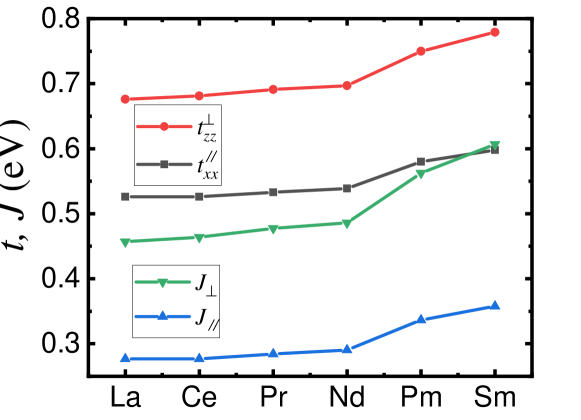
- RE element substitution from La to Sm increases the effective inter-layer spin exchange J⊥ and intra-layer J∥ due to enhanced hopping integrals.
- The superconducting pairing remains inter-layer s-wave pairing throughout the La-to-Sm series, with no change in pairing symmetry.
- The superconducting transition temperature Tc increases significantly, nearly doubling from ~80 K in La₃Ni₂O₇ to ~160 K in Sm₃Ni₂O₇ under pressure.
- The enhancement of Tc is driven primarily by the increase in J⊥, which is mediated through strong Hund’s coupling and inter-layer hopping of 3d_z² orbitals.
- The strong-coupling t-J∥-J⊥ model predicts a Tc enhancement opposite to that of weak-coupling RPA analysis, highlighting the importance of strong correlations.
- The 3d_z² orbital degrees of freedom play a crucial indirect role by enabling strong J⊥, which is then transmitted to the 3dₓ²⁻ʸ² orbitals via Hund’s coupling.
Read this paper
Open the full text in the Nubint reader and ask about any passage as you read.
Read this paper on NubintThis review was generated by AI from the original paper. Please check the paper before citing it.