
[Paper Review] Effect of the degree of an initial mutant in Moran processes in structured populations
This study investigates how the degree of an initial mutant affects fixation probability and extinction/fixedation times in Moran processes on structured populations using Erdős-Rényi and Barabási-Albert random graphs. Through stochastic simulations and mean-field approximations, it finds that higher-degree initial mutants have lower fixation probabilities and shorter extinction times, while fixation time remains unaffected by initial degree—highlighting the critical role of initial placement in evolutionary dynamics on networks.
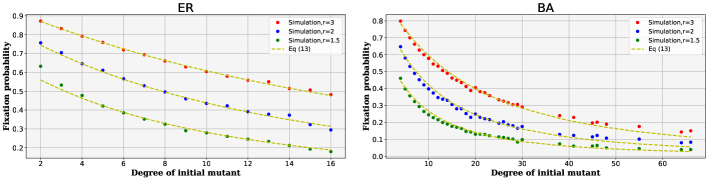
We study the effect of the mutant's degree on the fixation probability, extinction and fixation times, in the Moran process on Erdös-Rényi and Barabási-Albert graphs. We performed stochastic simulations and use mean-field type approximations to obtain analytical formulas. We showed that the initial placement of a mutant has a significant impact on the fixation probability and extinction time, while it has no effect on the fixation time. In both types of graphs, an increase in the degree of a initial mutant results in a decreased fixation probability and a shorter time to extinction.
Motivation & Objective
- To investigate the impact of initial mutant degree on fixation probability and fixation/extinction times in structured populations.
- To analyze how network structure—specifically Erdős-Rényi and Barabási-Albert graphs—affects evolutionary dynamics.
- To assess whether the initial placement of a mutant, particularly its degree, influences long-term evolutionary outcomes.
- To develop analytical approximations using mean-field and pair-approximation methods for complex network topologies.
- To compare fixation and extinction dynamics between scale-free (Barabási-Albert) and random (Erdős-Rényi) networks under identical conditions.
Proposed method
- Modeling the Moran process as a continuous-time Markov chain on random graphs with fixed population size and mutant fitness r > 1.
- Performing stochastic simulations on Erdős-Rényi and Barabási-Albert networks to estimate fixation and extinction probabilities and times.
- Deriving analytical approximations using mean-field and pair-approximation techniques to model transition probabilities between states with i and j mutants.
- Using the transition rate matrix to compute expected fixation and extinction times via recursive summation of first passage times.
- Formulating analytical expressions for fixation time T^f_i and extinction time T^e_i as differences between first-passage times from state 1 to i and from state 1 to N.
- Validating analytical results against simulation data, particularly assessing accuracy for varying values of r and network types.
Experimental results
Research questions
- RQ1How does the degree of the initial mutant influence the fixation probability in structured populations?
- RQ2Does the initial degree of a mutant affect the expected time to fixation in the Moran process on complex networks?
- RQ3How does the initial degree of a mutant impact the expected time to extinction in structured populations?
- RQ4To what extent do network topology (Erdős-Rényi vs. Barabási-Albert) and the presence of hubs modulate the effects of initial mutant degree?
- RQ5How accurate are mean-field and pair-approximation methods in predicting fixation and extinction times for complex network structures?
Key findings
- An increase in the degree of the initial mutant leads to a significant decrease in fixation probability in both Erdős-Rényi and Barabási-Albert networks.
- Higher-degree initial mutants experience significantly shorter extinction times, indicating faster elimination from the population.
- Fixation time is independent of the initial mutant's degree, as the process depends on the entire population dynamics rather than the starting node.
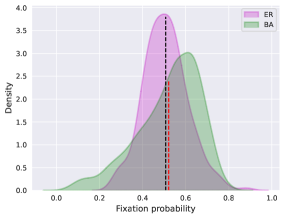
- For networks of the same size and average degree, fixation probability is higher in Erdős-Rényi graphs than in Barabási-Albert graphs when comparing mutants with the same initial degree.
- Despite lower individual fixation probability for high-degree mutants, the average fixation probability across all initial positions is higher in Barabási-Albert networks due to the presence of hubs.
- Analytical approximations become more accurate as mutant fitness r increases, due to reduced likelihood of mutant number decreasing after initial growth.
Read this paper
Open the full text in the Nubint reader and ask about any passage as you read.
Read this paper on NubintThis review was generated by AI from the original paper. Please check the paper before citing it.