
[Paper Review] Effective theory of Black Holes in the 1/D expansion
This paper develops an effective membrane theory for black holes in the large-D limit of Einstein-(A)dS gravity, showing that black holes can be described as dynamical surfaces (membranes) in a background spacetime. At leading order, the effective equations reduce to soap-film dynamics, recovering the Schwarzschild black hole as a spherical membrane; non-trivial solutions include black droplets in AdS and non-uniform black strings, with corrections computed to next-to-leading order in 1/D.
The gravitational field of a black hole is strongly localized near its horizon when the number of dimensions D is very large. In this limit, we can effectively replace the black hole with a surface in a background geometry (eg Minkowski or Anti-deSitter space). The Einstein equations determine the effective equations that this 'black hole surface' (or membrane) must satisfy. We obtain them up to next-to-leading order in 1/D for static black holes of the Einstein-(A)dS theory. To leading order, and also to next order in Minkowski backgrounds, the equations of the effective theory are the same as soap-film equations, possibly up to a redshift factor. In particular, the Schwarzschild black hole is recovered as a spherical soap bubble. Less trivially, we find solutions for 'black droplets', ie black holes localized at the boundary of AdS, and for non-uniform black strings.
Motivation & Objective
- To formulate a non-perturbative effective theory for black holes in the large-D limit of Einstein-(A)dS gravity.
- To describe black holes as dynamical membranes embedded in a background spacetime (Minkowski or AdS), capturing their long-wavelength dynamics.
- To derive the effective equations of motion for these membranes up to next-to-leading order in 1/D.
- To identify and construct new black hole solutions—such as black droplets and non-uniform black strings—within the effective membrane framework.
- To establish the correspondence between the effective membrane dynamics and known black hole solutions, including the Schwarzschild black hole as a spherical soap bubble.
Proposed method
- Use the 1/D expansion to separate radial gradients (large, ~D) from tangential gradients (small), enabling a systematic solution of the Einstein equations.
- Solve the radial dependence of the metric using a parametric expansion, isolating the near-horizon region where the gravitational field is localized.
- Derive effective equations for the membrane embedding functions from the vector constraints in the radial direction.
- At leading order, show that the effective membrane equations match soap-film equations, possibly with a redshift factor.
- Compute next-to-leading-order corrections in 1/D for static black holes in Minkowski and AdS backgrounds.
- Use the effective stress tensor to reconstruct the far-zone gravitational field, confirming consistency with known solutions like Schwarzschild.
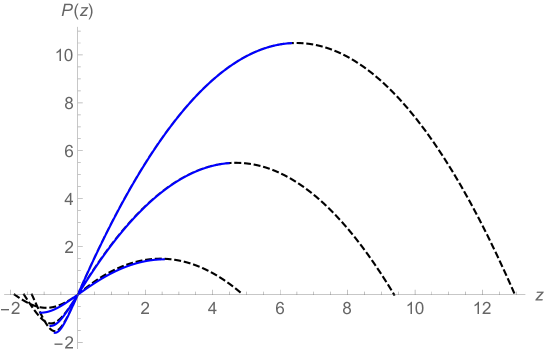
Experimental results
Research questions
- RQ1How can black holes in high spacetime dimensions be effectively described as membranes in a background geometry?
- RQ2What are the effective equations of motion for such membranes in Minkowski and Anti-de Sitter spacetimes at leading and next-to-leading order in 1/D?
- RQ3Can the Schwarzschild black hole be recovered as a spherical membrane solution in the effective theory?
- RQ4Do non-trivial solutions such as black droplets (localized at the AdS boundary) and non-uniform black strings emerge from the effective membrane equations?
- RQ5What is the role of the effective stress tensor in reconstructing the far-zone gravitational field and verifying consistency with known solutions?
Key findings
- The effective membrane equations at leading order in 1/D reduce to soap-film equations, with the Schwarzschild black hole realized as a spherical membrane in Minkowski space.
- In Anti-de Sitter space, the effective theory admits solutions for black droplets—black holes localized at the boundary—parameterized by a surface gravity and horizon radius.
- Non-uniform black strings are found as solutions to the effective membrane equations, indicating the possibility of phase transitions in higher-dimensional black holes.
- The next-to-leading-order corrections in 1/D are derived for static black holes in Minkowski and AdS backgrounds, extending the validity of the effective theory.
- The effective stress tensor on the membrane successfully reproduces the far-zone Schwarzschild gravitational potential, confirming consistency with linearized gravity.
- The theory decouples the near-horizon membrane dynamics from far-zone gravitational waves, with coupling suppressed non-perturbatively in 1/D.

Read this paper
Open the full text in the Nubint reader and ask about any passage as you read.
Read this paper on NubintThis review was generated by AI from the original paper. Please check the paper before citing it.