
[Paper Review] Efficient Formation of Massive Galaxies at Cosmic Dawn by Feedback-Free Starbursts
This paper proposes that feedback-free starbursts (FFBs) in high-redshift, massive dark matter haloes at z ~ 10 enable near-100% star formation efficiency (SFE ≈ 1) due to high densities (>3×10³ cm⁻³) and low metallicities, which suppress feedback. These conditions allow rapid gas cooling and star formation in dense, shielded clouds, forming compact, luminous galaxies with SFR ~65 M☉/yr and stellar masses ~10¹⁰ M☉, explaining the excess bright galaxies seen by JWST without requiring exotic physics or top-heavy IMFs.
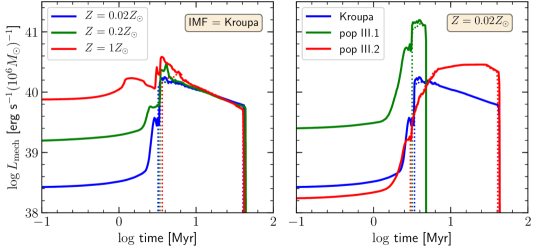
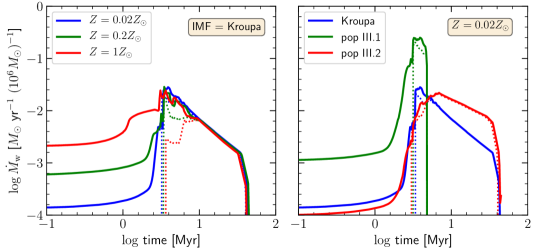
JWST observations indicate a surprising excess of luminous galaxies at $z\sim 10$ and above, consistent with efficient conversion of the accreted gas into stars, unlike the suppression of star formation by feedback at later times. We show that the high densities and low metallicities at this epoch {\it guarantee} a high star-formation efficiency (SFE) in the most massive dark-matter haloes. Feedback-free starbursts (FFBs) occur when the free-fall time is shorter than $\sim 1$ Myr, below the time for low-metallicity massive stars to develop winds and supernovae. This corresponds to a characteristic density of $\sim 3 imes 10^3$cm$^{-3}$. A comparable threshold density permits a starburst by allowing cooling to star-forming temperatures in a free-fall time. The galaxies within $\sim 10^{11} M_\odot$ haloes at $z \sim 10$ are expected to have FFB densities. The halo masses allow efficient gas supply by cold streams in a halo crossing time $\sim 80$ Myr. The FFBs gradually turn all the accreted gas into stars in clusters of $\sim 10^{4-7} M_\odot$ within galaxies that are rotating discs or shells. The starbursting clouds are insensitive to radiative feedback and are shielded against feedback from earlier stars. We predict high SFE above thresholds in redshift and halo mass, where the density is $10^{3-4}$cm$^{-3}$. The $z\sim 10$ haloes of $\sim 10^{10.8} M_\odot$ are predicted to host galaxies of $\sim 10^{10} M_\odot$ with SFR $\sim 65 M_\odot$ yr$^{-1}$ and sub-kpc sizes. The metallicity is $\leq 0.1 Z_\odot$ with little gas, dust, outflows and hot circumgalactic gas, allowing a top-heavy IMF but not requiring it. The compact galaxies with thousands of young FFB clusters may have implications on reionization, black-hole growth and globular clusters.
Motivation & Objective
- To resolve the puzzling excess of luminous galaxies at z ~ 10 observed by JWST, which contradicts standard ΛCDM predictions of low star formation efficiency.
- To identify physical mechanisms enabling high star formation efficiency in early massive galaxies, particularly in the absence of stellar feedback.
- To demonstrate that high-density, low-metallicity conditions at cosmic dawn naturally lead to feedback-free starbursts (FFBs) in massive haloes.
- To provide a physical explanation for the observed compact, blue, high-SFR galaxies at z ~ 10 without invoking top-heavy initial mass functions or exotic cosmologies.
Proposed method
- Proposes that feedback-free starbursts (FFBs) occur when the free-fall time is shorter than ~1 Myr, preventing feedback from massive stars (winds and supernovae) from disrupting star formation.
- Identifies a critical density threshold of ~3×10³ cm⁻³, below which gas cools efficiently in a free-fall time, triggering short, intense starbursts.
- Uses halo mass and redshift-dependent density profiles to show that haloes with M_v ~ 10¹⁰.⁸ M☉ at z ~ 10 naturally reach FFB conditions in their central regions.
- Models gas accretion via cold streams with crossing time ~80 Myr, enabling sustained feeding of central galaxies and multiple FFB generations.
- Applies the condition that cooling time must be comparable to free-fall time to identify regions conducive to FFBs, especially in discs and shells.
- Assumes shielding of dense star-forming clouds from external radiation and winds, allowing FFBs to proceed unimpeded.
Experimental results
Research questions
- RQ1Why do JWST observations show an order-of-magnitude excess of bright galaxies at z ~ 10 compared to ΛCDM predictions?
- RQ2What physical mechanism enables near-100% star formation efficiency in massive haloes at cosmic dawn, despite feedback suppression in later epochs?
- RQ3How do high densities and low metallicities at z ~ 10 suppress feedback and allow feedback-free starbursts?
- RQ4What are the structural and observable properties of galaxies formed via feedback-free starbursts at z ~ 10?
- RQ5Can feedback-free starbursts explain the formation of compact, luminous, low-dust galaxies with high SFRs without requiring a top-heavy IMF?
Key findings
- At z ~ 10, haloes with M_v ~ 10¹⁰.⁸ M☉ naturally reach densities >3×10³ cm⁻³, enabling feedback-free starbursts (FFBs) with star formation efficiency ε ≈ 1.
- The predicted star formation rate for such galaxies is ~65 M☉/yr within effective radii ≤1 kpc, consistent with observed luminous, compact galaxies.
- Stellar masses of ~10¹⁰ M☉ are formed, with metallicities ≤0.1 Z☉ and minimal dust, due to low gas fractions and weak feedback.
- The galaxies are expected to be compact, with sizes ≤1 kpc, and may appear as thick discs with giant clumps or spheroidal shells.
- FFB clusters are shielded from external feedback and may survive as globular clusters today, or seed massive black holes via dynamical friction and accretion.
- The model predicts high SFE above a redshift and halo mass threshold, with M_v ~ 10¹⁰.⁵ M☉ at z ~ 10 and M_v ~ 3.5×10⁹ M☉ at z ~ 15.
Read this paper
Open the full text in the Nubint reader and ask about any passage as you read.
Read this paper on NubintThis review was generated by AI from the original paper. Please check the paper before citing it.