
[Paper Review] Emergent resonances in a thin film tailored by optically-induced small permittivity asymmetries
This paper demonstrates all-optical control of photonic quasi-bound states in the continuum (qBICs) in a thin film by using interfering ultrashort laser pulses to create transient, periodic permittivity asymmetries. The method enables tunable resonances in wavelength and quality factor, with picosecond-precision time-selective near-field enhancement and spectrally selective third harmonic generation.
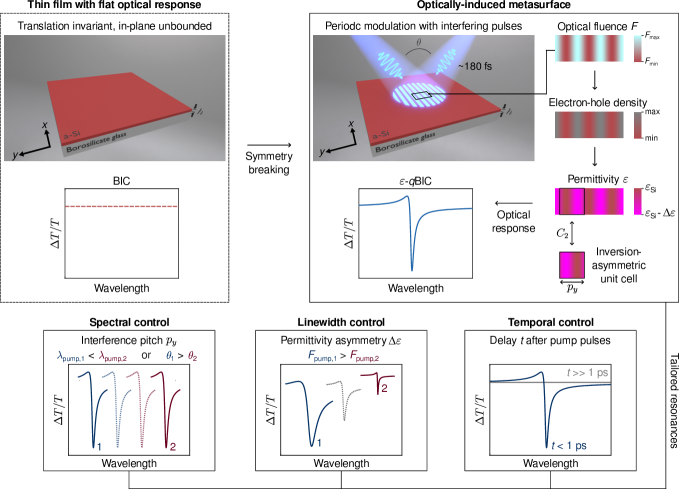
Resonances are usually associated with finite systems - the vibrations of clamped strings in a guitar or the optical modes in a cavity defined by mirrors. In optics, resonances may be induced in infinite continuous media via periodic modulations of their optical properties. Here we demonstrate that periodic modulations of the permittivity of a featureless thin film can also act as a symmetry breaking mechanism, allowing the excitation of photonic $ extit{quasi}$-bound states in the continuum ($ extit{q}$BICs). By interfering two ultrashort laser pulses in the unbounded film, transient resonances can be tailored through different parameters of the pump beams. We show that the system offers resonances tunable in wavelength and quality-factor, and spectrally selective enhancement of third harmonic generation. Due to a fast decay of the permittivity asymmetry, we observe ultrafast dynamics, enabling time-selective near-field enhancement with picosecond precision. Optically-induced permittivity asymmetries may be exploited in on-demand weak to ultrastrong light-matter interaction regimes and light manipulation at dynamically chosen wavelengths in lithography-free metasurfaces.
Motivation & Objective
- To demonstrate that transient, optically-induced permittivity asymmetries in a continuous thin film can break symmetry and enable excitation of quasi-Bound States in the Continuum (qBICs).
- To achieve all-optical, dynamic control over photonic resonances without geometric patterning or lithography.
- To enable tunability of resonance wavelength and quality factor (Q) through manipulation of pump beam parameters.
- To demonstrate time-resolved, picosecond-precision near-field enhancement via ultrafast decay of the induced permittivity asymmetry.
- To achieve spectrally selective enhancement of third harmonic generation (THG) through engineered qBIC resonances.
Proposed method
- Two ultrashort (≈180 fs) laser pulses are interfered on a hydrogenated amorphous silicon (a-Si) thin film to create a transient 1D periodic permittivity modulation via electron-hole pair excitation at bright fringes.
- The induced permittivity asymmetry breaks in-plane inversion symmetry (C₂), enabling the formation of ε-qBICs that are symmetry-protected and exhibit high Q-factors.
- The system is modeled using the finite element method (COMSOL RF module) with unit cell simulations to compute eigenfrequencies and Q-factors, neglecting edge effects from Gaussian beam profiles.
- Time-resolved transmittance and third harmonic generation (THG) measurements are performed using a pump-probe setup with a supercontinuum probe beam and a mechanically channeled wavelength-tunable OPA.
- Lock-in detection at <2 kHz and spectrograph-based spectral analysis enable high-sensitivity measurement of resonance shifts and THG enhancement.
- Theoretical analysis uses a model of spatially varying permittivity based on interference fringe intensity, with homogeneous permittivity assumed in each bright/dark fringe.
Experimental results
Research questions
- RQ1Can transient, optically-induced permittivity asymmetries in a continuous, unpatterned thin film support symmetry-protected quasi-Bound States in the Continuum (ε-qBICs)?
- RQ2To what extent can the resonance wavelength and quality factor (Q) of such ε-qBICs be dynamically tuned via pump beam parameters?
- RQ3Can the ultrafast decay of the induced permittivity asymmetry enable time-selective near-field enhancement with picosecond precision?
- RQ4Is spectrally selective enhancement of third harmonic generation (THG) achievable through engineered ε-qBIC resonances in a lithography-free system?
- RQ5How does the Q-factor of the ε-qBICs scale with the magnitude of the induced permittivity asymmetry?
Key findings
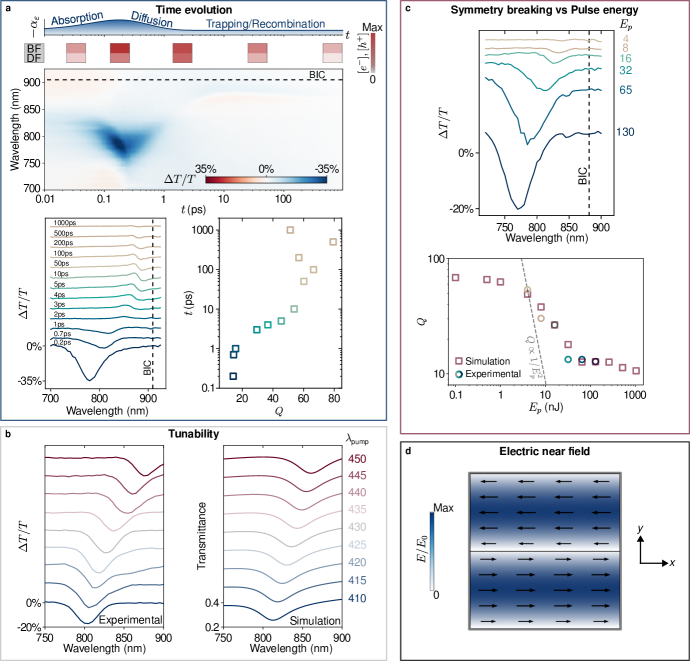
- The system supports optically-induced, transient ε-qBICs with quality factors (Q) that increase as the permittivity asymmetry decreases, consistent with theoretical predictions.
- Resonance wavelength and Q-factor are dynamically tunable via control of the pump beam angle and intensity, enabling continuous spectral tuning across the measured range.
- Ultrafast decay of the permittivity asymmetry (on the order of picoseconds) enables time-selective near-field enhancement with sub-picosecond temporal resolution.
- Spectrally selective enhancement of third harmonic generation (THG) is observed at the qBIC resonance wavelength, with enhancement factors dependent on the Q-factor and pump intensity.
- Theoretical simulations using unit cell models accurately predict the experimental resonance shifts and Q-factors, validating the model of spatially modulated permittivity from interference fringes.
- The absence of geometric patterning or lithography enables a scalable, reconfigurable platform for on-demand light-matter interaction at dynamically chosen wavelengths.
Read this paper
Open the full text in the Nubint reader and ask about any passage as you read.
Read this paper on NubintThis review was generated by AI from the original paper. Please check the paper before citing it.