
[Paper Review] Emerging Drug Interaction Prediction Enabled by Flow-based Graph Neural Network with Biomedical Network
This paper proposes EmerGNN, a flow-based graph neural network that predicts drug-drug interactions (DDI) for emerging drugs by leveraging biomedical networks such as HetioNet to extract and weight relevant paths between drug pairs. By learning pairwise representations through directional information flow along weighted biomedical relations, EmerGNN achieves higher accuracy than existing methods in cold-start DDI prediction while providing interpretable, path-based explanations.
Accurately predicting drug-drug interactions (DDI) for emerging drugs, which offer possibilities for treating and alleviating diseases, with computational methods can improve patient care and contribute to efficient drug development. However, many existing computational methods require large amounts of known DDI information, which is scarce for emerging drugs. In this paper, we propose EmerGNN, a graph neural network (GNN) that can effectively predict interactions for emerging drugs by leveraging the rich information in biomedical networks. EmerGNN learns pairwise representations of drugs by extracting the paths between drug pairs, propagating information from one drug to the other, and incorporating the relevant biomedical concepts on the paths. The different edges on the biomedical network are weighted to indicate the relevance for the target DDI prediction. Overall, EmerGNN has higher accuracy than existing approaches in predicting interactions for emerging drugs and can identify the most relevant information on the biomedical network.
Motivation & Objective
- To address the challenge of predicting drug-drug interactions (DDI) for emerging drugs with limited clinical interaction data.
- To overcome the limitations of existing GNN-based DDI prediction methods that rely heavily on historical interaction data and fail in cold-start scenarios.
- To develop a model that effectively integrates heterogeneous biomedical networks (e.g., HetioNet) to extract and weight relevant biological pathways between drug pairs.
- To enable interpretable DDI prediction by identifying key biomedical concepts and relations on the paths connecting emerging drug pairs.
- To improve patient safety and accelerate drug development by enabling early detection of potentially harmful interactions for new drugs.
Proposed method
- EmerGNN constructs a flow-based GNN that propagates information along subgraphs connecting a drug pair in the biomedical network, capturing directional flow from one drug to another.
- It extracts and weights paths between emerging and existing drugs using attention mechanisms, where edge weights reflect relevance to the target DDI prediction.
- The model learns joint representations of drug pairs by aggregating information from biomedical entities (e.g., genes, diseases) and relations (e.g., CrC, CbG, CtD) along these paths.
- It integrates both the DDI network and the biomedical network into a unified framework, enabling cross-network message passing for improved representation learning.
- The method uses beam search with attention-based path selection to identify the most relevant subpaths for each drug pair, enhancing interpretability.
- It employs a GNN architecture that operates on local subgraphs around the drug pair, focusing on relevant topological structures rather than global graph propagation.

Experimental results
Research questions
- RQ1Can a GNN-based model effectively predict drug-drug interactions for emerging drugs when historical interaction data is scarce?
- RQ2How can biomedical networks be leveraged to provide meaningful inductive bias for cold-start DDI prediction?
- RQ3Which types of biomedical relations (e.g., gene-disease, drug-gene) are most predictive of specific DDI types?
- RQ4To what extent does path-based information flow in biomedical networks improve prediction performance compared to global graph embeddings?
- RQ5Can the model’s predictions be interpreted by identifying the key biological pathways and relations involved in the predicted interactions?
Key findings
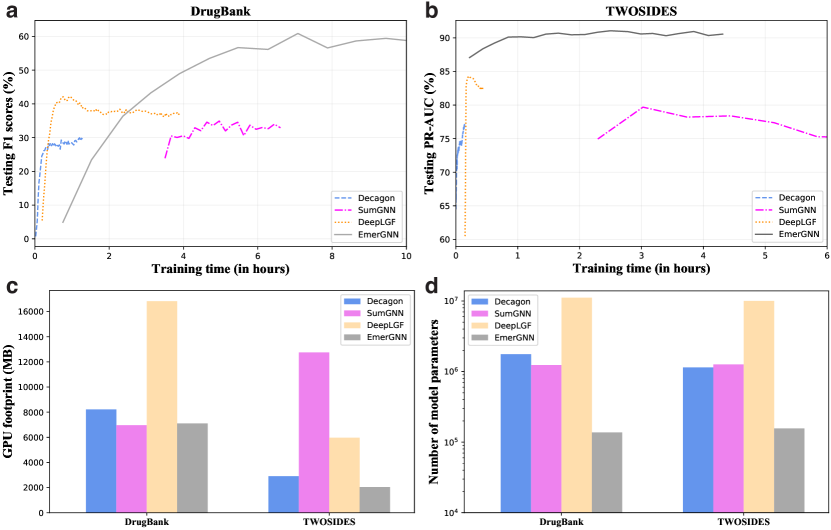
- EmerGNN outperforms existing GNN-based methods in predicting DDIs for emerging drugs, particularly in the S1 (emerging vs. existing) and S2 (emerging vs. emerging) settings.
- The model achieves higher macro F1 scores than strong baselines such as Decagon, SumGNN, and CompGCN, especially in low-frequency interaction groups.
- Attention mechanisms successfully identify the most relevant biomedical relations on the paths, with top-5 attended relations (e.g., CrC, CtD, CsSE) contributing significantly to prediction performance.
- Ablation studies show that removing interaction edges from the test set and adding them to training improves performance, confirming the model’s robustness in cold-start scenarios.
- t-SNE visualization confirms that EmerGNN learns more discriminative and semantically meaningful representations for drug pairs compared to models like SumGNN and CompGCN.
- The model’s interpretability is validated by showing that predicted interactions correlate strongly with specific interaction types and biomedical relations on selected paths, as demonstrated in heatmap and histogram analyses.
Read this paper
Open the full text in the Nubint reader and ask about any passage as you read.
Read this paper on NubintThis review was generated by AI from the original paper. Please check the paper before citing it.