
[Paper Review] Empirical Analysis of the Strengths and Weaknesses of PEFT Techniques for LLMs
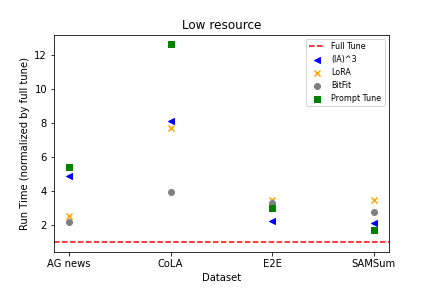
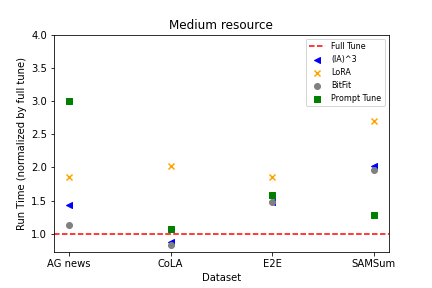
The paper benchmarks PEFT methods (LoRA, IA3, BitFit, Prompt Tune) on FLAN-T5-XL across data sizes and tasks, proposing a framework to choose methods; it finds full tuning often converges faster in low/medium data, while PEFT excels with larger data and can be highly parameter-efficient.
As foundation models continue to exponentially scale in size, efficient methods of adaptation become increasingly critical. Parameter-efficient fine-tuning (PEFT), a recent class of techniques that require only modifying a small percentage of the model parameters, is currently the most popular method for adapting large language models (LLMs). Several PEFT techniques have recently been proposed with varying tradeoffs. We provide a comprehensive and uniform benchmark of various PEFT techniques across a representative LLM, the FLAN-T5 model, and evaluate model performance across different data scales of classification and generation datasets. Based on this, we provide a framework for choosing the optimal fine-tuning techniques given the task type and data availability. Contrary to popular belief, we also empirically prove that PEFT techniques converge slower than full tuning in low data scenarios, and posit the amount of data required for PEFT methods to both perform well and converge efficiently. Lastly, we further optimize these PEFT techniques by selectively choosing which parts of the model to train, and find that these techniques can be applied with significantly fewer parameters while maintaining and even improving performance.
Motivation & Objective
- Provide a uniform, comprehensive benchmark of PEFT techniques on a representative LLM (FLAN-T5) across data scales and task types (classification and generation).
- Analyze convergence speeds, accuracy, and other metrics to understand when to use PEFT versus full fine-tuning.
- Identify which parts of the model (layers/submodules) are most impactful to train for different PEFT methods.
- Propose a practical framework to select PEFT methods based on task type and data availability.
- Demonstrate potential ablations to reduce trained parameters while maintaining or improving performance.
Proposed method
- Evaluate four PEFT techniques (LoRA, (IA)3, prompt tuning, BitFit) against full fine-tuning on FLAN-T5-XL across multiple datasets and data scales.
- Use exact string-match accuracy for AG News and CoLA, and ROUGE-L for E2E NLG and SAMSum.
- Conduct ablation studies varying which layers/submodules are trained and which components are modified (e.g., attention vs dense blocks).
- Analyze convergence speed, memory usage, and compute cost to derive efficiency-accuracy tradeoffs.
- Provide parameter-count figures and compare efficiency by normalizing performance per parameter (and per run time).
- Establish empirical guidelines for when full tuning or PEFT is preferable given resource constraints and data availability.
Experimental results
Research questions
- RQ1How do different PEFT techniques perform across classification and generation tasks on FLAN-T5-XL at low, medium, and high data scales?
- RQ2What are the convergence characteristics and resource costs of PEFT versus full fine-tuning across data regimes?
- RQ3Which model components (layers, attention blocks, activations) matter most when applying PEFT methods?
- RQ4Can PEFT approaches be further optimized by selective training of specific layers or submodules without harming performance?
- RQ5What framework can guide practitioners in choosing the appropriate PEFT technique for a given task and data regime?
Key findings
- PEFT techniques generally underperform full tuning in convergence speed at low/medium resource data, but can match or exceed performance at higher data volumes.
- BitFit and LoRA tend to perform well in low/medium-resource scenarios, while full tuning gains relative performance with more data.
- $(IA)^{3}$ offers memory efficiency via element-wise scaling and can reduce parameter count substantially with minimal performance loss in ablations.
- Attention-level modifications and later-layer selections are particularly important for downstream performance, with later or random layer choices often outperform early-layer choices in $(IA)^{3}$.
- Significant parameter reductions (often about half or more) can be achieved without sacrificing performance, enabling more efficient adaptation.
Read this paper
Open the full text in the Nubint reader and ask about any passage as you read.
Read this paper on NubintThis review was generated by AI from the original paper. Please check the paper before citing it.