
[Paper Review] Empirical evidence of Large Language Model's influence on human spoken communication
The study analyzes 280,000 YouTube transcripts from 20k+ academic channels and finds a significant post-ChatGPT rise in usage of words distinctive to ChatGPT-edited text, indicating humans are increasingly imitating LLM language in spoken communication.
From the invention of writing and the printing press, to television and social media, human history is punctuated by major innovations in communication technology, which fundamentally altered how ideas spread and reshaped our culture. Recent chatbots powered by generative artificial intelligence constitute a novel medium that encodes cultural patterns in their neural representations and disseminates them in conversations with hundreds of millions of people. Understanding whether these patterns transmit into human language, and ultimately shape human culture, is a fundamental question. While fully quantifying the causal impact of a chatbot like ChatGPT on human culture is very challenging, lexicographic shift in human spoken communication may offer an early indicator of such broad phenomenon. Here, we apply econometric causal inference techniques to 740,249 hours of human discourse from 360,445 YouTube academic talks and 771,591 conversational podcast episodes across multiple disciplines. We detect a measurable and abrupt increase in the use of words preferentially generated by ChatGPT, such as delve, comprehend, boast, swift, and meticulous, after its release. These findings suggest a scenario where machines, originally trained on human data and subsequently exhibiting their own cultural traits, can, in turn, measurably reshape human culture. This marks the beginning of a closed cultural feedback loop in which cultural traits circulate bidirectionally between humans and machines. Our results motivate further research into the evolution of human-machine culture, and raise concerns over the erosion of linguistic and cultural diversity, and the risks of scalable manipulation.
Motivation & Objective
- Assess whether AI systems influence human spoken language beyond written text.
- Quantify changes in word usage after the ChatGPT release in a large-scale set of academic videos.
- Examine the relationship between GPT-distinctive words and their adoption in spoken language.
Proposed method
- Construct a dataset of 360,445 YouTube videos from academic institutions, filtering to 279,480 transcripts in English.
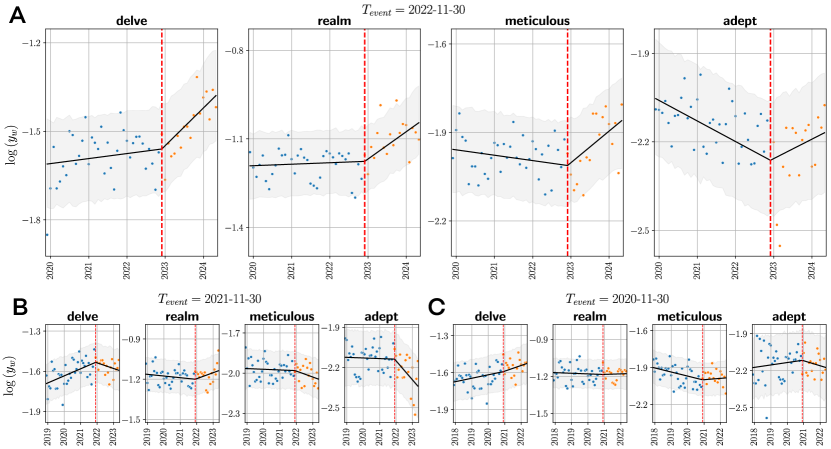
- Model monthly word-frequency trends with a hierarchical Bayesian Gaussian regression assessing natural vs. post-event changes.
- Identify GPT-distinctive words using Liang et al.’s dataset and compute the log-frequency ratio log(P_w,GPT / P_w,human).
- Calculate the trend-change coefficient beta_w,GPT after ChatGPT’s release (T_event = 2022-11-30) over 18 months.
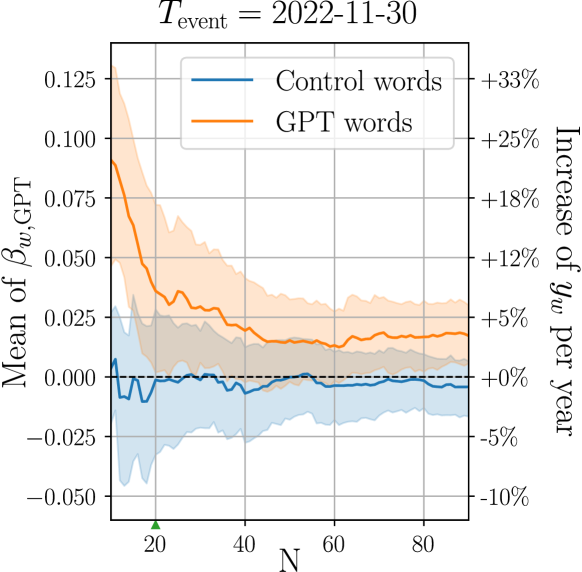
- Assess correlation between GPT-word distinctiveness and adoption in speech, focusing on top N GPT words (e.g., top 20).
- Validate robustness via sensitivity analyses on N and change points.
Experimental results
Research questions
- RQ1Do humans alter spoken language after exposure to LLMs like ChatGPT, beyond writing?
- RQ2Is there a measurable shift in the frequency of words characteristic of ChatGPT-edited text within academic spoken communication?
- RQ3Are words more distinctive to ChatGPT more likely to see accelerated adoption in speech after ChatGPT’s release?
- RQ4How does the association between GPT-word distinctiveness and adoption behave across different word sets and observation windows?
Key findings
- Post-ChatGPT, certain GPT words show accelerated adoption in spoken language (e.g., beta_w,GPT around 0.11–0.12 with 95% HDI [0.04, 0.18], [0.02, 0.22]).
- GPT words experience approximately 35–51% higher trend after 18 months than pre-event baselines.
- A significant association exists between ChatGPT-distinctive words and greater adoption in speech, strongest when considering the top 20 GPT words (r = 0.63, p < 0.01).
- Control words (bottom N) do not show substantial post-event trend changes, indicating specificity to GPT words.
- The observed trend changes emerge only after several months post-release, requiring post-ChatGPT data to detect effects.
Read this paper
Open the full text in the Nubint reader and ask about any passage as you read.
Read this paper on NubintThis review was generated by AI from the original paper. Please check the paper before citing it.