
[Paper Review] End-to-End Pseudo-LiDAR for Image-Based 3D Object Detection
This paper proposes an end-to-end differentiable pseudo-LiDAR framework that jointly trains depth estimation and 3D object detection, overcoming the limitations of separate training in traditional pseudo-LiDAR. By introducing differentiable change-of-representation modules—particularly a soft quantization layer—it enables back-propagation through the entire pipeline, achieving state-of-the-art performance on the KITTI image-based 3D detection benchmark with PointRCNN.
Reliable and accurate 3D object detection is a necessity for safe autonomous driving. Although LiDAR sensors can provide accurate 3D point cloud estimates of the environment, they are also prohibitively expensive for many settings. Recently, the introduction of pseudo-LiDAR (PL) has led to a drastic reduction in the accuracy gap between methods based on LiDAR sensors and those based on cheap stereo cameras. PL combines state-of-the-art deep neural networks for 3D depth estimation with those for 3D object detection by converting 2D depth map outputs to 3D point cloud inputs. However, so far these two networks have to be trained separately. In this paper, we introduce a new framework based on differentiable Change of Representation (CoR) modules that allow the entire PL pipeline to be trained end-to-end. The resulting framework is compatible with most state-of-the-art networks for both tasks and in combination with PointRCNN improves over PL consistently across all benchmarks -- yielding the highest entry on the KITTI image-based 3D object detection leaderboard at the time of submission. Our code will be made available at https://github.com/mileyan/pseudo-LiDAR_e2e.
Motivation & Objective
- Address the performance gap between LiDAR-based and image-based 3D object detection by enabling end-to-end training in pseudo-LiDAR pipelines.
- Overcome the misalignment between depth estimation and 3D detection objectives when trained separately, which leads to suboptimal depth predictions around object boundaries.
- Enable back-propagation through the transformation from 2D depth maps to 3D point clouds using differentiable change-of-representation (CoR) modules.
- Maintain compatibility with existing state-of-the-art depth estimators and LiDAR-based detectors while improving their joint performance.
- Achieve state-of-the-art results on the KITTI image-based 3D object detection leaderboard using end-to-end training with minimal architectural changes.
Proposed method
- Introduce differentiable change-of-representation (CoR) modules to bridge the gap between 2D depth maps and 3D point clouds, enabling gradient flow across the entire pipeline.
- Design a novel differentiable soft quantization CoR module to handle the non-differentiable nature of standard quantization, allowing gradients to back-propagate from the detector to the depth network.
- Support two types of LiDAR-based detectors: those requiring quantized 3D tensors (e.g., PIXOR) and those processing raw point clouds (e.g., PointRCNN), via tailored CoR modules.
- Integrate the depth estimator and 3D detector into a single end-to-end training pipeline, where the detection loss guides depth estimation to improve object boundary accuracy.
- Use radial basis function (RBF) kernels in the soft quantization module to compute weighted contributions of points to discrete bins, enabling smooth gradients during back-propagation.
- Train the full system jointly using a multi-task loss combining depth estimation and 3D detection objectives, optimizing for final detection performance.
Experimental results
Research questions
- RQ1Can end-to-end training of depth estimation and 3D object detection improve detection accuracy compared to separate training in pseudo-LiDAR pipelines?
- RQ2How can non-differentiable operations like quantization be made compatible with back-propagation in a joint training framework?
- RQ3To what extent does end-to-end training refine depth predictions around object boundaries, particularly for distant or occluded objects?
- RQ4Can the proposed framework maintain compatibility with existing state-of-the-art depth estimators and 3D detectors without architectural modifications?
- RQ5Does end-to-end training lead to measurable improvements on standard benchmarks like KITTI, especially in the hard (far-away, occluded) detection categories?
Key findings
- The proposed end-to-end pseudo-LiDAR (E2E-PL) framework with PointRCNN achieves the highest mAP on the KITTI image-based 3D object detection leaderboard at the time of submission, outperforming both baseline pseudo-LiDAR and PL++.
- E2E-PL improves mAP by 3.5% and 4.2% on the moderate and hard categories, respectively, compared to the baseline pseudo-LiDAR with PointRCNN.
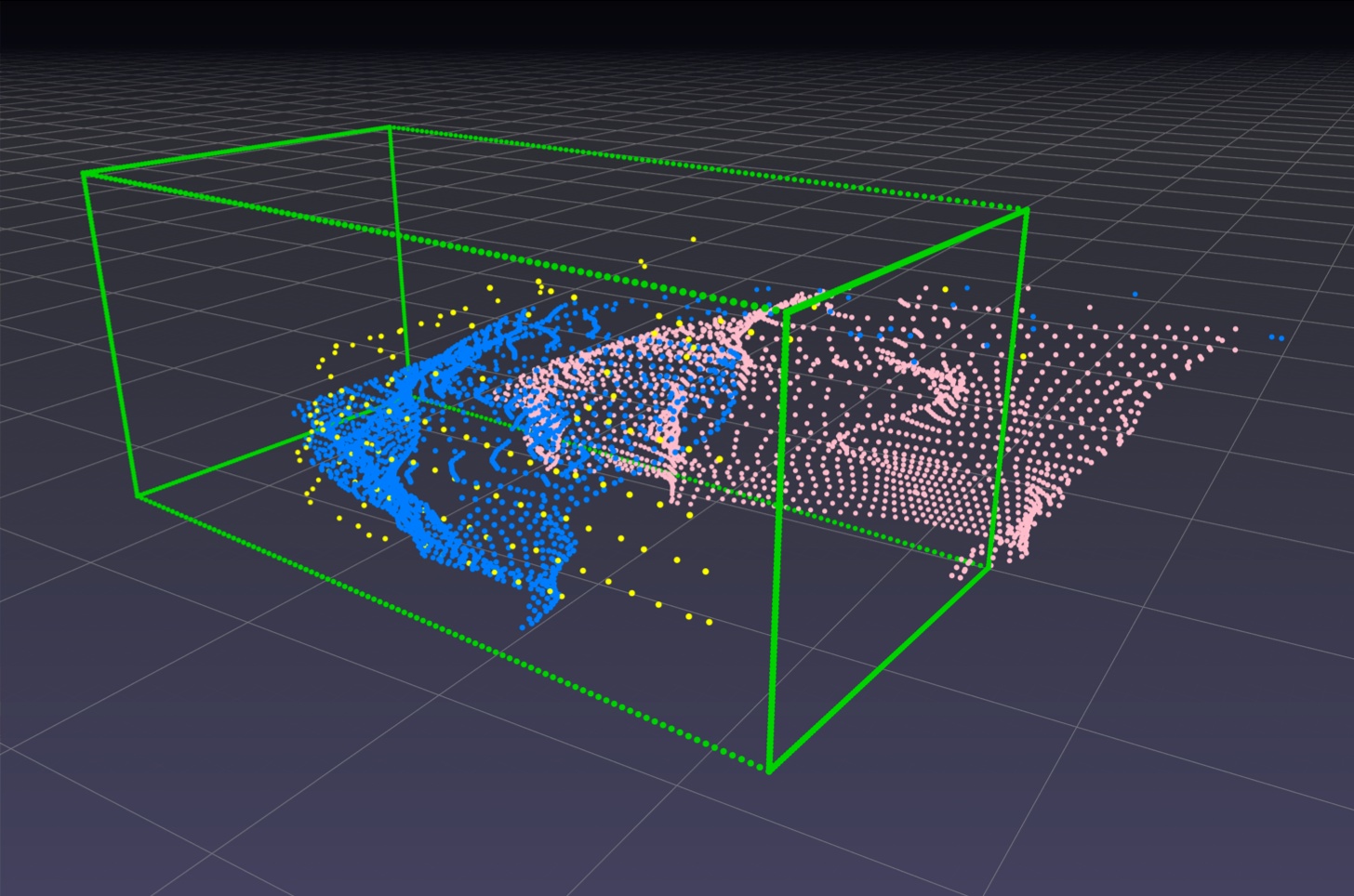
- Qualitative results show that end-to-end training significantly reduces depth estimation artifacts on object tops and improves point cloud quality around cars, especially for far-away and occluded objects.
- The detection performance improves across all categories: E2E-PL achieves 77.1% mAP on the hard category, compared to 72.9% for PL++ and 70.1% for baseline PL.
- The inference speed of E2E-PL is comparable to baseline pseudo-LiDAR, with 0.49s/frame for PointRCNN and 0.55s/frame for PIXOR on a single GPU, indicating minimal computational overhead.
- The soft quantization CoR module enables effective gradient flow, as evidenced by improved depth predictions and reduced false positives in detection results, especially in challenging scenarios.
Read this paper
Open the full text in the Nubint reader and ask about any passage as you read.
Read this paper on NubintThis review was generated by AI from the original paper. Please check the paper before citing it.