
[Paper Review] End-to-End Spectro-Temporal Graph Attention Networks for Speaker Verification Anti-Spoofing and Speech Deepfake Detection
This paper proposes RawGAT-ST, a fully end-to-end spectro-temporal graph attention network that learns discriminative relationships between spectral sub-bands and temporal segments directly from raw audio for speaker verification anti-spoofing and speech deepfake detection. It achieves a state-of-the-art equal error rate (EER) of 1.06% on the ASVspoof 2019 logical access dataset through model-level fusion of spectral and temporal attention and a novel graph pooling strategy.
Artefacts that serve to distinguish bona fide speech from spoofed or deepfake speech are known to reside in specific subbands and temporal segments. Various approaches can be used to capture and model such artefacts, however, none works well across a spectrum of diverse spoofing attacks. Reliable detection then often depends upon the fusion of multiple detection systems, each tuned to detect different forms of attack. In this paper we show that better performance can be achieved when the fusion is performed within the model itself and when the representation is learned automatically from raw waveform inputs. The principal contribution is a spectro-temporal graph attention network (GAT) which learns the relationship between cues spanning different sub-bands and temporal intervals. Using a model-level graph fusion of spectral (S) and temporal (T) sub-graphs and a graph pooling strategy to improve discrimination, the proposed RawGAT-ST model achieves an equal error rate of 1.06 % for the ASVspoof 2019 logical access database. This is one of the best results reported to date and is reproducible using an open source implementation.
Motivation & Objective
- To address the challenge of detecting diverse spoofing attacks in speaker verification by modeling discriminative artefacts across both spectral and temporal domains.
- To overcome the limitations of prior models that rely on hand-crafted features or late fusion by enabling end-to-end learning from raw waveforms.
- To improve detection performance by fusing spectral and temporal attention mechanisms within a single model architecture using graph neural networks.
- To enhance discrimination through a novel graph pooling strategy that reduces graph dimensionality while preserving key features.
- To demonstrate the superiority of a unified, end-to-end approach over score-level fusion of separate spectral or temporal models.
Proposed method
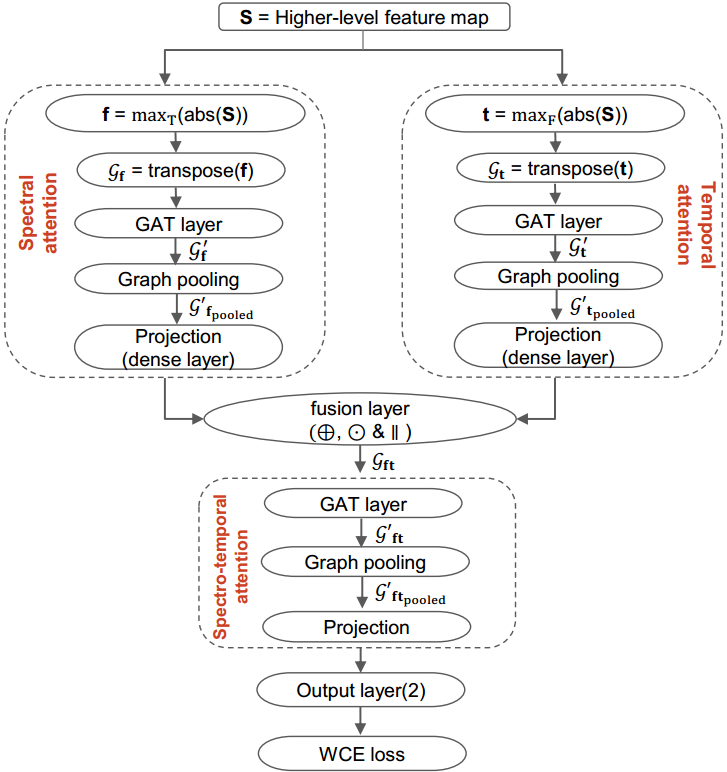
- The model uses a one-dimensional sinc convolution layer to extract raw waveform representations directly, eliminating the need for hand-crafted features like MFCCs or spectrograms.
- It constructs two separate sub-graphs: one for spectral attention (S) and one for temporal attention (T), each modeling relationships between nodes representing sub-bands or time segments.
- A spectro-temporal graph attention network (GAT-ST) fuses the S and T sub-graphs at the model level, enabling joint learning of complementary cues across both domains.
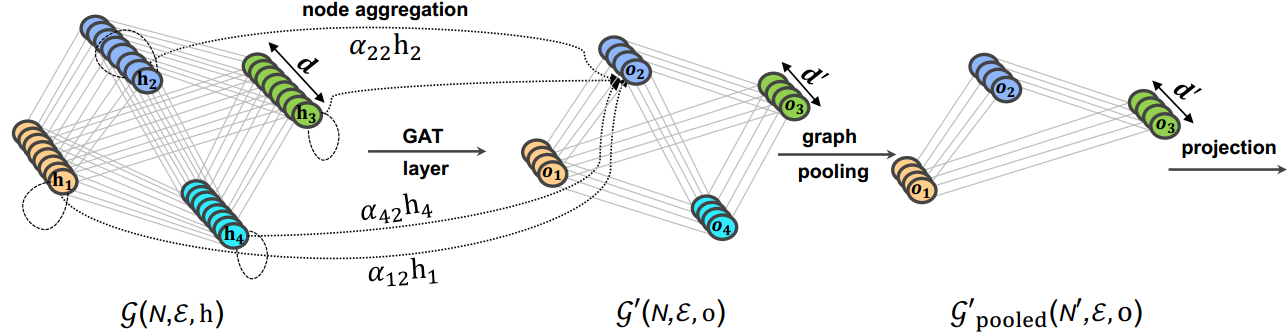
- The graph attention mechanism computes learnable attention weights between node pairs, aggregating features into a lower-dimensional representation to improve discrimination.
- A novel graph pooling strategy reduces the number of nodes by selecting the most informative features, enhancing model robustness and performance.
- The architecture is trained end-to-end using a self-attention mechanism that dynamically emphasizes the most discriminative spectral and temporal regions.
Experimental results
Research questions
- RQ1Can a unified, end-to-end model that jointly models spectral and temporal relationships outperform separate models or late fusion strategies in anti-spoofing?
- RQ2Does learning representations directly from raw waveforms improve detection performance compared to using hand-crafted acoustic features?
- RQ3How does model-level fusion of spectral and temporal attention in a graph neural network architecture compare to score-level fusion in terms of performance and generalization?
- RQ4To what extent does graph pooling improve discrimination by focusing on the most informative spectro-temporal features?
- RQ5Can a single, lightweight model achieve state-of-the-art performance across diverse spoofing attacks without relying on complex architectures or external feature engineering?
Key findings
- The RawGAT-ST model achieves an equal error rate (EER) of 1.06% on the ASVspoof 2019 logical access dataset, which is among the best results reported to date.
- The ablation study shows that removing spectral attention increases EER to 1.87%, indicating its greater importance compared to temporal attention alone.
- The inclusion of graph pooling reduces EER from 2.47% (without pooling) to 1.06%, demonstrating its significant contribution to performance improvement.
- The model outperforms its previous version using late score fusion (ResNet18-GAT-T) by 63% in min-tDCF and 77% in EER, highlighting the benefit of model-level fusion.
- Despite having only 0.44 million parameters, RawGAT-ST outperforms most existing models, including those with more complex architectures and hand-crafted features.
- The model is one of only two systems (alongside Res-TSSDNet) that operate directly on raw audio, confirming the advantage of end-to-end learning for this task.
Read this paper
Open the full text in the Nubint reader and ask about any passage as you read.
Read this paper on NubintThis review was generated by AI from the original paper. Please check the paper before citing it.