
[Paper Review] end-to-end training of a large vocabulary end-to-end speech recognition system
This paper presents a scalable, on-the-fly end-to-end speech recognition training framework using CPU-GPU clusters, leveraging vocal tract length perturbation (VTLP) and acoustic simulation for data augmentation. The system achieves a 2.44% WER on LibriSpeech test-clean and 7.92% WER on a proprietary Bixby dataset using a BFA model with shallow fusion, demonstrating state-of-the-art performance in both near- and far-field scenarios.
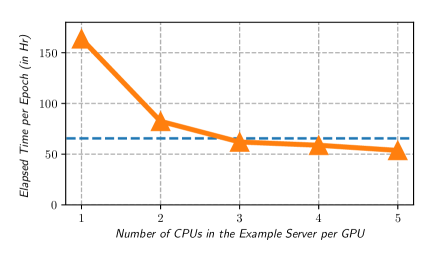
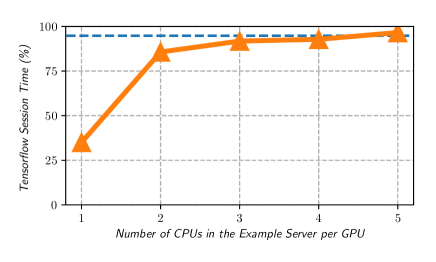
In this paper, we present an end-to-end training framework for building state-of-the-art end-to-end speech recognition systems. Our training system utilizes a cluster of Central Processing Units(CPUs) and Graphics Processing Units (GPUs). The entire data reading, large scale data augmentation, neural network parameter updates are all performed "on-the-fly". We use vocal tract length perturbation [1] and an acoustic simulator [2] for data augmentation. The processed features and labels are sent to the GPU cluster. The Horovod allreduce approach is employed to train neural network parameters. We evaluated the effectiveness of our system on the standard Librispeech corpus [3] and the 10,000-hr anonymized Bixby English dataset. Our end-to-end speech recognition system built using this training infrastructure showed a 2.44 % WER on test-clean of the LibriSpeech test set after applying shallow fusion with a Transformer language model (LM). For the proprietary English Bixby open domain test set, we obtained a WER of 7.92 % using a Bidirectional Full Attention (BFA) end-to-end model after applying shallow fusion with an RNN-LM. When the monotonic chunckwise attention (MoCha) based approach is employed for streaming speech recognition, we obtained a WER of 9.95 % on the same Bixby open domain test set.
Motivation & Objective
- To develop a scalable, distributed end-to-end speech recognition training system capable of handling large-scale, diverse speech data.
- To improve robustness in far-field and noisy environments through effective data augmentation techniques.
- To achieve state-of-the-art word error rates (WER) on standard and proprietary speech recognition benchmarks.
- To enable efficient, on-the-fly processing of data augmentation and model training using CPU-GPU clusters.
- To demonstrate the effectiveness of combining VTLP and acoustic simulation for speaker and environmental variability.
Proposed method
- The system uses a cluster of CPUs and GPUs, with data processing, augmentation, and feature extraction performed on-the-fly via example servers using tf.data and sharded TFRecords.
- Vocal Tract Length Perturbation (VTLP) is applied to simulate speaker variability, while an acoustic simulator generates realistic far-field speech with varying room impulse responses and noise conditions.
- Neural network parameters are updated using the Horovod allreduce framework with Adam optimizer, enabling efficient distributed training across GPU nodes.
- The training pipeline avoids pre-computation of acoustic simulation parameters, instead generating them dynamically during training to reduce storage and increase flexibility.
- Shallow fusion with Transformer and RNN language models is applied to improve decoding performance on test sets.
- Signal enhancement via a Neural Beam Former (NBF) is used in conjunction with data augmentation to further improve far-field recognition accuracy.
Experimental results
Research questions
- RQ1Can a fully end-to-end speech recognition system achieve state-of-the-art performance on large-scale, diverse speech datasets using distributed training and on-the-fly data augmentation?
- RQ2How effective are VTLP and acoustic simulation in improving robustness to speaker variability and far-field acoustic conditions?
- RQ3What is the impact of combining data augmentation with advanced language models on word error rate reduction?
- RQ4How does the performance of end-to-end models compare to conventional WFST-based systems in far-field and open-domain settings?
- RQ5Can the same augmented training data be used effectively for both near-field and far-field speech recognition without performance degradation?
Key findings
- The end-to-end system achieved a 2.44% WER on the LibriSpeech test-clean set using a BFA model with a Transformer language model, outperforming previous state-of-the-art results.
- On the proprietary Bixby open-domain test set, the system achieved a 7.92% WER using a BFA model with shallow fusion to an RNN-LM, representing a 10% relative improvement over the conventional WFST-based system.
- For streaming inference, the MoChA-based model achieved a 9.95% WER on the same Bixby test set, showing strong performance under real-time constraints.
- The use of VTLP and acoustic simulation significantly improved recognition accuracy in far-field conditions, with additional gains when combined with a Neural Beam Former (NBF).
- The on-the-fly data processing pipeline maintained high performance on clean data while enhancing robustness to noise and reverberation, proving the method's versatility across environments.
- The Horovod-based allreduce training framework enabled efficient distributed training, supporting large-scale model optimization across multi-GPU clusters.
Read this paper
Open the full text in the Nubint reader and ask about any passage as you read.
Read this paper on NubintThis review was generated by AI from the original paper. Please check the paper before citing it.