
[論文レビュー] Entanglement Routing over Networks with Time Multiplexed Repeaters
本稿は、時間多重化中継器を用いてもつれ分配レートを向上させるための局所的でマルチパスルーティングプロトコルを提案する。局所的リンク状態知識を活用し、時間多重化ブロック長 $k$ を最適化することで、スループットの向上とメモリのデコherenceの間でバランスをとる。実用的なデコherenceモデル下で、レートを最大化する最適な $k_{\text{opt}}$ が明らかになる。
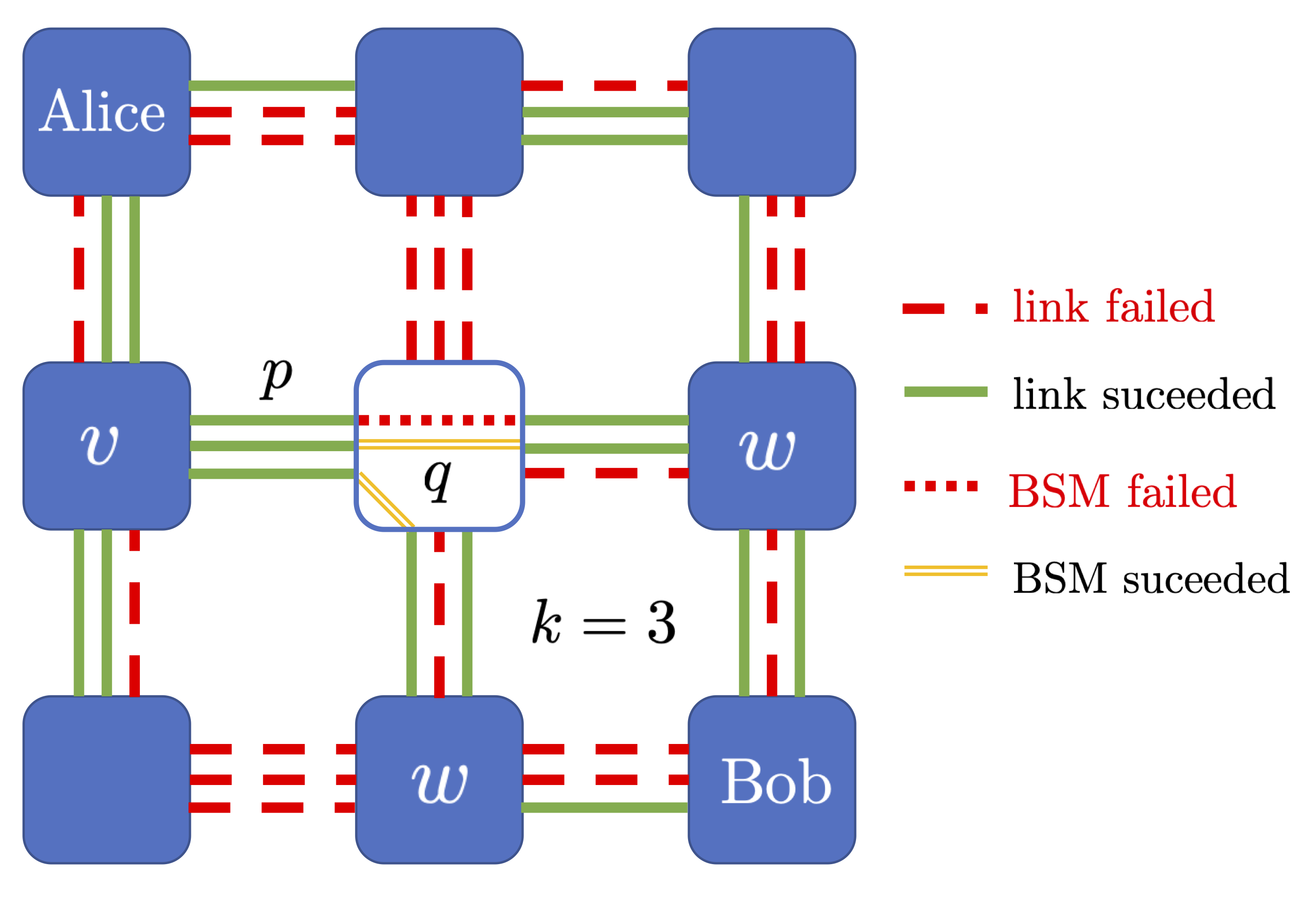
Quantum networks will be able to service consumers with long-distance entanglement by use of quantum repeaters that generate Bell pairs (or links) with their neighbors, iid with probability $p$ and perform Bell State Measurements (BSMs) on the links that succeed iid with probability $q$. While global link state knowledge is required to maximize the rate of entanglement generation between any two consumers, it increases the protocol latency due to the classical communication requirements and requires long quantum memory coherence times. We propose two entanglement routing protocols that require only local link state knowledge to relax the quantum memory coherence time requirements and reduce the protocol latency. These protocols utilize multi-path routing protocol and time multiplexed repeaters. The time multiplexed repeaters first generate links for $k$-time steps before performing BSMs on any pairs of links. Our two protocols differ in the decision rule used for performing BSMs at the repeater: the first being a static path based routing protocol and second a dynamic distance based routing protocol. The performance of these protocols depends on the quantum network topology and the consumers' location. We observe that the average entanglement rate and the latency increase with the time multiplexing block length, $k$, irrespective of the protocol. When a step function memory decoherence model is introduced such that qubits are held in the quantum memory for an exponentially distributed time with mean $μ$, an optimal $k$ ($k_ ext{opt}$) value appears, such that for increasing $k$ beyond $k_{ m opt}$ hurts the entanglement rate. $k_{ m opt}$ decreases with $p$ and increases with $μ$. $k_{ m opt}$ appears due to the tradeoff between benefits from time multiplexing and the increased likelihood of previously established Bell pairs decohering due to finite memory coherence times.
研究の動機と目的
- 長距離のもつれ分配における高い遅延と限られた量子メモリ寿命の課題に対処すること。
- 大規模で動的な量子ネットワークでは現実的でない、グローバルなネットワーク状態知識への依存を低減すること。
- 時間多重化中継器を用いてもつれ生成レートを向上させるスケーラブルで局所的ルーティングプロトコルを開発すること。
- 現実的なメモリモデル下で、時間多重化の利点とデコherenceによるリンク損失のトレードオフを分析すること。
- 確率的リンク生成とメモリのデコherence下でもつれレートを最大化する最適な時間多重化ブロック長 $k_{\text{opt}}$ を特定すること。
提案手法
- 各中継器が自身のもつれ試行とトポロジーに基づいてスワップ決定を行う、局所的リンク状態知識のみを用いる距離ベースのマルチパスルーティングプロトコルを採用。
- 複数の時間スロットにわたりベル状態測定(BSM)を実行可能な時間多重化中継器をモデル化し、もつれスワッピングの成功確率を向上。
- 量子ビットが指数分布(平均 $\mu$)に従って保存される段階関数型メモリデコherenceモデルを導入。これによりリンク生存確率に影響を与える。
- ネットワークスナップショット全体における最大二部もつれ容量を計算するために、混合整数二次制約プログラミング(MIQCP)を用いる。
- メモリデコherenceを伴う決定論的リンク生成($p=1$)に対して、解析的レート式を導出。リンク生存確率を $s(t) = e^{-t/\mu}$ としてモデル化。
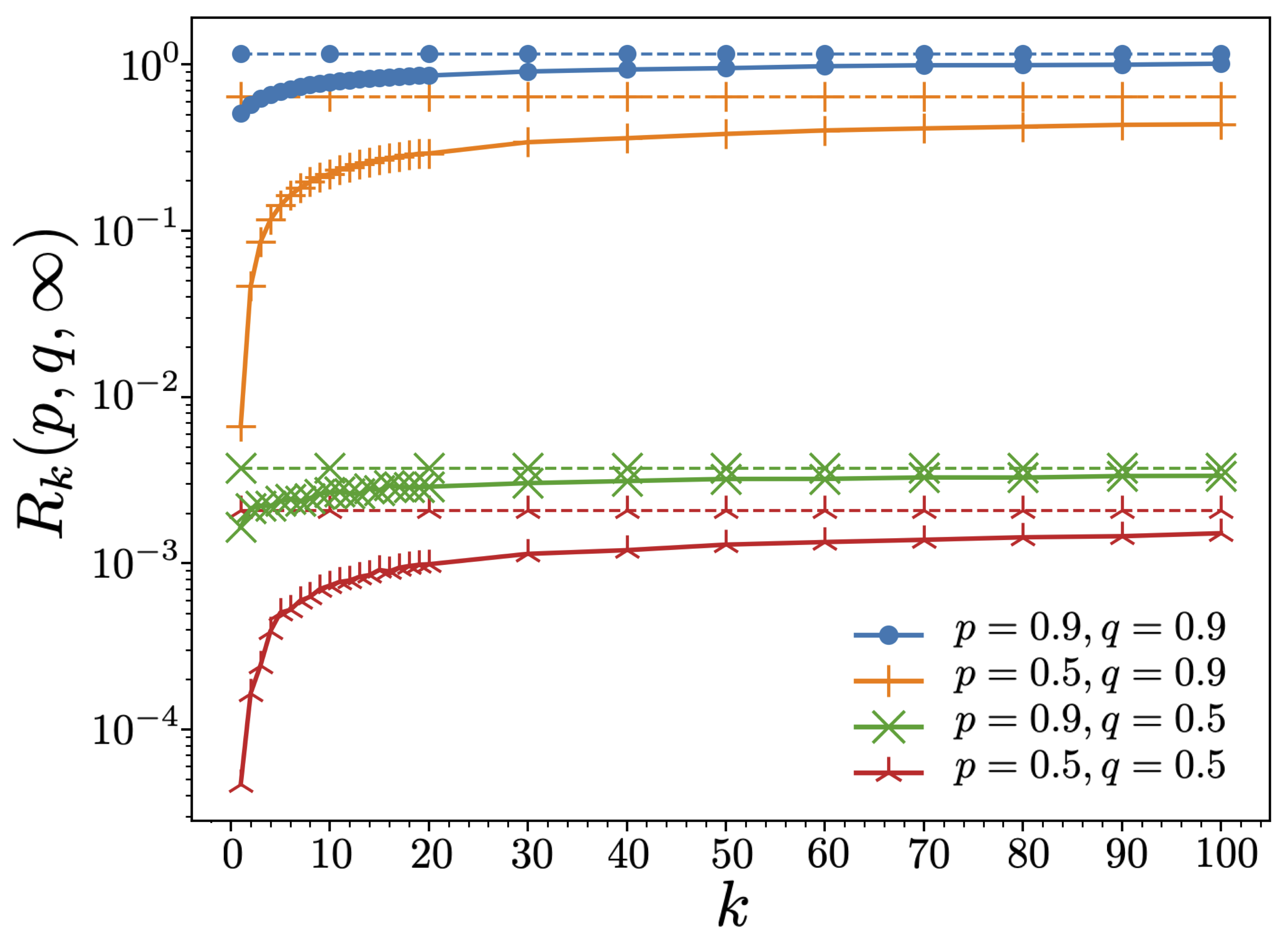
- 時間経過に伴う複数の利用可能なリンクの確率を組み込んだ、平均もつれレート $R_k(1,q,\mu)$ を $k$、$q$、$\mu$ の関数として評価。
実験結果
リサーチクエスチョン
- RQ1確率的リンク生成を持つ量子ネットワークにおいて、時間多重化ブロック長 $k$ が平均もつれ分配レートに与える影響は何か?
- RQ2メモリデコherenceが存在する場合、もつれレートを最大化する最適な $k_{\text{opt}}$ は何か?
- RQ3時間多重化の利点の増大とデコherenceによる損失リスクの上昇のトレードオフは、プロトコルのパフォーマンスにどのように影響するか?
- RQ4最小限のグローバル状態知識を必要とする局所的ルーティングプロトコルは、グローバル最適化手法と同等のレートを達成できるか?
- RQ5メモリデコherence($\mu$)の存在が、時間多重化中継器ネットワークのスケーラビリティとパフォーマンスに与える影響は何か?
主な発見
- 平均もつれ分配レートは時間多重化ブロック長 $k$ が増加するにつれて上昇するが、それに伴い初期遅延も増加する。
- 平均 $\mu$ の指数分布に従うメモリデコherenceモデル下で、多重化の利点とデコherence損失のバランスを取る最適な $k_{\text{opt}}$ が出現する。
- リンク生成確率 $p$ が低下するか、メモリコherency時間 $\mu$ が延びるにつれて、$k_{\text{opt}}$ は最適パフォーマンスを維持するために増加する。
- 確率 $p=1$ の場合、解析的レート $R_k(1,q,\mu)$ が導出されシミュレーションで検証され、ベースライン項 $q^{d-1}/k$ に対して逆比例するスケーリングが示された。
- 単一路ルーティングより高いレートを達成し、グローバル最適化性能に近い結果を、局所的知識のみで達成。
- MIQCPに基づく容量計算により、確率的リンク利用可能性とBSM成功確率を考慮した、ネットワークスナップショット全体における最大もつれフローの正確な推定が可能になった。
より良い研究を、今すぐ始めましょう
論文の読解から最終レビューまで、研究時間を劇的に削減しましょう。
クレジットカード登録不要
このレビューはAIが作成し、人間の編集者が確認しました。