
[Paper Review] Epic-Sounds: A Large-scale Dataset of Actions That Sound
EPIC-SOUNDS introduces a large-scale, audio-specific dataset of 78.4k categorized sound events and 39.2k non-categorized segments from egocentric kitchen videos, annotated via human listeners focusing solely on audio. It enables accurate audio-only recognition and detection, with state-of-the-art models achieving up to 84.3% top-1 accuracy, highlighting the limitations of using visual labels for audio training due to temporal and semantic misalignments.
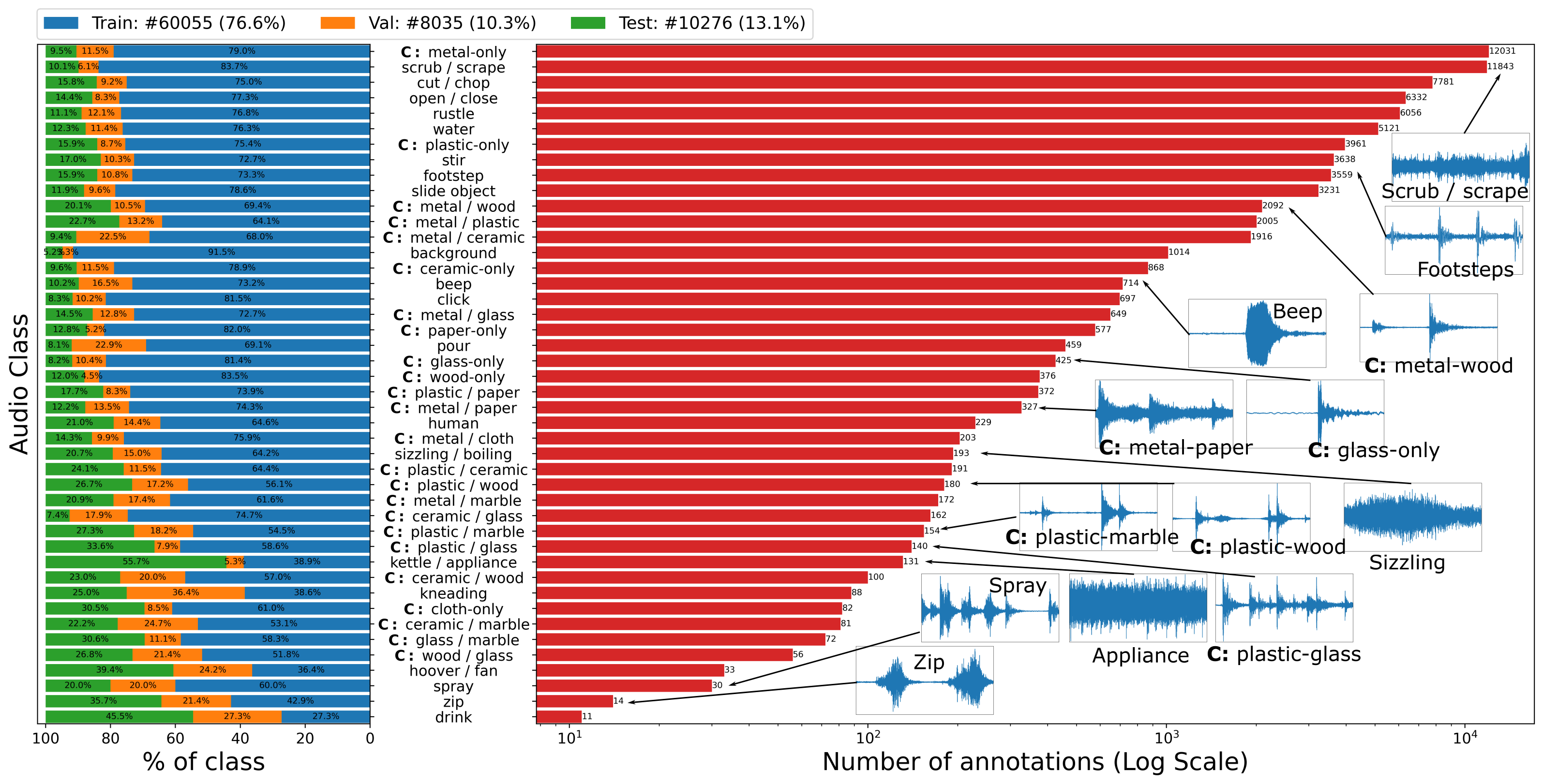
We introduce EPIC-SOUNDS, a large-scale dataset of audio annotations capturing temporal extents and class labels within the audio stream of the egocentric videos. We propose an annotation pipeline where annotators temporally label distinguishable audio segments and describe the action that could have caused this sound. We identify actions that can be discriminated purely from audio, through grouping these free-form descriptions of audio into classes. For actions that involve objects colliding, we collect human annotations of the materials of these objects (e.g. a glass object being placed on a wooden surface), which we verify from video, discarding ambiguities. Overall, EPIC-SOUNDS includes 78.4k categorised segments of audible events and actions, distributed across 44 classes as well as 39.2k non-categorised segments. We train and evaluate state-of-the-art audio recognition and detection models on our dataset, for both audio-only and audio-visual methods. We also conduct analysis on: the temporal overlap between audio events, the temporal and label correlations between audio and visual modalities, the ambiguities in annotating materials from audio-only input, the importance of audio-only labels and the limitations of current models to understand actions that sound.
Motivation & Objective
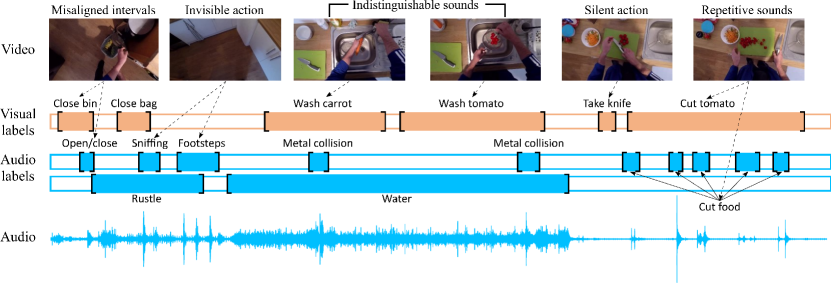
- To address the misalignment between visual and audio event annotations in egocentric video datasets, where audio and visual events often differ in timing and class semantics.
- To create a large-scale, audio-specific dataset with temporally precise and semantically grounded labels derived from human listening, independent of visual annotations.
- To enable reliable evaluation of audio-only models by providing audio-specific class labels and material annotations for object collisions.
- To benchmark state-of-the-art audio recognition models on a dataset that reflects real-world audio challenges, such as indistinguishable sounds and silent actions.
- To demonstrate that audio-only labels are essential for training robust audio classifiers, as visual labels lead to poor generalization due to temporal and semantic mismatches.
Proposed method
- Annotators listened to audio from EPIC-KITCHENS-100 videos and temporally segmented distinct sound events, labeling their onset and offset with free-form descriptions of the causing action.
- Descriptions were clustered into 44 audio-specific classes based on perceptual similarity, forming a taxonomy of audible events independent of visual labels.
- For collision events, annotators specified the materials of interacting objects (e.g., glass on wood), which were verified against visual ground truth to eliminate errors.
- A two-stage evaluation protocol was used: fine-tuning and linear probing of state-of-the-art audio models (ASF and SSAST) on the audio-only dataset.
- Data augmentation via SpecAugment was applied, and test-time augmentation used sub-clip averaging to improve robustness.
- Models were trained with cross-entropy loss using SGD (ASF) and AdamW (SSAST), with fixed hyperparameters and weight decay of 0.0001.
Experimental results
Research questions
- RQ1How do audio and visual event annotations differ in temporal extent and semantic class assignment in egocentric videos?
- RQ2Can audio-only labels improve the performance of audio recognition models compared to using visual labels as supervision?
- RQ3To what extent do current audio models fail to recognize actions that sound, especially when sounds are indistinguishable or silent?
- RQ4How do material properties of colliding objects affect the audibility and recognizability of sounds in real-world settings?
- RQ5What is the impact of data modality mismatch on model generalization, and how can audio-specific datasets mitigate this?
Key findings
- The top-1 accuracy of the fine-tuned ASF model reached 84.3% on the test set, outperforming SSAST by 1.11 percentage points.
- Linear probe results showed a significant drop in performance—especially for SSAST, where accuracy nearly halved—indicating that self-supervised pretraining alone does not yield class-discriminative features.
- Both models struggled with bi-material collision classes, frequently misclassifying them as metal-only collisions, suggesting difficulty in capturing material-dependent acoustic variations.
- 51.78% of 'wood/glass collision' visual actions had no visual annotation but produced distinct audio, highlighting the value of audio-only labels for capturing otherwise missed events.
- 71.43% of 'take basket' and 'pour basil' actions were silent, resulting in 0-to-1 visual-to-audio misalignment, proving that visual labels miss critical audio signals.
- The dataset contains 117,553 total sound segments across 100 hours of video, with 78,400 categorized into 44 audio-specific classes, enabling robust evaluation of audio-only models.
Read this paper
Open the full text in the Nubint reader and ask about any passage as you read.
Read this paper on NubintThis review was generated by AI from the original paper. Please check the paper before citing it.