
[論文レビュー] ESPnet: End-to-End Speech Processing Toolkit
tldr: ESPnet は Kaldi風のデータ処理を備え、Chainer と PyTorch 上に構築されたオープンソースのエンドツーエンドASRツールキットであり、ハイブリッドCTC/アテンションモデル、マルチオブジェクティブ訓練、ジョインデコーディング、言語モデル統合をサポート;WSJ、CSJ、HKUST で競争力のある結果を benchmark する。
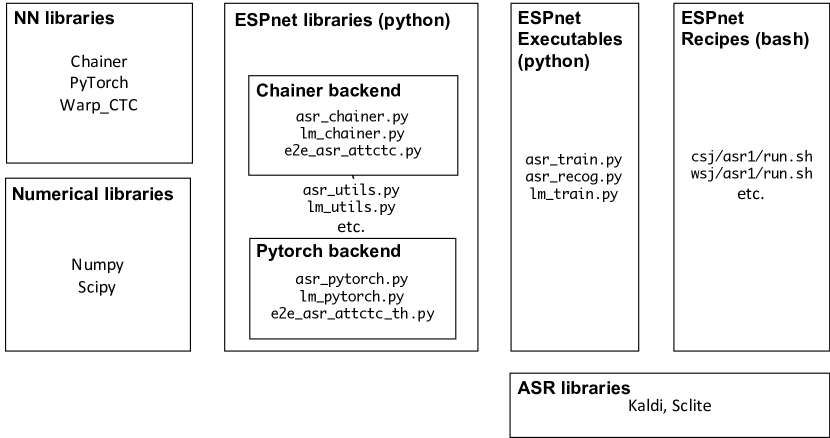
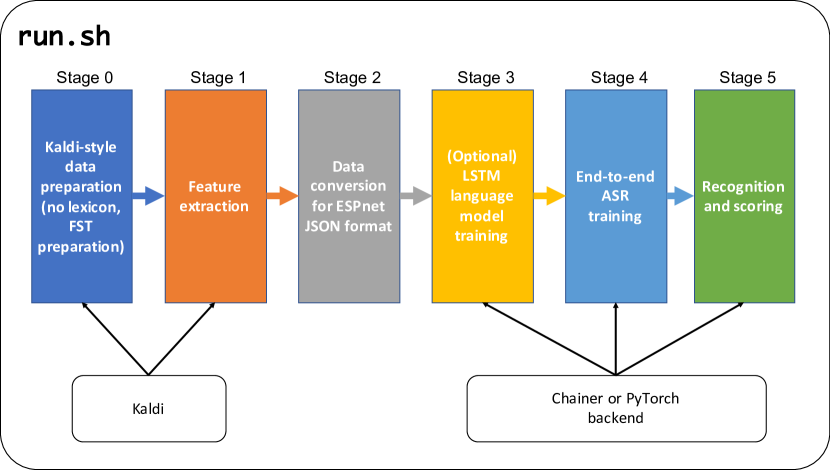
This paper introduces a new open source platform for end-to-end speech processing named ESPnet. ESPnet mainly focuses on end-to-end automatic speech recognition (ASR), and adopts widely-used dynamic neural network toolkits, Chainer and PyTorch, as a main deep learning engine. ESPnet also follows the Kaldi ASR toolkit style for data processing, feature extraction/format, and recipes to provide a complete setup for speech recognition and other speech processing experiments. This paper explains a major architecture of this software platform, several important functionalities, which differentiate ESPnet from other open source ASR toolkits, and experimental results with major ASR benchmarks.
研究の動機と目的
- Motivate the need for a unified end-to-end ASR platform that simplifies training and evaluation.
- Provide a flexible architecture leveraging CTC/attention hybrids for robust end-to-end ASR.
- Offer Kaldi-style data processing and recipes to ease reproducibility and benchmarking.
- Demonstrate competitive performance on major ASR benchmarks (WSJ, CSJ, HKUST).
- Highlight implementation efficiency and scalability (multi-GPU, PyTorch/Chainer backends).
提案手法
- Adopts a hybrid CTC/attention end-to-end ASR framework to jointly train and decode using a single encoder.
- Uses multiobjective training combining L_ctc and L_att with a tunable alpha parameter (L = alpha L_ctc + (1-alpha) L_att).
- Employs warp CTC for faster CTC computation and supports various attention types (location-aware, dot-product, additive, multi-head).
- Implements joint decoding by combining CTC and attention scores in a one-pass beam search.
- Integrates RNNLMs during decoding via shallow fusion (log p_lm) with a beta scaling parameter.
- Provides Kaldi-style data preprocessing and feature extraction, ensuring compatibility with Kaldi recipes and 80-dim log-MMel features (plus pitch).
- Supports multiple backends (Chainer and PyTorch) and simple, compact Python codebase (~5.4K lines) for model and recognition modules.
- Offers end-to-end ASR recipes for WSJ, Librispeech, TED-LIUM, CSJ, AMI, HKUST, VoxForge, CHiME-4/5 to enable standardized benchmarking.
実験結果
リサーチクエスチョン
- RQ1Can end-to-end ASR achieve competitive performance with a unified CTC/attention framework across multiple languages and tasks?
- RQ2Does multiobjective training and joint CTC/attention decoding improve robustness and convergence in end-to-end ASR?
- RQ3What are the practical benefits (speed, simplicity, reproducibility) of Kaldi-style data preprocessing in an end-to-end toolkit?
- RQ4How effectively can end-to-end models leverage external language models during decoding?
- RQ5To what extent can ESPnet scale to adverse/noisy environments and multilingual settings?
主な発見
| ツールキット / セットアップ | 指標 | dev93 | eval92 | 備考 |
|---|---|---|---|---|
| ESPNET (Chainer) | CER | 10.1 | 7.6 | Baseline with VGG2-BLSTM (4 BLSTM layers) |
| ESPNET (Chainer) + BLSTM | CER | 8.5 | 5.9 | Deep encoder (6 BLSTM layers) |
| ESPNET + char-LSTMLM | CER | 8.3 | 5.2 | Incorporates character LM |
| ESPNET + joint decoding | CER | 5.5 | 3.8 | Hybrid CTC/attention joint decoding |
| ESPNET + label smoothing | CER | 5.3 | 3.6 | With label smoothing |
| ESPNET (Chainer) | WER | 12.4 | 8.9 | WSJ results |
- On WSJ, deeper encoders and integration of char-based LMs and joint decoding progressively improve CER and WER, with joint decoding achieving CER 5.5 (dev93) / 3.8 (eval92) and WER 12.4 (dev93) / 8.9 (eval92).
- ESPnet with PyTorch backend trains much faster (5 hours on one GPU) than some baselines, and 20 hours on Chainer, highlighting efficiency gains.
- CSJ results show ESPnet achieving CERs of 8.7/6.2/6.9 (eval1/eval2/eval3) with multi-GPU setup providing small improvements (e.g., 8.5/6.1/6.8).
- HKUST Mandarin CTS results show ESPnet approaching state-of-the-art HMM/DNN systems, with CER 28.3 compared to 28.2–34.8 in competing methods.
- Overall, ESPnet delivers competitive end-to-end ASR performance across WSJ, CSJ, and HKUST, sometimes matching or surpassing lattice-free MMI-based or hybrid systems under certain configurations.
- The framework emphasizes simplicity and accessibility, achieving comparable performance with significantly reduced codebase size (~5.4K Python lines) compared to Kaldi and Julius.
より良い研究を、今すぐ始めましょう
論文設計から論文執筆まで、研究時間を劇的に削減しましょう。
クレジットカード登録不要
このレビューはAIが作成し、人間の編集者が確認しました。