
[Paper Review] European Option Pricing Under Generalized Tempered Stable Process: Empirical Analysis
This paper proposes European option pricing under the Generalized Tempered Stable (GTS) distribution using S&P 500 index returns, applying the Esscher transform to preserve distributional structure and computing option prices via both Fractional Fast Fourier Transform (FRFT) and 12-point Composite Newton-Cotes Quadrature. The key finding is that the Black-Scholes model underprices near-the-money and in-the-money options under GTS, while yielding identical prices for deep out-of-the-money and deep in-the-money options.
The paper investigates the performance of the European option price when the log asset price follows a rich class of Generalized Tempered Stable (GTS) distribution. The GTS distribution is an alternative to Normal distribution and $α$-stable distribution for modeling asset return and many physical and economic systems. The data used in the option pricing computation comes from fitting the GTS distribution to the underlying S\&P 500 Index return distribution. The Esscher transform method shows that the GTS distribution preserves its structure. The extended Black-Scholes formula and the Generalized Black-Scholes Formula are applied in the study. The 12-point rule Composite Newton-Cotes Quadrature and the Fractional Fast Fourier (FRFT) algorithms were implemented, and they yield the same European option price at two decimal places. Compared to the option price under the GTS distribution, the Black-Scholes (BS) model is underpriced for the Near-The-Money (NTM) and the in-the-money (ITM) options. However, the BS model and GTS European options yield the same option price for the deep out-of-the-money (OTM) and the deep-in-the-money (ITM) options.
Motivation & Objective
- To investigate European option pricing under the Generalized Tempered Stable (GTS) distribution as an alternative to the normal and α-stable distributions.
- To address the limitations of the Black-Scholes model, particularly its failure to capture fat tails and skewness in asset returns.
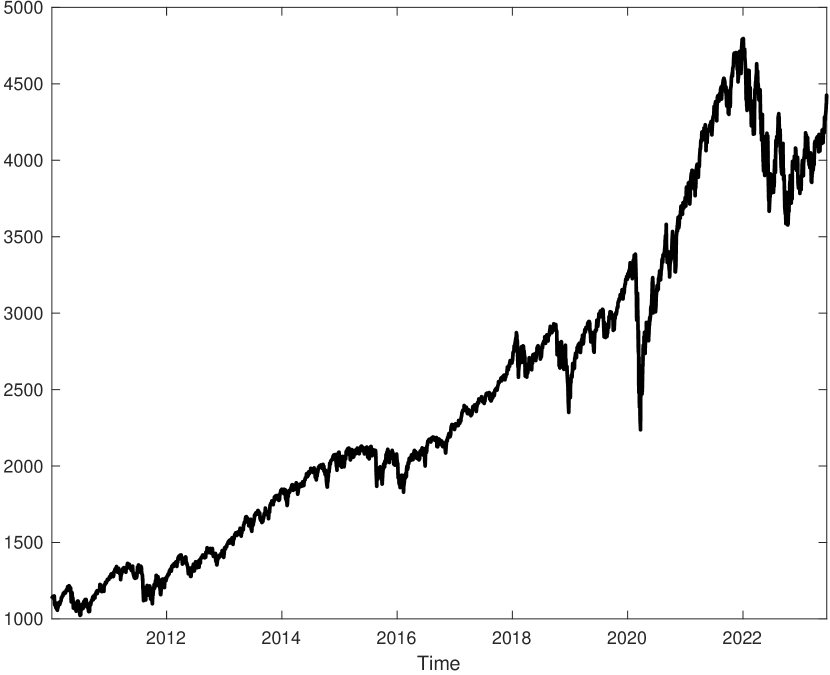
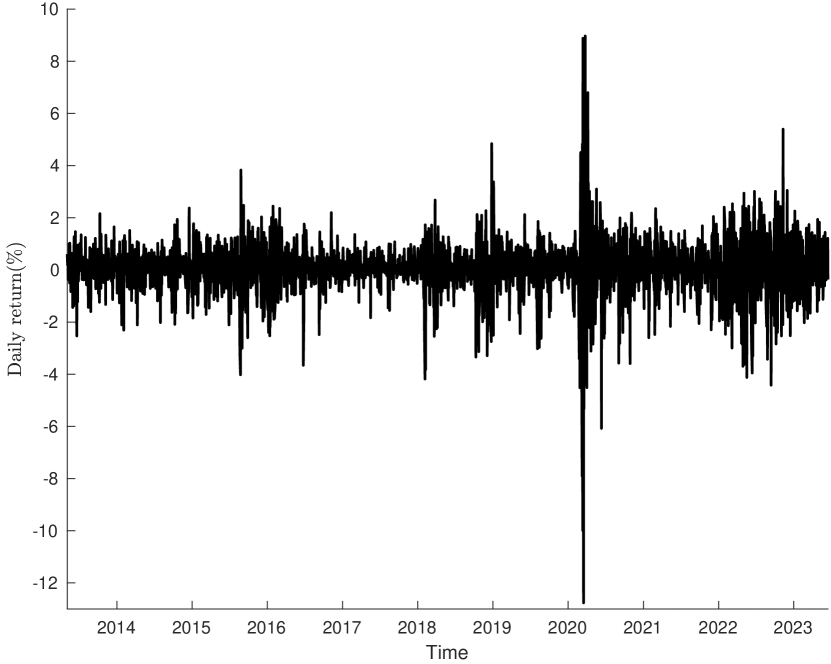
- To empirically calibrate the seven-parameter GTS distribution to S&P 500 index return data.
- To compare option pricing performance between the Black-Scholes model and the GTS-based model across varying moneyness and time to maturity.
- To validate two computational methods—FRFT and 12-point Composite Newton-Cotes Quadrature—for pricing under the GTS framework.
Proposed method
- Empirically fits the seven-parameter GTS distribution to historical S&P 500 index returns to model log asset price dynamics.
- Applies the Esscher transform to derive the Equivalent Martingale Measure (EMM), ensuring the GTS distribution preserves its structure under the risk-neutral measure.
- Employs the Extended Black-Scholes Formula using the cumulative distribution function (CDF) computed via the Fractional Fast Fourier Transform (FRFT) algorithm.
- Uses the 12-point rule Composite Newton-Cotes Quadrature to compute the Generalized Black-Scholes Formula as a numerical benchmark.
- Validates consistency between the two computational methods by comparing option prices to two decimal places.
- Analyzes the pricing error between the Black-Scholes model and the GTS-based model across a range of moneyness levels and maturities.
Experimental results
Research questions
- RQ1How does the GTS distribution improve option pricing accuracy compared to the Black-Scholes model in capturing stylized features of asset returns?
- RQ2To what extent do the FRFT and Composite Newton-Cotes Quadrature methods yield consistent European option prices under the GTS framework?
- RQ3How does the pricing discrepancy between the Black-Scholes model and the GTS model vary with option moneyness and time to maturity?
- RQ4Does the Black-Scholes model systematically underprice or overprice options relative to the GTS model across different moneyness regimes?
- RQ5What is the magnitude and pattern of the pricing error between the Black-Scholes and GTS-based models, particularly for deep in-the-money and deep out-of-the-money options?
Key findings
- The FRFT and 12-point Composite Newton-Cotes Quadrature methods produce identical European option prices under the GTS distribution to two decimal places, confirming numerical robustness.
- The Black-Scholes model underprices near-the-money (NTM) and in-the-money (ITM) options when compared to the GTS-based model, indicating a significant pricing bias in the BS framework.
- For deep out-of-the-money (OTM) and deep-in-the-money (ITM) options, the Black-Scholes and GTS-based models yield the same option price, suggesting convergence in extreme moneyness regimes.
- The pricing error between the Black-Scholes and GTS models is positive (i.e., BS overprices) for out-of-the-money options and negative (i.e., BS underprices) for at-the-money and in-the-money options, consistent with findings under the Variance-Gamma process.
- The magnitude of the pricing error under the GTS model is slightly different from that observed under the Variance-Gamma process, indicating distinct tail and skewness dynamics in the two models.
- The Equivalent Martingale Measure (EMM) exists for the GTS distribution, and the Esscher transform preserves the GTS structure, validating its use in risk-neutral pricing.
Better researchstarts right now
From reading papers to final review, dramatically reduce your research time.
No credit card · Free plan available
This review was created by AI and reviewed by human editors.