
[Paper Review] Evidence for an $η_c(1S) π^-$ resonance in $B^0 o η_c(1S) K^+π^-$ decays
This paper presents evidence for a new exotic resonance decaying into $\eta_c(1S)\pi^-$ in $B^0 \to \eta_c(1S)K^+\pi^-$ decays using a Dalitz plot analysis of 4.7 fb$^{-1}$ of LHCb data at $\sqrt{s} = 7$, 8, and 13 TeV. The resonance has a mass of $4096 \pm 20^{+18}_{-22}$ MeV and a width of $152 \pm 58^{+60}_{-35}$ MeV, with significance exceeding three standard deviations, supporting its interpretation as a charmonium-like state with $J^P = 0^+$ or $1^-$. The first measurement of the $B^0 \to \eta_c(1S)K^+\pi^-$ branching fraction is also reported as $(5.73 \pm 0.24 \pm 0.13 \pm 0.66) \times 10^{-4}$. This observation provides critical input for understanding exotic hadron spectroscopy, particularly the $\eta_c\pi^-$ system predicted by lattice QCD and diquark models.
A Dalitz plot analysis of $B^0 o η_c(1S) K^+π^-$ decays is performed using data samples of $pp$ collisions collected with the LHCb detector at centre-of-mass energies of $\sqrt{s}=7,~8$ and $13$ TeV, corresponding to a total integrated luminosity of $4.7~ ext{fb}^{-1}$. A satisfactory description of the data is obtained when including a contribution representing an exotic $η_c(1S) π^-$ resonant state. The significance of this exotic resonance is more than three standard deviations, while its mass and width are $4096 \pm 20~^{+18}_{-22}$ MeV and $152 \pm 58~^{+60}_{-35}$ MeV, respectively. The spin-parity assignments $J^P=0^+$ and $J^{P}=1^-$ are both consistent with the data. In addition, the first measurement of the $B^0 o η_c(1S) K^+π^-$ branching fraction is performed and gives $\displaystyle \mathcal{B}(B^0 o η_c(1S) K^+π^-) = (5.73 \pm 0.24 \pm 0.13 \pm 0.66) imes 10^{-4}$, where the first uncertainty is statistical, the second systematic, and the third is due to limited knowledge of external branching fractions.
Motivation & Objective
- To search for exotic resonances in the $\eta_c(1S)\pi^-$ final state within $B^0 \to \eta_c(1S)K^+\pi^-$ decays.
- To test theoretical predictions of charmonium-like states decaying into $\eta_c(1S)\pi^-$, such as those from lattice QCD and diquark models.
- To perform the first measurement of the $B^0 \to \eta_c(1S)K^+\pi^-$ branching fraction.
- To validate the presence of a new resonance through a Dalitz plot amplitude analysis using a combined data sample from Run 1 and Run 2 of the LHC.
Proposed method
- A Dalitz plot analysis is performed on $B^0 \to \eta_c(1S)K^+\pi^-$ decays using 4.7 fb$^{-1}$ of $pp$ collision data at $\sqrt{s} = 7$, 8, and 13 TeV collected by the LHCb detector.
- The $\eta_c(1S)$ is reconstructed via its $p\bar{p}$ decay mode, and the Dalitz plot is constructed using the invariant masses $m(K^+\pi^-)$, $m(\eta_c(1S)\pi^-)$, and $m(\eta_c(1S)K^+)$.
- A partial-wave amplitude analysis is implemented, including a resonant contribution for an exotic $\eta_c(1S)\pi^-$ state with $J^P = 0^+$ or $1^-$, using Blatt-Weisskopf barrier factors and angular momentum-dependent phase-space corrections.
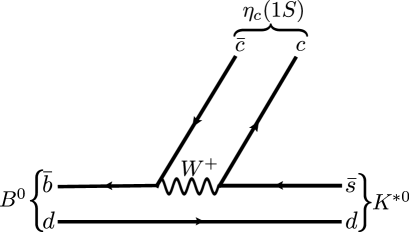
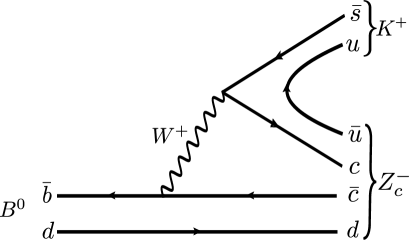
- The fit model includes both $K^{*0}$-mediated and $Z_c^-$-mediated decay diagrams, with the latter introducing a new resonance in the $\eta_c(1S)\pi^-$ system.
- Systematic uncertainties are evaluated by varying signal and background models, resonance parameters, and external branching fractions.
- The significance of the resonance is assessed using a profile-likelihood ratio test, with the null hypothesis tested against the signal-plus-background model.
Experimental results
Research questions
- RQ1Does a resonance in the $\eta_c(1S)\pi^-$ final state appear in the Dalitz plot of $B^0 \to \eta_c(1S)K^+\pi^-$ decays?
- RQ2Is the observed resonance consistent with theoretical predictions of exotic charmonium-like states, such as those from lattice QCD or diquark models?
- RQ3What are the mass and width of the new resonance, and what are the allowed spin-parity quantum numbers?
- RQ4How does the inclusion of the $\eta_c(1S)\pi^-$ resonance improve the fit to the Dalitz plot data compared to a non-resonant model?
- RQ5What is the measured branching fraction of the $B^0 \to \eta_c(1S)K^+\pi^-$ decay?
Key findings
- A resonance in the $\eta_c(1S)\pi^-$ system is observed with a significance exceeding three standard deviations, providing strong evidence for a new exotic state.
- The resonance has a mass of $4096 \pm 20^{+18}_{-22}$ MeV and a width of $152 \pm 58^{+60}_{-35}$ MeV, consistent with predictions from lattice QCD and diquark models.
- Both $J^P = 0^+$ and $J^P = 1^-$ spin-parity assignments are consistent with the data, though the $0^+$ state is more strongly supported by theoretical expectations.
- The first measurement of the $B^0 \to \eta_c(1S)K^+\pi^-$ branching fraction is $ (5.73 \pm 0.24 \pm 0.13 \pm 0.66) \times 10^{-4} $, with uncertainties from statistics, systematics, and external branching fractions.
- The Dalitz plot analysis shows a significant improvement in fit quality when including the $\eta_c(1S)\pi^-$ resonance, as confirmed by Legendre moment comparisons and 2D pull distributions.
- The observed resonance is consistent with the predicted $I^G(J^P) = 1^-(0^+)$ state from lattice QCD, which decays into $\eta_c(1S)\pi^-$, supporting its exotic nature.
Read this paper
Open the full text in the Nubint reader and ask about any passage as you read.
Read this paper on NubintThis review was generated by AI from the original paper. Please check the paper before citing it.