
[Paper Review] Evidence of the quantum-optical nature of high-harmonic generation
This paper provides experimental evidence that high-harmonic generation (HHG) in semiconductors produces non-classical light, demonstrating two-mode squeezing and violation of the Cauchy-Schwarz inequality through second-order intensity correlation measurements. Using a commercial fiber laser and standard semiconductors, the study reveals a transition from super-Poissonian to Poissonian photon statistics with increasing laser intensity, confirming multipartite entanglement and establishing HHG as a room-temperature platform for broadband, multimode quantum light.
High-harmonic generation is a light up-conversion process occurring in a strong laser field, leading to coherent bursts of extreme ultrashort broadband radiation [1]. As a new perspective, we propose that ultrafast strong-field electronic or photonic processes such as high-harmonic generation can potentially generate non-classical states of light well before the decoherence of the system occurs [2, 3]. This could address fundamental challenges in quantum technology such as scalability, decoherence or the generation of massively entangled states [4]. Here, we report experimental evidence of the non-classical nature of the harmonic emission in several semiconductors excited by a femtosecond infrared laser. By investigating single- and double beam intensity cross-correlation [5], we measure characteristic, non-classical features in the single photon statistics. We observe two-mode squeezing in the generated harmonic radiation, which depends on the laser intensity that governs the transition from Super-Poissonian to Poissonian photon statistics. The measured violation of the Cauchy-Schwarz inequality realizes a direct test of multipartite entanglement in high-harmonic generation [6]. This result is supported by the theory of multimodal detection and the Hamiltonian from which the effective squeezing modes of the harmonics can be derived [7, 8]. With this work, we show experimentally that high-harmonic generation is a new quantum bosonic platform that intrinsically produces non-classical states of light with unique features such as multipartite broadband entanglement or multimode squeezing. The source operates at room temperature using standard semiconductors and a standard commercial fiber laser, opening new routes for the quantum industry, such as optical quantum computing, communication and imaging.
Motivation & Objective
- To investigate the quantum optical nature of high-harmonic generation (HHG) in semiconductors as a source of non-classical light.
- To test whether HHG can generate non-classical states such as squeezed or entangled photons before decoherence occurs.
- To demonstrate experimentally that HHG produces multipartite entanglement and multimode squeezing using standard, compact laser and semiconductor systems.
- To validate the presence of non-classical correlations through direct measurement of second-order intensity correlation functions.
- To explore the feasibility of using HHG as a scalable, room-temperature platform for quantum photonic technologies.
Proposed method
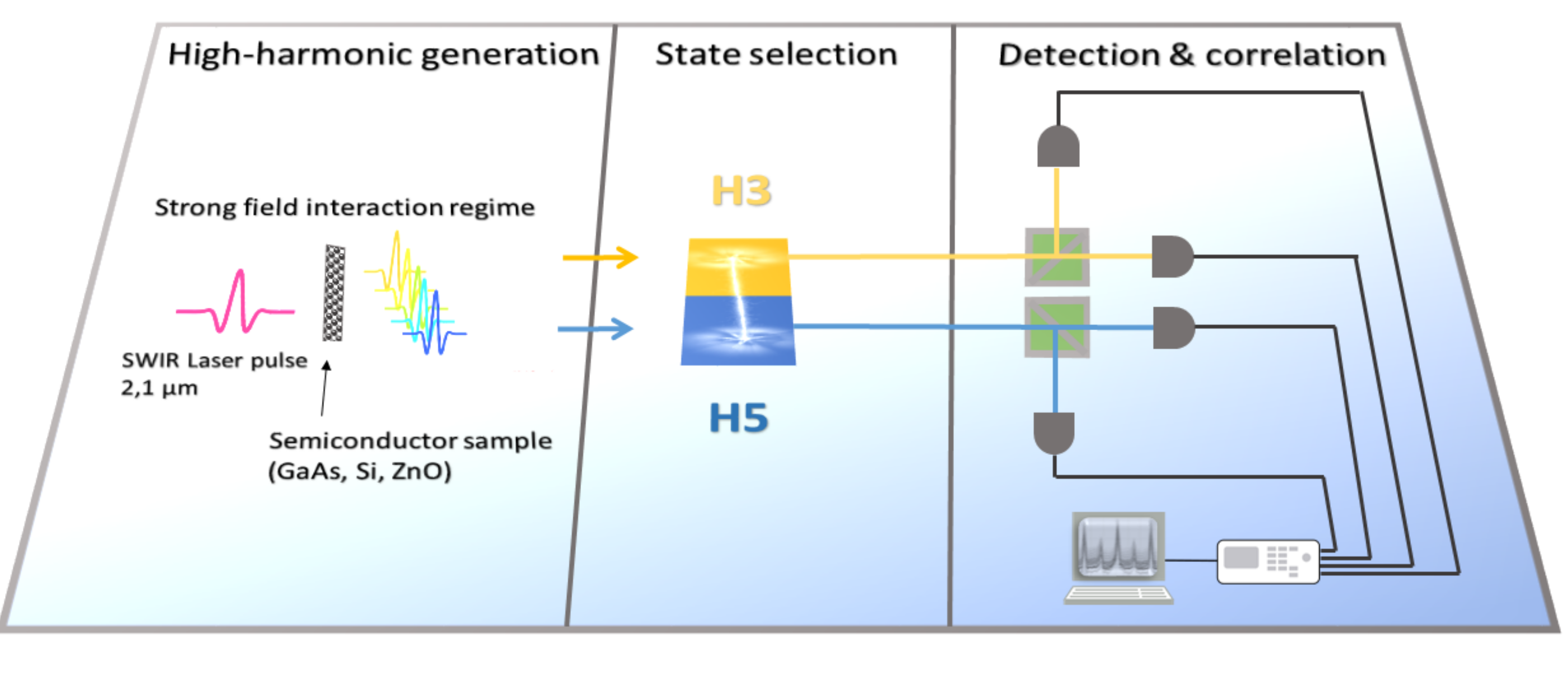
- Employed a femtosecond infrared fiber laser to drive high-harmonic generation in ZnO, Si, and GaAs at room temperature.
- Performed single- and double-beam Hanbury Brown and Twiss (HBT) intensity cross-correlation measurements to extract second-order correlation functions $g^{(2)}$.
- Measured photon statistics via single-photon counting to detect deviations from classical behavior, including super-Poissonian and Poissonian statistics.
- Calculated the $R$ parameter from experimental data to test violation of the classical Cauchy-Schwarz inequality, a signature of non-classical multimode correlations.
- Used spectral filtering and polarization control to isolate specific harmonic orders (H3 and H5) and minimize background noise.
- Conducted loss-tolerant $g^{(2)}$ measurements by introducing controlled optical losses to verify robustness of the non-classical signal.
Experimental results
Research questions
- RQ1Can high-harmonic generation in semiconductors produce non-classical states of light such as squeezed or entangled photons?
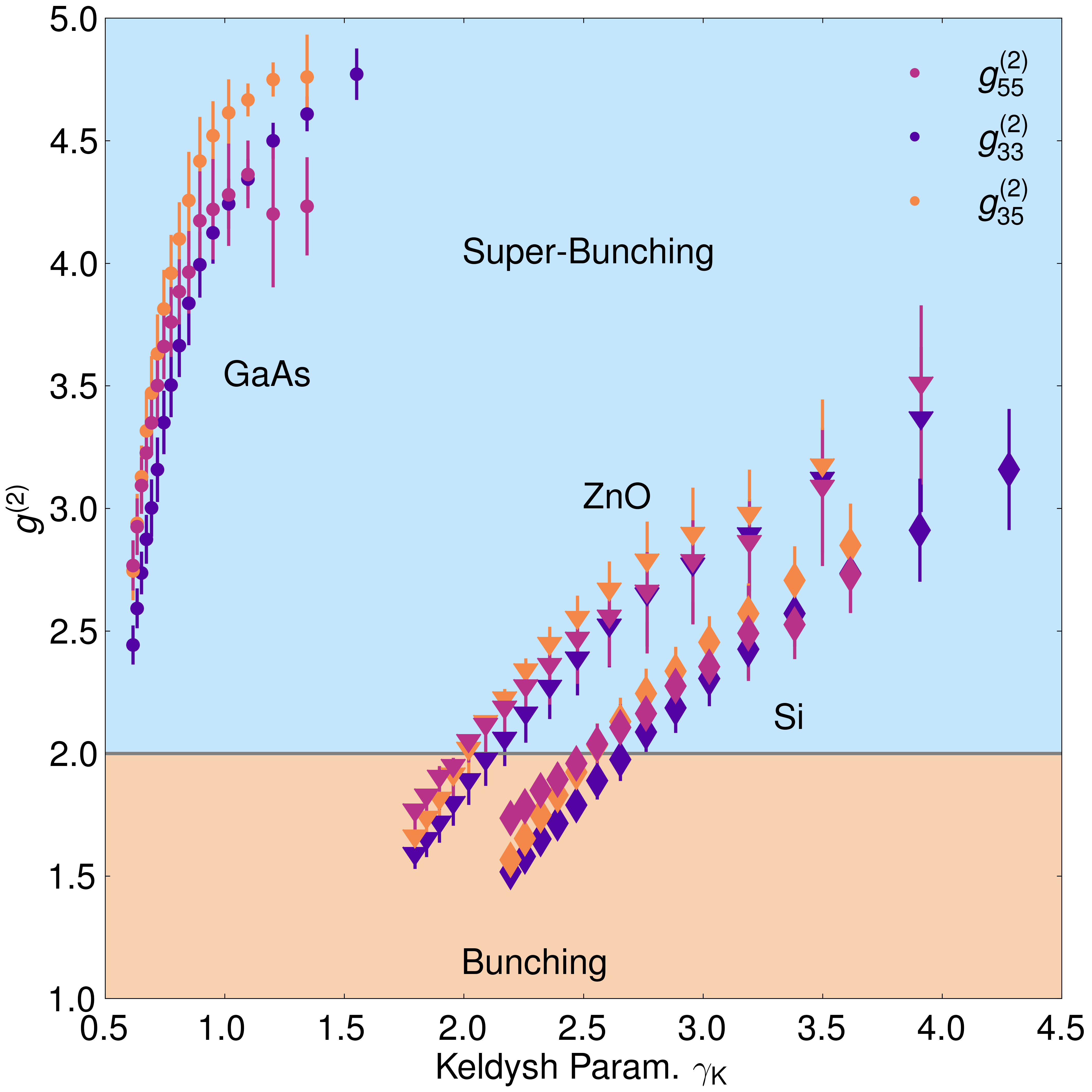
- RQ2How does the photon statistics (e.g., $g^{(2)}$) of the harmonic emission evolve with increasing laser intensity?
- RQ3Is there experimental evidence of multipartite entanglement in high-harmonic emission, as indicated by violation of the Cauchy-Schwarz inequality?
- RQ4Can non-classical features in HHG be observed using standard, commercially available lasers and semiconductors at room temperature?
- RQ5To what extent are the measured quantum optical properties robust against optical losses in the detection chain?
Key findings
- The second-order correlation function $g^{(2)}$ for harmonic emission in ZnO and Si decreases from super-Poissonian ($g^{(2)} > 2$) to Poissonian ($g^{(2)} \approx 1$) with increasing laser intensity, indicating a transition from classical to non-classical photon statistics.
- Violation of the classical Cauchy-Schwarz inequality was experimentally observed, with $R > 1$ across multiple samples (ZnO, Si, GaAs), confirming the presence of non-classical multimode correlations.
- The $R$ parameter exceeded the classical limit of 1 for all measured harmonic pairs (H3–H5), demonstrating direct evidence of multipartite entanglement in the harmonic emission.
- The photon statistics and $g^{(2)}$ values remained stable under controlled optical losses, confirming the robustness of the non-classical signal to detector noise and attenuation.
- The transition from perturbative to non-perturbative HHG regime was clearly marked by a crossover in harmonic photon yield, correlating with the change in $g^{(2)}$ behavior.
- The results were consistent across three different semiconductors (ZnO, Si, GaAs), with GaAs showing stronger bunching, indicating material-dependent non-classical features.
Read this paper
Open the full text in the Nubint reader and ask about any passage as you read.
Read this paper on NubintThis review was generated by AI from the original paper. Please check the paper before citing it.