
[Paper Review] evosax: JAX-based Evolution Strategies
evosax is a JAX-based library that enables high-performance, hardware-accelerated evolution strategies (ES) by leveraging JAX's JIT compilation, automatic vectorization, and multi-device parallelism. It supports 30 ES algorithms—including finite-difference, natural evolution strategies, and genetic algorithms—enabling scalable black-box optimization on GPUs and TPUs with a single-line parallelization command.
The deep learning revolution has greatly been accelerated by the 'hardware lottery': Recent advances in modern hardware accelerators and compilers paved the way for large-scale batch gradient optimization. Evolutionary optimization, on the other hand, has mainly relied on CPU-parallelism, e.g. using Dask scheduling and distributed multi-host infrastructure. Here we argue that also modern evolutionary computation can significantly benefit from the massive computational throughput provided by GPUs and TPUs. In order to better harness these resources and to enable the next generation of black-box optimization algorithms, we release evosax: A JAX-based library of evolution strategies which allows researchers to leverage powerful function transformations such as just-in-time compilation, automatic vectorization and hardware parallelization. evosax implements 30 evolutionary optimization algorithms including finite-difference-based, estimation-of-distribution evolution strategies and various genetic algorithms. Every single algorithm can directly be executed on hardware accelerators and automatically vectorized or parallelized across devices using a single line of code. It is designed in a modular fashion and allows for flexible usage via a simple ask-evaluate-tell API. We thereby hope to facilitate a new wave of scalable evolutionary optimization algorithms.
Motivation & Objective
- Address the underutilization of modern hardware accelerators (GPUs/TPUs) in evolutionary computation, which has historically relied on CPU-based parallelism.
- Enable efficient, scalable black-box optimization (BBO) by porting evolution strategies to JAX’s high-performance computational stack.
- Facilitate next-generation evolutionary algorithms through hardware-parallel execution, automatic vectorization, and modular design.
- Support diverse optimization workloads, including neuroevolution, meta-learning, and architecture search, by providing extensible utilities and encodings.
- Bridge the gap between gradient-based deep learning and derivative-free optimization by making ES natively compatible with modern accelerator hardware.
Proposed method
- Implement evolution strategies in JAX to exploit JIT compilation, automatic differentiation, and hardware-parallel execution across devices.
- Expose a modular ask-evaluate-tell API that allows seamless integration with any objective function, including stochastic rollouts and neural network evaluations.
- Support 30 distinct ES algorithms, including finite-difference gradient-based methods (e.g., OpenAI-ES, ARS), natural evolution strategies (e.g., SNES, xNES), and CMA-ES variants.
- Integrate hardware-parallel execution via JAX’s `pmap` and `vmap` for batched ES runs across multiple random seeds or hyperparameter settings with a single line of code.
- Provide utilities for parameter reshaping (e.g., from flat vectors to neural network weights), fitness shaping (z-scoring, rank-based), and indirect encodings (e.g., hypernetworks, random matrix projections).
- Enable efficient execution on large-scale problems through optimized memory usage and support for sub-population distribution across devices using JAX’s collective operations (e.g., `pmean`).
Experimental results
Research questions
- RQ1Can evolution strategies be efficiently accelerated on modern hardware accelerators (GPUs/TPUs) using JAX’s functional programming stack?
- RQ2To what extent can JAX’s automatic vectorization and hardware parallelization improve the throughput and scalability of black-box optimization?
- RQ3How do JAX-compiled evolution strategies compare in performance and stability to traditional CPU-based implementations across diverse optimization tasks?
- RQ4Can modular, composable utilities in evosax enable new research directions in meta-learned evolution strategies and indirect encoding?
- RQ5What is the impact of hardware acceleration on the convergence and sample efficiency of ES in high-dimensional, non-differentiable optimization problems?
Key findings
- evosax enables full hardware acceleration of evolution strategies via JAX’s JIT compilation and multi-device parallelism, reducing wall-clock training time for large-scale ES runs.
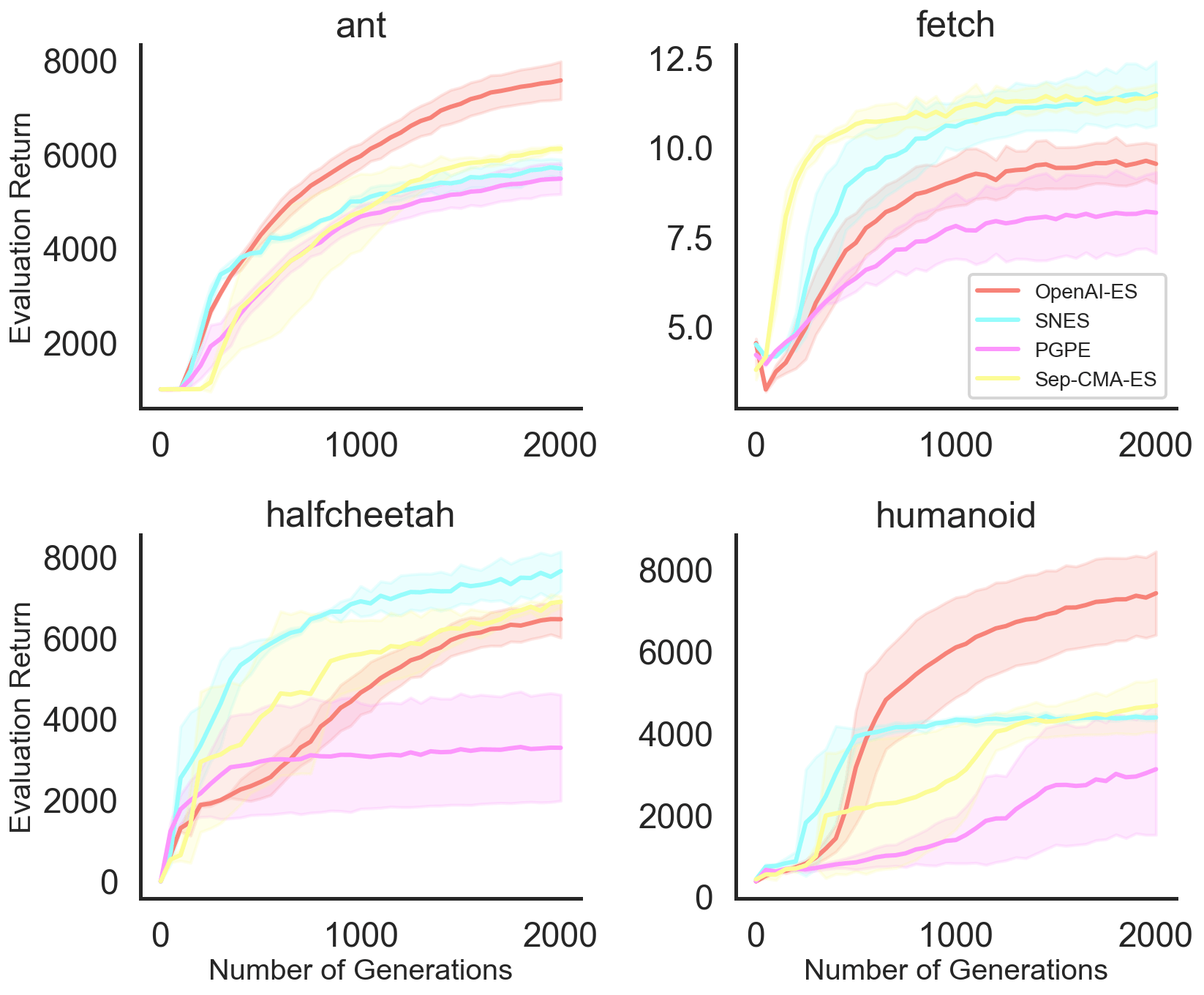
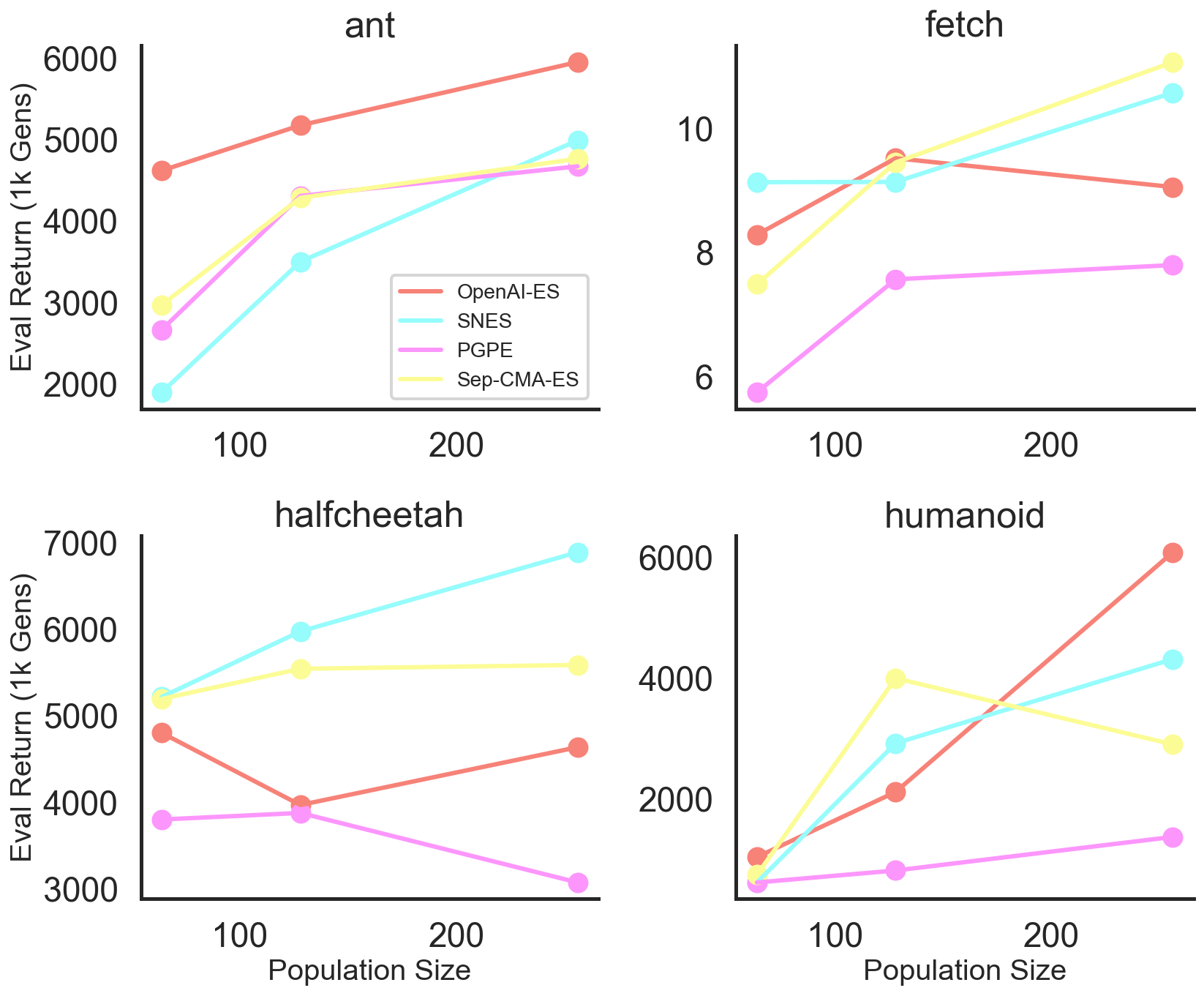
- The library supports 30 diverse evolution strategies, including finite-difference, natural evolution, and CMA-ES variants, with consistent performance across continuous control tasks using the Brax environment.
- Experiments on four neuroevolution tasks show that JAX-compiled ES (e.g., OpenAI-ES, SNES, Sep-CMA-ES) achieve stable and reproducible performance with minimal code changes.
- Single-line parallelization via `pmap` allows users to run multiple ES instances across different random seeds or hyperparameters with no architectural changes.
- Fitness shaping, parameter reshaping, and indirect encoding utilities significantly streamline the integration of ES with deep learning pipelines and complex architectures.
- The library’s modular design enables advanced research directions such as learned evolution strategies, sub-population management, and strategy ensembling, previously limited by computational bottlenecks.
Read this paper
Open the full text in the Nubint reader and ask about any passage as you read.
Read this paper on NubintThis review was generated by AI from the original paper. Please check the paper before citing it.