
[Paper Review] Expansion-Squeeze-Excitation Fusion Network for Elderly Activity Recognition
This paper proposes an Expansion-Squeeze-Excitation Fusion Network (ESE-FN) that enhances elderly activity recognition by learning modal- and channel-wise attention mechanisms to fuse RGB and skeleton features. The method achieves state-of-the-art accuracy of 96.7% on the large-scale ETRI-Activity3D dataset, outperforming existing methods through a novel multi-modal loss and dual-attention fusion strategy.
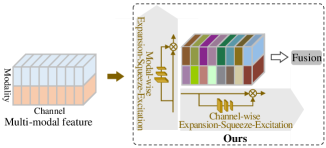
This work focuses on the task of elderly activity recognition, which is a challenging task due to the existence of individual actions and human-object interactions in elderly activities. Thus, we attempt to effectively aggregate the discriminative information of actions and interactions from both RGB videos and skeleton sequences by attentively fusing multi-modal features. Recently, some nonlinear multi-modal fusion approaches are proposed by utilizing nonlinear attention mechanism that is extended from Squeeze-and-Excitation Networks (SENet). Inspired by this, we propose a novel Expansion-Squeeze-Excitation Fusion Network (ESE-FN) to effectively address the problem of elderly activity recognition, which learns modal and channel-wise Expansion-Squeeze-Excitation (ESE) attentions for attentively fusing the multi-modal features in the modal and channel-wise ways. Furthermore, we design a new Multi-modal Loss (ML) to keep the consistency between the single-modal features and the fused multi-modal features by adding the penalty of difference between the minimum prediction losses on single modalities and the prediction loss on the fused modality. Finally, we conduct experiments on a largest-scale elderly activity dataset, i.e., ETRI-Activity3D (including 110,000+ videos, and 50+ categories), to demonstrate that the proposed ESE-FN achieves the best accuracy compared with the state-of-the-art methods. In addition, more extensive experimental results show that the proposed ESE-FN is also comparable to the other methods in terms of normal action recognition task.
Motivation & Objective
- To address the challenge of recognizing subtle, similar elderly activities involving human-object interactions and low-amplitude movements.
- To improve feature fusion between RGB videos and skeleton sequences by capturing discriminative spatiotemporal patterns across modalities.
- To design a learnable attention mechanism that models both inter-modal and inter-channel dependencies for enhanced feature representation.
- To ensure consistency between single-modal and fused multi-modal predictions through a novel multi-modal loss function.
- To validate generalization by evaluating performance on a standard normal action recognition benchmark (NTU RGB+D).
Proposed method
- Proposes a dual-attention mechanism: Modal-wise ESE Attention (M-ESEA) to fuse features across RGB and skeleton modalities.
- Introduces Channel-wise ESE Attention (C-ESEA) to enhance discriminative power by modeling channel-wise dependencies in fused features.
- Employs a two-stage fusion pipeline: first modal-wise fusion via M-Net, then channel-wise fusion via C-Net.
- Designs a Multi-modal Loss (ML) that penalizes the difference between the minimum single-modal prediction loss and the fused modality's prediction loss to enforce consistency.
- Uses a two-branch backbone network to extract RGB and skeleton features independently before fusion.
- Applies expansion and squeezing operations to model both local and global feature interactions, extending the SENet family with up-sampling and down-sampling behavior.
Experimental results
Research questions
- RQ1Can a dual-attention fusion mechanism that operates simultaneously on modal and channel dimensions improve elderly activity recognition performance?
- RQ2How effective is the proposed Multi-modal Loss in maintaining consistency between single-modal and fused predictions?
- RQ3Does the ESE-FN generalize to normal action recognition tasks beyond elderly-specific activities?
- RQ4To what extent do the expansion and squeeze operations enhance feature representation compared to standard attention mechanisms?
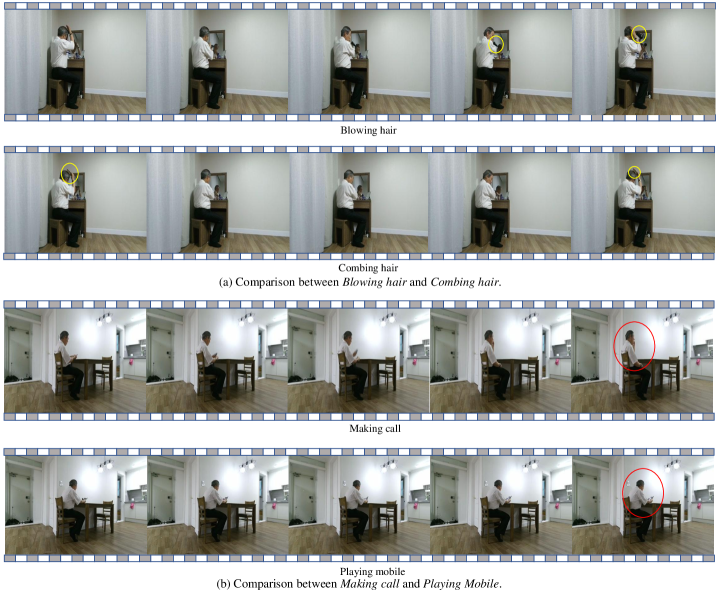
- RQ5How does the model perform on highly challenging, visually similar elderly activities such as 'blowing hair' vs 'combing hair'?
Key findings
- ESE-FN achieves a state-of-the-art accuracy of 96.7% on the ETRI-Activity3D dataset, surpassing existing methods.
- The model improves by 0.7% and 0.2% over the SOTA methods on the NTU RGB+D dataset under Cross-Subject and Cross-View protocols, respectively.
- The confusion matrices on NTU RGB+D show strong class-wise recognition performance, with main diagonals consistently lighter, indicating high recognition accuracy across all 60 action classes.
- The ablation study confirms that both M-ESEA and C-ESEA components contribute significantly to performance gain, validating the effectiveness of dual-attention fusion.
- The proposed Multi-modal Loss effectively stabilizes training and improves generalization by enforcing consistency between single-modal and fused predictions.
- The model demonstrates robustness on fine-grained, similar elderly activities such as 'making a call' vs 'playing mobile', where only subtle hand movements or object interactions differ.
Read this paper
Open the full text in the Nubint reader and ask about any passage as you read.
Read this paper on NubintThis review was generated by AI from the original paper. Please check the paper before citing it.