
[Paper Review] Experimental analysis of energy transfers between a quantum emitter and light fields
This paper experimentally measures unitary and correlation energy transfers between a quantum emitter and light fields using a semiconductor quantum dot in a microcavity. By performing self-homodyne measurements during spontaneous emission, the authors observe that unitary energy transfer is limited to ~50% of total energy, decreasing with dephasing, and demonstrate that interference with a classical field reveals quantum purity dependence of energy exchange.
Energy transfer between quantum systems can either be achieved through an effective unitary interaction or through the generation of entanglement. This observation defines two types of energy exchange: unitary and correlation energy. Here we propose and implement experimental protocols to access these energy transfers in interactions between a quantum emitter and light fields. Upon spontaneous emission, we measure the unitary energy transfer from the emitter to the optical field and show that it never exceeds half of the total energy and is reduced when introducing decoherence. We then study the interference of the emitted field and a laser field at a beam splitter and show that the energy transfers quantitatively depend on the quantum purity of the emitted field.
Motivation & Objective
- To experimentally probe the distinction between unitary and correlation energy in quantum energy transfer processes.
- To measure the fraction of unitary energy transferred during spontaneous emission from a quantum emitter to a photonic field.
- To investigate how quantum coherence and purity affect energy exchange in closed quantum systems.
- To demonstrate experimentally that energy transfer efficiency depends on the quantum nature of the emitted field.
- To validate theoretical predictions on the maximum 50% unitary energy transfer limit in spontaneous emission.
Proposed method
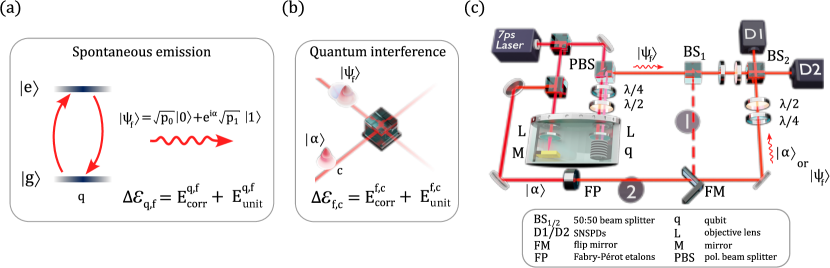
- Use of a single InGaAs/GaAs quantum dot embedded in an optical microcavity as a tunable quantum emitter.
- Implementation of self-homodyne interferometry to measure the unitary energy fraction via interference of emitted photons with a delayed copy of themselves.
- Employment of a beam splitter to interfere the spontaneously emitted photonic field with a coherent classical field derived from the same laser source.
- Use of superconducting nanowire single-photon detectors (SNSPDs) to record output intensities in both interference configurations.
- Control of quantum emitter coherence via temperature tuning to study dephasing effects on energy transfer.
- Quantitative analysis of photonic state purity using second-order correlation functions and indistinguishability metrics.
Experimental results
Research questions
- RQ1What fraction of the total energy transferred during spontaneous emission is unitary, and does it reach the theoretical 50% limit?
- RQ2How does environmental dephasing, induced by increasing emitter temperature, affect the unitary energy transfer fraction?
- RQ3To what extent does the quantum purity of the emitted photonic field influence the energy exchange with a classical field?
- RQ4Can interference between a quantum field and a coherent classical field quantitatively reveal the correlation energy component?
- RQ5How do first- and second-order field correlations relate to the partitioning of energy into unitary and correlation components?
Key findings
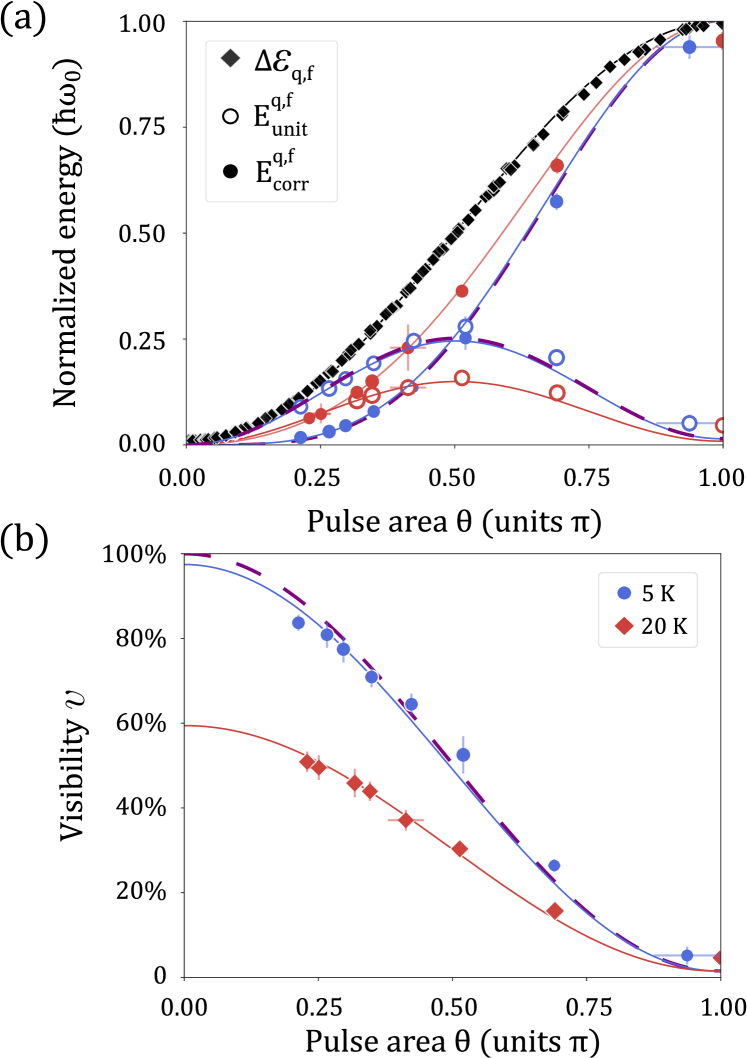
- The experimentally measured unitary energy transfer during spontaneous emission reaches a maximum of approximately 50% of the total energy, consistent with theoretical predictions.
- Increasing the emitter temperature reduces the unitary energy fraction, demonstrating a direct link between dephasing and loss of coherence in energy transfer.
- The energy transfer efficiency in interference with a classical field is quantitatively dependent on the quantum purity of the emitted photonic field, as confirmed by second-order correlation measurements.
- The observed reduction in unitary energy transfer under dephasing is correlated with increased second-order intensity correlation, indicating a loss of single-photon character.
- The measured indistinguishability and number purity of the emitted field show a strong correlation with the energy partitioning, validating the theoretical framework.
- The experimental setup successfully isolates and quantifies both unitary and correlation energy components in a closed bipartite quantum system.
Read this paper
Open the full text in the Nubint reader and ask about any passage as you read.
Read this paper on NubintThis review was generated by AI from the original paper. Please check the paper before citing it.