
[Paper Review] Explainable AI for clinical risk prediction: a survey of concepts, methods, and modalities
This survey proposes a comprehensive framework for explainable AI (XAI) in clinical risk prediction, integrating interpretability, fairness, and transparency across multimodal healthcare data. It advocates for end-to-end validation using synthetic datasets, multi-method explainability, and open science practices to enhance trust, reliability, and clinical adoption.
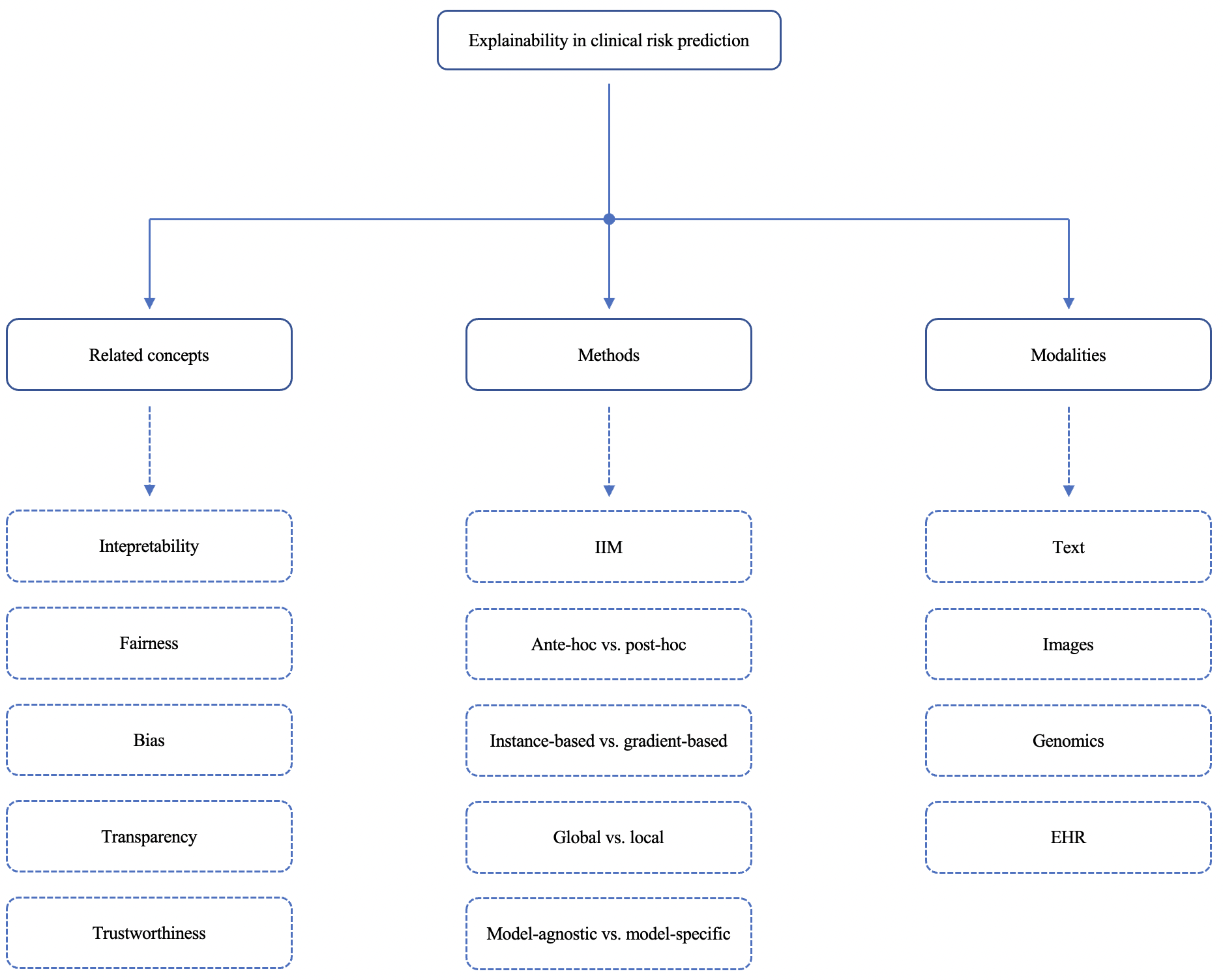
Recent advancements in AI applications to healthcare have shown incredible promise in surpassing human performance in diagnosis and disease prognosis. With the increasing complexity of AI models, however, concerns regarding their opacity, potential biases, and the need for interpretability. To ensure trust and reliability in AI systems, especially in clinical risk prediction models, explainability becomes crucial. Explainability is usually referred to as an AI system's ability to provide a robust interpretation of its decision-making logic or the decisions themselves to human stakeholders. In clinical risk prediction, other aspects of explainability like fairness, bias, trust, and transparency also represent important concepts beyond just interpretability. In this review, we address the relationship between these concepts as they are often used together or interchangeably. This review also discusses recent progress in developing explainable models for clinical risk prediction, highlighting the importance of quantitative and clinical evaluation and validation across multiple common modalities in clinical practice. It emphasizes the need for external validation and the combination of diverse interpretability methods to enhance trust and fairness. Adopting rigorous testing, such as using synthetic datasets with known generative factors, can further improve the reliability of explainability methods. Open access and code-sharing resources are essential for transparency and reproducibility, enabling the growth and trustworthiness of explainable research. While challenges exist, an end-to-end approach to explainability in clinical risk prediction, incorporating stakeholders from clinicians to developers, is essential for success.
Motivation & Objective
- To address the growing need for explainability in complex AI models used for clinical risk prediction, where decisions directly impact patient outcomes.
- To clarify the interplay between explainability, interpretability, fairness, bias, and transparency in clinical AI systems.
- To evaluate and validate XAI methods across diverse clinical modalities such as EHRs, medical imaging, and text using quantitative and clinical assessment.
- To advocate for external validation, synthetic dataset testing, and code sharing to improve reliability and reproducibility in XAI research.
- To promote an end-to-end, stakeholder-inclusive approach—from clinicians and patients to developers—to ensure trust and real-world usability.
Proposed method
- Systematically reviews concepts of explainability, interpretability, fairness, and transparency in clinical AI, distinguishing them from one another.
- Analyzes a range of XAI techniques, including post-hoc methods (e.g., LIME, SHAP), inherently interpretable models (e.g., XGBoost, decision trees), and rule-based systems.
- Proposes using synthetic datasets with known generative factors to rigorously test XAI method reliability before clinical deployment.
- Integrates quantitative evaluation metrics such as AUROC and F1 scores adapted for feature ranking and corruption-based robustness testing.
- Emphasizes the need for multi-method explainability—combining multiple XAI techniques—to improve robustness and reduce bias.
- Calls for open access and code sharing to ensure transparency, reproducibility, and trust in XAI research.
Experimental results
Research questions
- RQ1How can explainable AI methods be systematically evaluated for reliability and validity in clinical risk prediction across different data modalities?
- RQ2What is the relationship between interpretability, fairness, transparency, and trust in AI-driven clinical decision-making?
- RQ3To what extent can synthetic datasets with known underlying factors be used to validate XAI methods in healthcare?
- RQ4How can clinicians and patients be meaningfully involved in the design and evaluation of explainable AI systems?
- RQ5What role do regulatory frameworks and open science practices play in advancing trustworthy and reproducible XAI in healthcare?
Key findings
- Explainable AI is essential for building trust in clinical risk prediction models, especially given the high-stakes consequences of model errors or biases.
- Post-hoc explanation methods alone are insufficient; a combination of multiple interpretability techniques is required for comprehensive model understanding.
- Testing XAI methods on synthetic datasets with known generative factors significantly improves reliability and validation confidence.
- Quantitative evaluation frameworks using corrupted features and ranking metrics (e.g., AUROC, F1) are effective for assessing feature importance explanations.
- Open access and code sharing are critical for reproducibility and long-term trust in XAI research, especially in sensitive domains like healthcare.
- Despite progress, many claims of explainability in clinical AI are exaggerated, and real-world clinical uptake remains limited without rigorous validation and stakeholder engagement.
Read this paper
Open the full text in the Nubint reader and ask about any passage as you read.
Read this paper on NubintThis review was generated by AI from the original paper. Please check the paper before citing it.