
[Paper Review] Exploring Different Time-series-Transformer (TST) Architectures: A Case Study in Battery Life Prediction for Electric Vehicles (EVs)
This study evaluates multiple Time-series-Transformer (TST) architectures—including vanilla-TST, encoder-only TST, and hybrid TST-LSTM models—against a baseline LSTM for predicting battery state-of-charge (SOC) and temperature in electric vehicles using real-world driving data. The vanilla-TST model achieved the highest predictive accuracy, outperforming both LSTM and hybrid architectures, which suffered from information loss due to asymmetric design.
In recent years, battery technology for electric vehicles (EVs) has been a major focus, with a significant emphasis on developing new battery materials and chemistries. However, accurately predicting key battery parameters, such as state-of-charge (SOC) and temperature, remains a challenge for constructing advanced battery management systems (BMS). Existing battery models do not comprehensively cover all parameters affecting battery performance, including non-battery-related factors like ambient temperature, cabin temperature, elevation, and regenerative braking during EV operation. Due to the difficulty of incorporating these auxiliary parameters into traditional models, a data-driven approach is suggested. Time-series-transformers (TSTs), leveraging multiheaded attention and parallelization-friendly architecture, are explored alongside LSTM models. Novel TST architectures, including encoder TST + decoder LSTM and a hybrid TST-LSTM, are also developed and compared against existing models. A dataset comprising 72 driving trips in a BMW i3 (60 Ah) is used to address battery life prediction in EVs, aiming to create accurate TST models that incorporate environmental, battery, vehicle driving, and heating circuit data to predict SOC and battery temperature for future time steps.
Motivation & Objective
- To address the challenge of accurately predicting battery parameters like SOC and temperature in electric vehicles (EVs) under complex, real-world operating conditions.
- To explore the effectiveness of various Time-series-Transformer (TST) architectures—both standard and novel hybrid designs—compared to traditional LSTM models.
- To evaluate whether data-driven TST models can better capture the influence of non-battery-related factors (e.g., ambient temperature, regenerative braking, cabin climate) on battery performance than traditional physics-based models.
- To develop and benchmark a comprehensive set of TST-based models using a real-world dataset of 72 EV driving trips in a BMW i3.
Proposed method
- The study employs a real-world dataset from 72 driving trips in a BMW i3 (60 Ah), collecting battery, vehicle, environmental, and heating system data at high temporal resolution.
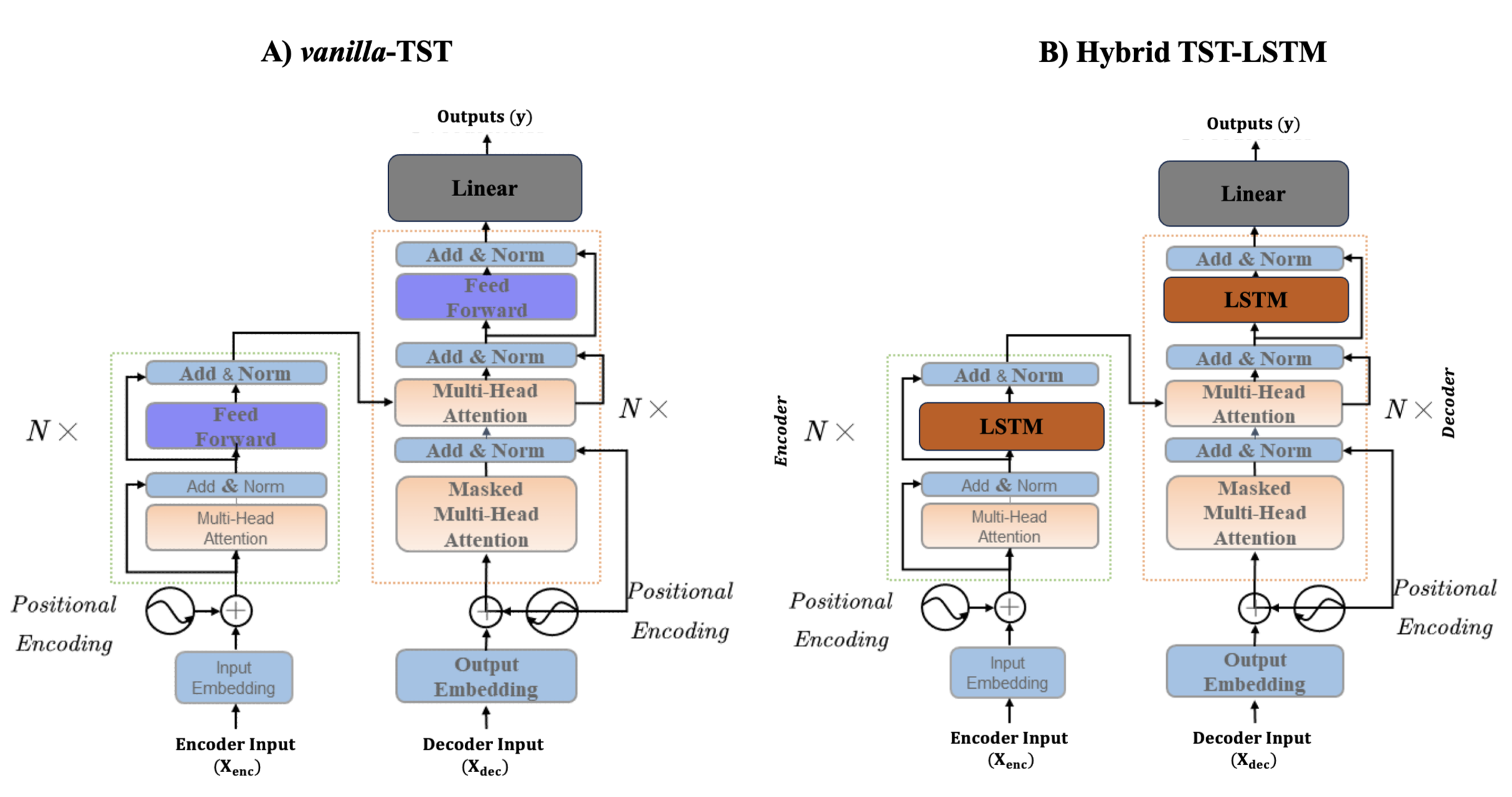
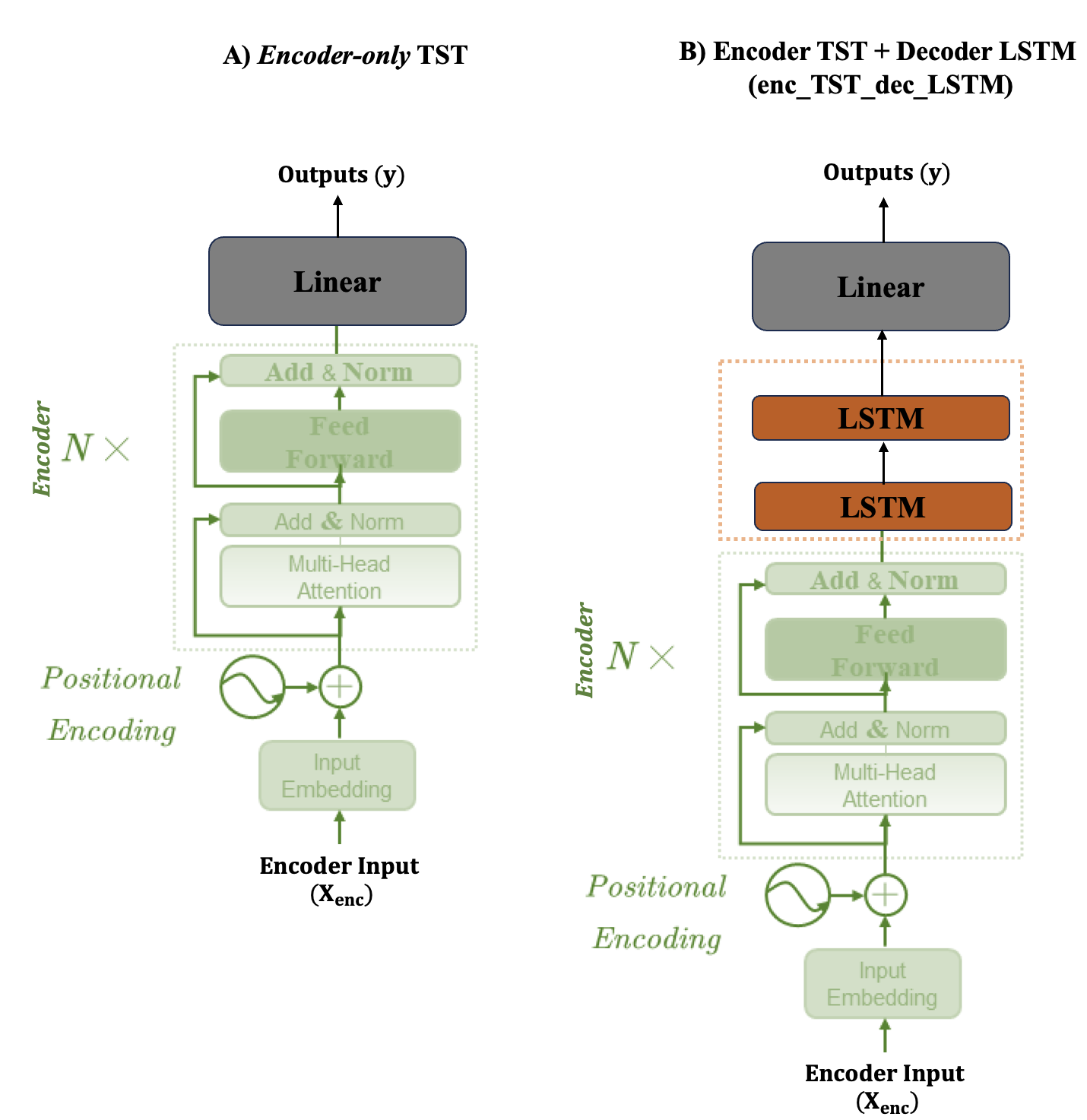
- Four TST-based models are trained: vanilla-TST (decoder-only), encoder-only TST (enc-TST), hybrid TST-LSTM (TST encoder with LSTM decoder), and enc-TST-dec-LSTM (TST encoder with LSTM decoder).
- A standard LSTM model is used as the baseline for comparison.
- Multiheaded self-attention and positional encoding are applied in all TST models to capture long-range temporal dependencies and sequential order.
- Models are trained to predict SOC and battery temperature for future time steps (1 to 5 minutes) using variable-length input sequences (W).
- Model performance is evaluated using mean absolute error (MAE) on test sequences, with results analyzed across different sequence lengths (W).
Experimental results
Research questions
- RQ1How do different TST architectures—vanilla-TST, encoder-only TST, and hybrid TST-LSTM models—compare in predicting SOC and battery temperature in EVs?
- RQ2Does incorporating an LSTM decoder into a TST encoder (e.g., enc-TST-dec-LSTM) improve prediction performance compared to standalone TST or LSTM models?
- RQ3To what extent do longer input sequences (W) improve the predictive accuracy of TST and LSTM models in battery parameter forecasting?
- RQ4Can TST models effectively capture the influence of non-battery-related driving and environmental factors (e.g., ambient temperature, regenerative braking) on battery behavior?
Key findings
- The vanilla-TST (v-TST) model achieved the highest predictive accuracy, outperforming both the baseline LSTM and all hybrid architectures.
- The hybrid TST-LSTM and enc-TST-dec-LSTM models underperformed, with the latter showing the highest testing errors, indicating that architectural asymmetry and information loss in hybrid designs degrade performance.
- All models demonstrated improved accuracy with increasing input sequence length (W), as longer contexts enabled better temporal representation learning.
- The performance ranking across models was: v-TST > LSTM > TST-LSTM > enc-TST > enc-TST-dec-LSTM, highlighting that simpler, more symmetric TST designs are more effective than complex hybrids.
- The results suggest that while TSTs are powerful for time-series modeling, the integration of LSTMs into TST architectures can disrupt attention mechanisms and reduce predictive fidelity.
- The study confirms that data-driven TST models can effectively model complex, multi-source inputs (battery, vehicle, environmental, and heating data) for accurate battery parameter prediction in real-world EV operation.
Read this paper
Open the full text in the Nubint reader and ask about any passage as you read.
Read this paper on NubintThis review was generated by AI from the original paper. Please check the paper before citing it.