
[Paper Review] Exploring Diversity-based Active Learning for 3D Object Detection in Autonomous Driving
This paper proposes a diversity-based active learning method for 3D object detection in autonomous driving that selects informative samples based on spatial and temporal diversity using GPS/IMU data. It outperforms uncertainty-based and random sampling under realistic annotation cost settings, where both frame and 3D bounding box annotation costs are considered, achieving state-of-the-art performance on nuScenes with improved sample efficiency and reduced cold-start issues.
3D object detection has recently received much attention due to its great potential in autonomous vehicle (AV). The success of deep learning based object detectors relies on the availability of large-scale annotated datasets, which is time-consuming and expensive to compile, especially for 3D bounding box annotation. In this work, we investigate diversity-based active learning (AL) as a potential solution to alleviate the annotation burden. Given limited annotation budget, only the most informative frames and objects are automatically selected for human to annotate. Technically, we take the advantage of the multimodal information provided in an AV dataset, and propose a novel acquisition function that enforces spatial and temporal diversity in the selected samples. We benchmark the proposed method against other AL strategies under realistic annotation cost measurement, where the realistic costs for annotating a frame and a 3D bounding box are both taken into consideration. We demonstrate the effectiveness of the proposed method on the nuScenes dataset and show that it outperforms existing AL strategies significantly. Code is available at https://github.com/Linkon87/Exploring-Diversity-based-Active-Learning-for-3D-Object-Detection-in-Autonomous-Driving
Motivation & Objective
- Address the high annotation cost of 3D object detection in autonomous driving by reducing reliance on large-scale human-annotated datasets.
- Overcome the limitations of existing active learning methods in 3D detection, particularly the lack of diversity-based strategies and realistic cost modeling.
- Develop a generalizable acquisition function applicable to all 3D detectors, independent of model architecture or feature extractor quality.
- Mitigate the cold-start problem in active learning by enabling initial batch selection without model predictions.
- Provide a realistic evaluation framework for active learning by modeling both frame-level and instance-level annotation costs.
Proposed method
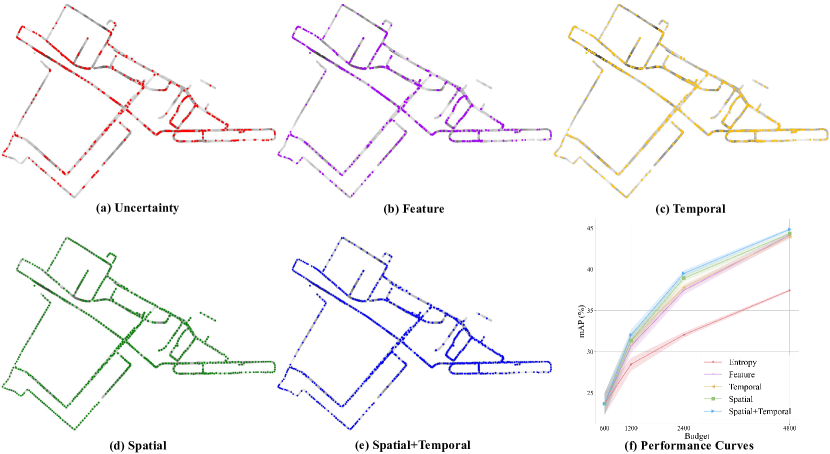
- Propose a novel acquisition function that enforces spatial diversity using GPS/IMU data to select samples from distinct locations.
- Introduce temporal diversity by selecting samples from different time steps to cover varying scene dynamics and object appearances.
- Combine spatial and temporal diversity with feature-based diversity (using deep features) activated only after an initial budget to avoid unreliable early features.
- Define spatial diversity using Euclidean and manifold distances between GPS coordinates, with manifold distance showing superior performance.
- Model annotation cost as a weighted sum of frame cost ($c_f$) and bounding box cost ($c_b$), enabling realistic evaluation across different cost regimes.
- Use a warm-start strategy by leveraging spatial and temporal diversity to select an informative initial batch without relying on model predictions.
Experimental results
Research questions
- RQ1Can diversity-based active learning, particularly in spatial and temporal dimensions, significantly improve 3D object detection performance with reduced annotation cost?
- RQ2How does realistic annotation cost modeling—considering both frame and 3D box annotation costs—affect the evaluation and ranking of active learning strategies?
- RQ3Can the proposed acquisition function effectively address the cold-start problem in active learning for 3D detection without requiring model predictions for the first batch?
- RQ4What is the optimal trade-off between spatial, temporal, and feature-based diversity terms in terms of performance and convergence speed?
- RQ5How robust is the proposed method to localization errors in GPS/IMU data, and can temporal and feature diversity mitigate such limitations?
Key findings
- The proposed Spatial+Temporal diversity method achieves 44.85% mAP on nuScenes at a 4800-cost budget, outperforming the baseline (44.64%) and all other baselines.
- Using manifold distance for spatial diversity yields 43.68% mAP at 4800 cost, outperforming Euclidean distance (42.98%) by 0.7 percentage points.
- Enabling feature diversity after a 1200-cost warm-up yields the best performance (45.02% mAP at 4800), indicating optimal timing for feature integration.
- Setting the feature diversity weight $\lambda_f = 1$ achieves the highest performance, with 45.02% mAP at 4800 cost, while higher or lower values degrade results.
- The proposed method consistently outperforms uncertainty-based and random sampling across all cost measurement settings, including the most realistic one ($c_f=0.6, c_b=0.04$).
- The method reduces the cold-start problem by enabling high-quality initial batch selection through spatial and temporal diversity, leading to faster convergence and better long-term performance.
Read this paper
Open the full text in the Nubint reader and ask about any passage as you read.
Read this paper on NubintThis review was generated by AI from the original paper. Please check the paper before citing it.