
[Paper Review] Exploring the nature of UV-bright $z \gtrsim 10$ galaxies detected by JWST: star formation, black hole accretion, or a non-universal IMF?
The study uses the Cosmic Archaeology Tool (CAT) semi-analytical model to quantify the roles of Pop III/II stars and AGN in the UV luminosity function from z~4 to 20, compares with JWST data, and tests IMF evolution as a solution to tensions at z>10.
We use the Cosmic Archaeology Tool (CAT) semi-analytical model to explore the contribution of Population (Pop) III/II stars and active galactic nuclei (AGNs) to the galaxy UV luminosity function (LF) evolution at $4 \leq z \leq 20$. We compare in particular with recent JWST data in order to explore the apparent tension between observations and theoretical models in the number density of bright galaxies at $z \gtrsim 10$. The model predicts a star formation history dominated by UV faint ($M_{ m UV} > - 18$) galaxies, with a Pop III contribution of $\lesssim 10\%$ ($\lesssim 0.5\%$) at $z \simeq 20$ ($z \simeq 10$). Stars are the primary sources of cosmic reionization, with $5 - 10 \%$ of ionizing photons escaping into the intergalatic medium at $5 \leq z \leq 10$, while the contribution of unobscured AGNs becomes dominant only at $z \lesssim 5$. The predicted stellar and AGN UV LFs reproduce the observational data at $5 \lesssim z \lesssim 9 - 10$. At higher redshift, CAT predicts a steeper evolution in the faint-end slope ($M_{ m UV} > - 18$), and a number density of bright galaxies ($M_{ m UV} \simeq -20$) consistent with data at $z \sim 10 - 11$, but smaller by 0.8 dex at $z \sim 12 - 13$, and 1.2 dex at $z \sim 14 - 16$, when compared to the values estimated by recent studies. Including the AGN emission does not affect the above findings, as AGNs contribute at most to $\lesssim 10 \%$ of the total UV luminosity at $M_{ m UV} < - 19$ and $z \gtrsim 10$. Interestingly, considering a gradual transition in the stellar IMF, modulated by metallicity and redshift as suggested by recent simulations, the model agrees with JWST data at $z \sim 12 - 13$, and the disagreement at $z \sim 14 - 16$ is reduced to 0.5 dex.
Motivation & Objective
- Assess the contributions of Pop III/II stars and AGN to the UV LF evolution from z~4 to 20.
- Evaluate the impact of AGN emission on bright-end UV luminosity at z>10.
- Test a metallicity- and redshift-driven gradual IMF transition on UVLF predictions.
- Compare CAT predictions with JWST observations to identify tensions and possible resolutions.
Proposed method
- Use CAT to generate a large sample of DM merger histories from z=4 to z=24.
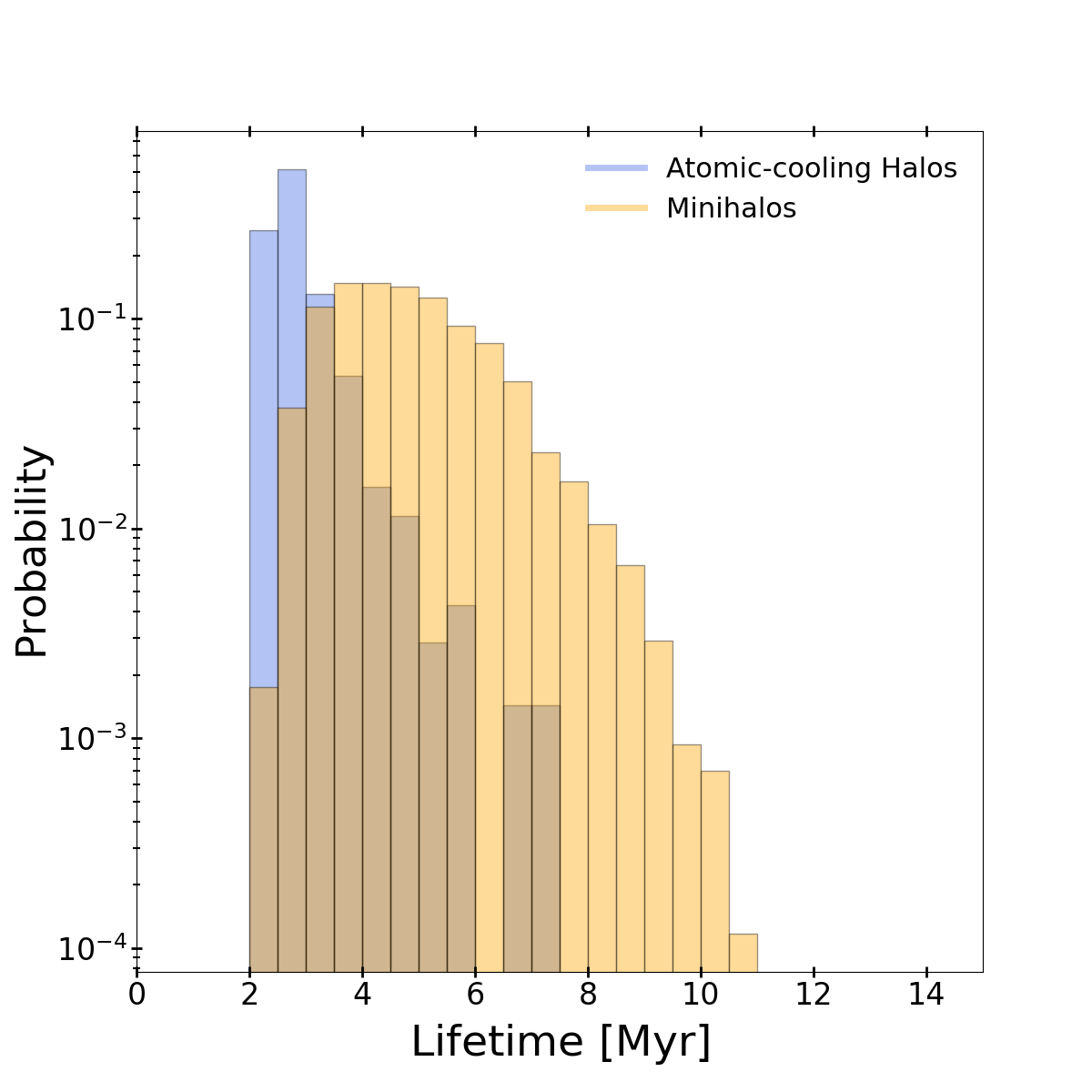
- Model star formation in minihalos and atomic-cooling halos with a calibrated SFR prescription.
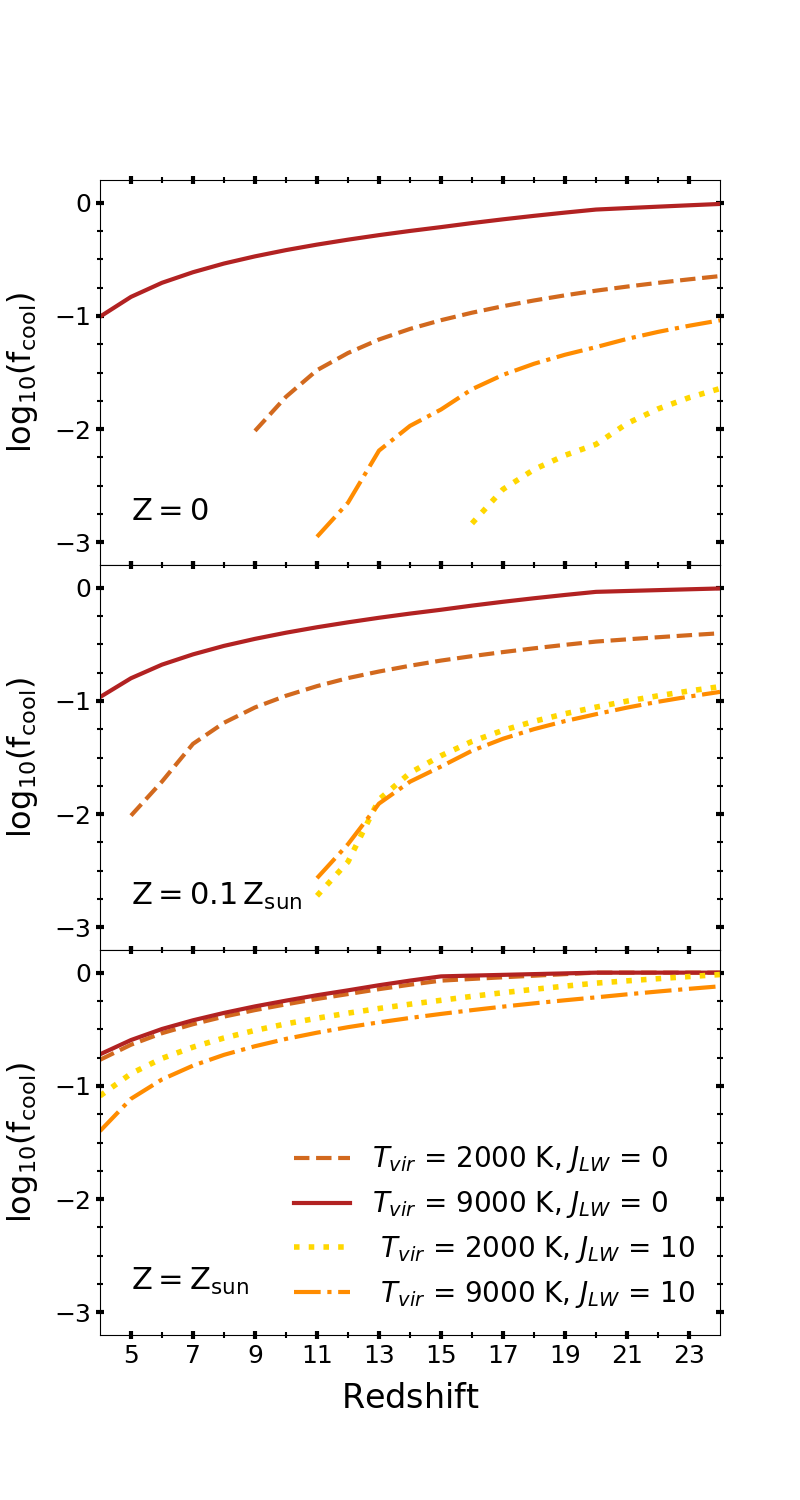
- Implement Pop III IMF with stochastic sampling and a transition to Pop II with Zcrit, plus enhanced Pop III SF efficiency.
- Compute BH seed formation, growth via Bondi-Hoyle accretion with Eddington cap, and mergers.
- Include SN and AGN mechanical feedback and LW/UV radiative feedback affecting cooling and star formation.
- Model photoionizing emission from Pop II/III stars and early BHs, with redshift-dependent escape fractions and IGM clumping to track reionization (Q_HII) and tau_e.
Experimental results
Research questions
- RQ1What is the relative contribution of Pop III/II stars and AGNs to the UV luminosity function across 4 ≤ z ≤ 20?
- RQ2Can including AGN emission reconcile the observed UV LF with theoretical predictions at z ≳ 10?
- RQ3Does a gradual IMF transition with metallicity/redshift improve agreement with JWST data at z ≈ 12–16?
- RQ4How do model predictions for the faint and bright ends of the UV LF compare to JWST measurements, and where do tensions remain?
Key findings
- Pop III contribution to UV luminosity is small, ≲10% at z ≈ 20 and ≲0.5% at z ≈ 10.
- Stars remain the primary sources of cosmic reionization, with 5–10% of ionizing photons escaping into the IGM between z=5 and z=10.
- Unobscured AGNs contribute at most ≲10% of the total UV luminosity for M_UV < −19 at z ≳ 10.
- The predicted UV LFs from stars and AGNs align with data at 5 ≲ z ≲ 9–10; at higher z, faint-end evolution is steeper and bright-end densities around z~10–11 match data but are lower by ~0.8 dex at z~12–13 and ~1.2 dex at z~14–16 compared with some studies.
- Including AGN emission does not substantially alter the conclusions about the LF in the high-z regime.
- A gradual IMF transition with metallicity/redshift brings the model into agreement with JWST data at z~12–13 and reduces the z~14–16 discrepancy to ~0.5 dex.
Read this paper
Open the full text in the Nubint reader and ask about any passage as you read.
Read this paper on NubintThis review was generated by AI from the original paper. Please check the paper before citing it.