
[Paper Review] Exposing flaws of generative model evaluation metrics and their unfair treatment of diffusion models
The paper shows that common evaluation metrics (especially Inception-based FID) poorly align with human judgments and unfairly penalize diffusion models, proposing DINOv2-based representations for better evaluation and highlighting memorization issues.
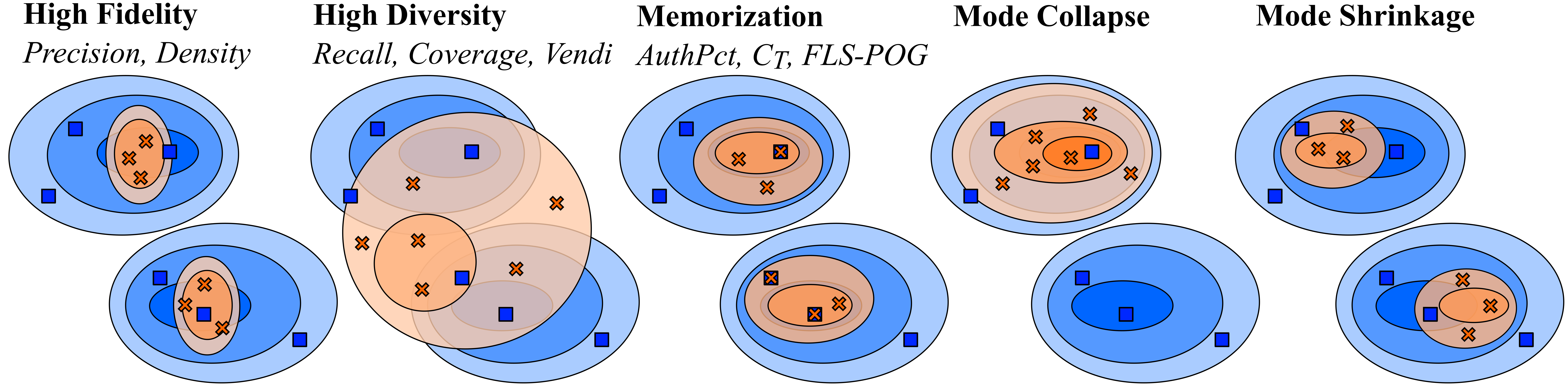
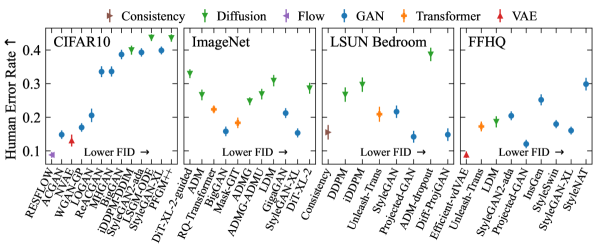
We systematically study a wide variety of generative models spanning semantically-diverse image datasets to understand and improve the feature extractors and metrics used to evaluate them. Using best practices in psychophysics, we measure human perception of image realism for generated samples by conducting the largest experiment evaluating generative models to date, and find that no existing metric strongly correlates with human evaluations. Comparing to 17 modern metrics for evaluating the overall performance, fidelity, diversity, rarity, and memorization of generative models, we find that the state-of-the-art perceptual realism of diffusion models as judged by humans is not reflected in commonly reported metrics such as FID. This discrepancy is not explained by diversity in generated samples, though one cause is over-reliance on Inception-V3. We address these flaws through a study of alternative self-supervised feature extractors, find that the semantic information encoded by individual networks strongly depends on their training procedure, and show that DINOv2-ViT-L/14 allows for much richer evaluation of generative models. Next, we investigate data memorization, and find that generative models do memorize training examples on simple, smaller datasets like CIFAR10, but not necessarily on more complex datasets like ImageNet. However, our experiments show that current metrics do not properly detect memorization: none in the literature is able to separate memorization from other phenomena such as underfitting or mode shrinkage. To facilitate further development of generative models and their evaluation we release all generated image datasets, human evaluation data, and a modular library to compute 17 common metrics for 9 different encoders at https://github.com/layer6ai-labs/dgm-eval.
Motivation & Objective
- Assess how well current generative-model evaluation metrics align with human perception of realism across diverse datasets.
- Evaluate how encoder choices (Inception vs. SSL-based) affect metric reliability.
- Investigate diversity, rarity, and memorization as separate evaluation axes.
- Provide datasets, human evaluation data, and a modular toolkit to compute 17 metrics for 9 encoders to facilitate better evaluation practice.
Proposed method
- Conduct a large-scale human evaluation of 41 models across CIFAR10, ImageNet1k, FFHQ, and LSUN-Bedroom to measure realism.
- Generate 100k images per model to form evaluation datasets.
- Evaluate 17 metrics using 9 different encoders, including Inception-V3, ConvNeXt, and seven SSL models (SimCLRv2, DINOv2, SwAV, MAE, data2vec, CLIP OpenCLIP, DreamSim).
- Compare metric scores to human-evaluated realism to assess correlation and reliability.
- Analyze diversity (Vendi score), rarity, and memorization (pixel-wise and reconstructive) to explain metric-behavior discrepancies.
- Release generated datasets, human data, and a modular dgm-eval library with 17 metrics.
Experimental results
Research questions
- RQ1Do current generative-model evaluation metrics correlate with human judgments of realism across diverse datasets?
- RQ2How do different encoders (Inception vs SSL-based) influence the reliability of evaluation metrics like FID and FD?
- RQ3Are diffusion models unfairly penalized by Inception-based metrics compared to GANs, and can SSL-based metrics resolve this?
- RQ4To what extent do memorization, diversity, and rarity explain discrepancies between human judgments and metrics?
Key findings
- No existing metric strongly correlates with human evaluators across datasets.
- Diffusion models outperform GANs in human-evaluated realism, yet are downranked by Inception-based metrics like FID.
- Replacing Inception-V3 with DINOv2-ViT-L/14 improves alignment between metrics and human judgments and offers richer evaluation.
- Memorization is evident on CIFAR10 but not clearly on ImageNet/FFHQ/LSUN, and current memorization metrics fail to reliably detect it.
- DINOv2-based FD scores correlate better with human judgment and better capture diversity when assessed per-class with Vendi, indicating improved evaluation capability.
Read this paper
Open the full text in the Nubint reader and ask about any passage as you read.
Read this paper on NubintThis review was generated by AI from the original paper. Please check the paper before citing it.