
[Paper Review] FACE: Evaluating Natural Language Generation with Fourier Analysis of Cross-Entropy
This paper proposes FACE, a novel metric for evaluating natural language generation by applying Fourier analysis to the cross-entropy sequences of generated and human-written text. By analyzing spectral similarities in entropy patterns, FACE effectively captures human-like linguistic periodicity, demonstrating strong correlation with human judgments, scalability with model size, and sensitivity to decoding strategies.
Measuring the distance between machine-produced and human language is a critical open problem. Inspired by empirical findings from psycholinguistics on the periodicity of entropy in language, we propose FACE, a set of metrics based on Fourier Analysis of the estimated Cross-Entropy of language, for measuring the similarity between model-generated and human-written languages. Based on an open-ended generation task and the experimental data from previous studies, we find that FACE can effectively identify the human-model gap, scales with model size, reflects the outcomes of different sampling methods for decoding, correlates well with other evaluation metrics and with human judgment scores.
Motivation & Objective
- To address the challenge of measuring similarity between model-generated and human-written language beyond perplexity.
- To leverage psycholinguistic insights on periodicity in language surprisal (cross-entropy) to design a new evaluation metric.
- To develop a computationally efficient, interpretable metric that reflects fine-grained structural patterns in language generation.
- To validate FACE’s performance across model sizes, decoding strategies, and human evaluation scores.
Proposed method
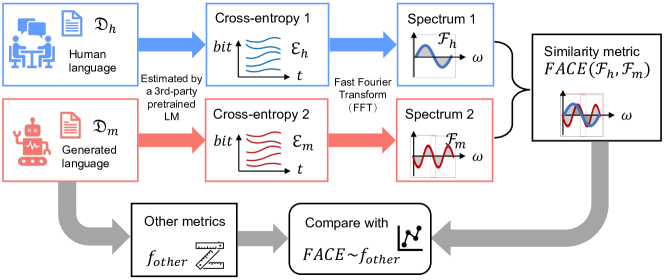
- Estimate cross-entropy sequences for human and model-generated text using a pre-trained language model as an estimator.
- Apply Fast Fourier Transform (FFT) to convert cross-entropy sequences into frequency spectra, treating them as stationary time-domain signals.
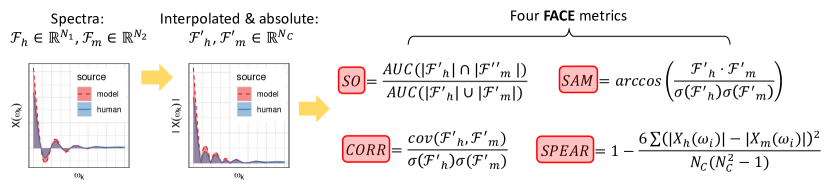
- Compute spectral similarity between human and model-generated data using metrics like Spectral Overlap (SO), which quantifies the overlap in power spectra.
- Use generalized additive models (GAMs) for smoothing aggregated spectra to enable visual and statistical comparison of spectral patterns.
- Validate stationarity of cross-entropy sequences using the Augmented Dickey-Fuller (ADF) test to ensure suitability for Fourier analysis.
- Implement and evaluate FACE across multiple models (GPT-2, OPT, BLOOM), decoding methods (e.g., top-k), and benchmark datasets.
Experimental results
Research questions
- RQ1Can Fourier analysis of cross-entropy sequences effectively distinguish between human-written and model-generated language?
- RQ2How does FACE performance scale with increasing model size across different architectures?
- RQ3To what extent does FACE reflect differences in decoding strategies such as top-k sampling?
- RQ4How well does FACE correlate with human judgment scores and other established evaluation metrics?
- RQ5What is the interpretability of spectral components in terms of linguistic periodicity and structural patterns?
Key findings
- FACE successfully identifies the human-model gap in open-ended text generation, with spectral similarity increasing as model size grows.
- Spectral Overlap (SO) outperforms other FACE variants in correlation with human judgment scores and existing metrics.
- The ADF test confirms stationarity in 74.5% to 97.9% of cross-entropy sequences, supporting the validity of Fourier analysis.
- Aggregated and smoothed spectra reveal that GPT-2 XL’s spectral profile is closer to human language than GPT-2 Small, indicating improved mimicry of natural periodicity.
- The first spectral peak at ω ≈ 0.12 corresponds to a cycle of approximately 8.3 tokens, suggesting recurring patterns in entropy that align across human and high-quality model outputs.
- FACE correlates well with human judgments and outperforms most existing metrics in alignment with human evaluation, demonstrating its robustness and interpretability.
Read this paper
Open the full text in the Nubint reader and ask about any passage as you read.
Read this paper on NubintThis review was generated by AI from the original paper. Please check the paper before citing it.