
[Paper Review] FAENet: Frame Averaging Equivariant GNN for Materials Modeling
FAENet introduces a novel, lightweight graph neural network that achieves E(3)-equivariance in materials modeling through stochastic frame averaging (SFA) of geometric data, eliminating architectural constraints. The method enables state-of-the-art accuracy and computational efficiency on OC20 and QM9 datasets, outperforming prior equivariant models in both scalability and symmetry preservation.
Applications of machine learning techniques for materials modeling typically involve functions known to be equivariant or invariant to specific symmetries. While graph neural networks (GNNs) have proven successful in such tasks, they enforce symmetries via the model architecture, which often reduces their expressivity, scalability and comprehensibility. In this paper, we introduce (1) a flexible framework relying on stochastic frame-averaging (SFA) to make any model E(3)-equivariant or invariant through data transformations. (2) FAENet: a simple, fast and expressive GNN, optimized for SFA, that processes geometric information without any symmetrypreserving design constraints. We prove the validity of our method theoretically and empirically demonstrate its superior accuracy and computational scalability in materials modeling on the OC20 dataset (S2EF, IS2RE) as well as common molecular modeling tasks (QM9, QM7-X). A package implementation is available at https://faenet.readthedocs.io.
Motivation & Objective
- To address the expressivity and scalability limitations of existing equivariant GNNs that enforce symmetries via complex architectural designs.
- To develop a flexible framework that preserves E(3) symmetries through data transformations rather than model architecture.
- To design a lightweight, high-performing GNN—FAENet—that processes geometric information freely while maintaining theoretical and empirical symmetry invariance.
- To empirically validate the superiority of SFA-based symmetry enforcement over data augmentation and no symmetry enforcement in materials property prediction.
Proposed method
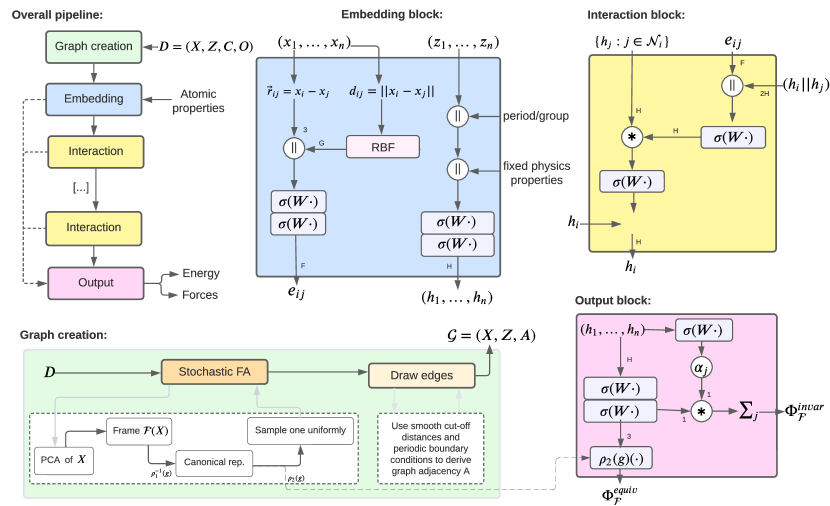
- Proposes stochastic frame averaging (SFA) as a symmetry-preserving data augmentation technique that projects atomic configurations into canonical frames to enforce E(3)-equivariance.
- Introduces FAENet, a GNN architecture that processes relative atomic positions without symmetry-preserving architectural constraints, relying on SFA for invariance.
- Uses frame averaging to transform input graphs into a canonical coordinate system, enabling any model to be equivariant to rotations, reflections, and translations.
- Employs a differentiable frame selection mechanism in SFA to sample multiple reference frames stochastically, improving generalization and symmetry robustness.
- Leverages geometric message passing with relative positions as edge features, maximizing expressivity while preserving symmetry through data preprocessing.
- Validates the method on multiple datasets using metrics like rotation invariance, reflection invariance, and force equivariance to quantify symmetry preservation.
Experimental results
Research questions
- RQ1Can E(3)-equivariance be effectively enforced in GNNs without architectural constraints by transforming data instead of designing symmetry-preserving layers?
- RQ2How does SFA-based symmetry enforcement compare to data augmentation and no symmetry enforcement in terms of model accuracy and symmetry preservation?
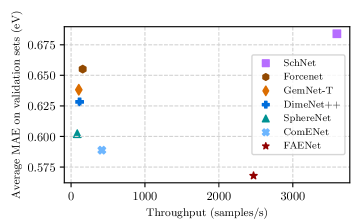
- RQ3Does a lightweight GNN like FAENet achieve better accuracy and scalability than complex, symmetry-constrained models on materials property prediction tasks?
- RQ4To what extent does SFA improve symmetry generalization compared to full frame averaging or standard data augmentation?
- RQ5Can FAENet generalize effectively to diverse materials datasets, including solid-state crystals and molecules, with minimal architectural modifications?
Key findings
- FAENet with SFA achieves a test MAE of 464 meV on the S2EF dataset, outperforming SchNet (918 meV) and ForceNet (655 meV), demonstrating superior accuracy and scalability.
- SFA reduces rotation invariance error to 6.94 meV on S2EF and reflection invariance to 6.96 meV, significantly outperforming data augmentation (8.88 and 9.12 meV) and no-FA (26.81 and 27.61 meV).
- On IS2RE, FAENet with SFA achieves a MAE of 569 meV, a 12% improvement over ForceNet and a 13% improvement over SchNet, while maintaining strong symmetry preservation.
- The SE(3)-SFA variant achieves slightly better metrics than full FA, suggesting that learning from fewer frames improves generalization without sacrificing symmetry.
- No-FA and No-Train show significantly worse symmetry metrics (e.g., 51.1 meV rotation invariance error), proving that symmetry enforcement is essential for robust performance.
- SFA outperforms data augmentation in both symmetry preservation and prediction accuracy, especially under 3D symmetries, with a 60% drop in rotation equivariance error on S2EF.
Read this paper
Open the full text in the Nubint reader and ask about any passage as you read.
Read this paper on NubintThis review was generated by AI from the original paper. Please check the paper before citing it.