
[Paper Review] Fairness and Privacy-Preserving in Federated Learning: A Survey
This survey provides a comprehensive analysis of fairness and privacy challenges in federated learning (FL), identifying key issues in client selection, incentive distribution, contribution evaluation, and group fairness. It evaluates existing privacy-preserving techniques like differential privacy and secure multiparty computation, and proposes a unified framework for balancing privacy, fairness, and model accuracy in FL systems.
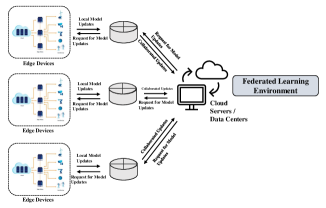
Federated learning (FL) as distributed machine learning has gained popularity as privacy-aware Machine Learning (ML) systems have emerged as a technique that prevents privacy leakage by building a global model and by conducting individualized training of decentralized edge clients on their own private data. The existing works, however, employ privacy mechanisms such as Secure Multiparty Computing (SMC), Differential Privacy (DP), etc. Which are immensely susceptible to interference, massive computational overhead, low accuracy, etc. With the increasingly broad deployment of FL systems, it is challenging to ensure fairness and maintain active client participation in FL systems. Very few works ensure reasonably satisfactory performances for the numerous diverse clients and fail to prevent potential bias against particular demographics in FL systems. The current efforts fail to strike a compromise between privacy, fairness, and model performance in FL systems and are vulnerable to a number of additional problems. In this paper, we provide a comprehensive survey stating the basic concepts of FL, the existing privacy challenges, techniques, and relevant works concerning privacy in FL. We also provide an extensive overview of the increasing fairness challenges, existing fairness notions, and the limited works that attempt both privacy and fairness in FL. By comprehensively describing the existing FL systems, we present the potential future directions pertaining to the challenges of privacy-preserving and fairness-aware FL systems.
Motivation & Objective
- To identify and systematize the key challenges in ensuring fairness and privacy in federated learning systems.
- To analyze existing privacy-preserving techniques such as differential privacy, secure multiparty computation, and trusted execution environments in the context of FL.
- To examine fairness issues in client selection, incentive distribution, contribution evaluation, and group-level bias in FL.
- To evaluate trade-offs between privacy, fairness, and model accuracy in FL and identify gaps in current research.
- To propose future research directions for building privacy-preserving, fairness-aware FL systems with improved efficiency and robustness.
Proposed method
- Systematic survey of 150+ recent works on privacy and fairness in FL, categorized by technical approach and application domain.
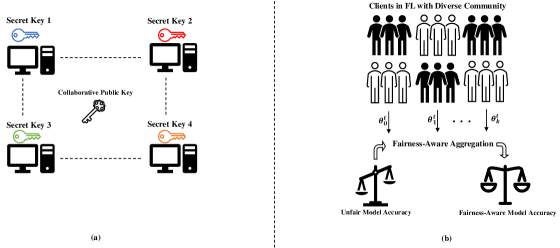
- Classification of privacy-preserving techniques into cryptographic (e.g., SMC, homomorphic encryption), statistical (e.g., differential privacy), and hardware-based (e.g., TEEs) methods.
- Analysis of fairness notions including individual fairness, group fairness, and contribution-based fairness, with emphasis on client selection and incentive mechanisms.
- Evaluation of trade-offs between privacy, accuracy, and communication efficiency across different privacy-preserving techniques using a comparative framework.
- Integration of continual learning and knowledge distillation techniques to reduce training costs and improve model adaptability in dynamic FL environments.
- Proposal of a multi-dimensional evaluation framework combining privacy metrics (e.g., privacy budget in DP), fairness metrics (e.g., demographic parity, equal opportunity), and accuracy benchmarks.
Experimental results
Research questions
- RQ1What are the primary privacy threats in federated learning, and how do existing techniques mitigate them?
- RQ2How do fairness issues manifest in client selection, incentive distribution, and model convergence in FL?
- RQ3What are the key trade-offs between privacy, fairness, and model accuracy in FL systems?
- RQ4Which privacy-preserving techniques are most effective in balancing security, efficiency, and model performance?
- RQ5What future research directions are needed to build scalable, fair, and privacy-preserving federated learning systems?
Key findings
- Existing privacy-preserving techniques such as differential privacy and secure multiparty computation often introduce significant computational overhead and reduce model accuracy.
- Fairness issues in FL arise primarily from biased client selection, uniform reward distribution, and inaccurate contribution evaluation, leading to reduced participation from low-capability clients.
- Group fairness violations are common when sensitive attributes like gender or ethnicity are not explicitly considered during model training, resulting in biased predictions.
- The integration of continual learning and knowledge distillation methods can reduce training costs and improve model adaptability in dynamic FL environments.
- No single privacy-preserving technique achieves optimal performance across all metrics; hybrid approaches combining cryptographic, statistical, and hardware-based methods show greater promise.
- A lack of standardized evaluation metrics for privacy and fairness hinders reproducibility and comparison across FL systems, necessitating domain-specific metric selection.
Read this paper
Open the full text in the Nubint reader and ask about any passage as you read.
Read this paper on NubintThis review was generated by AI from the original paper. Please check the paper before citing it.