
[Paper Review] Fast-Slow Transformer for Visually Grounding Speech
FaST-VGS is a novel Transformer-based model for visually grounded speech retrieval that unifies dual-encoder and cross-attention architectures into a single framework, enabling both fast coarse retrieval and accurate fine-grained retrieval. It achieves state-of-the-art performance on FACC, SpokenCOCO, and Places Audio benchmarks, while also demonstrating strong zero-shot transfer to phonetic and semantic tasks in the ZeroSpeech 2021 challenge.
We present Fast-Slow Transformer for Visually Grounding Speech, or FaST-VGS. FaST-VGS is a Transformer-based model for learning the associations between raw speech waveforms and visual images. The model unifies dual-encoder and cross-attention architectures into a single model, reaping the superior retrieval speed of the former along with the accuracy of the latter. FaST-VGS achieves state-of-the-art speech-image retrieval accuracy on benchmark datasets, and its learned representations exhibit strong performance on the ZeroSpeech 2021 phonetic and semantic tasks.
Motivation & Objective
- To develop a unified, efficient, and accurate model for speech-image retrieval using visual grounding.
- To bridge the performance gap between speech-image and text-image retrieval systems.
- To investigate the linguistic information encoded in self-supervised speech representations learned from visual supervision.
- To enable both fast and accurate retrieval using a single architecture through coarse-to-fine inference.
Proposed method
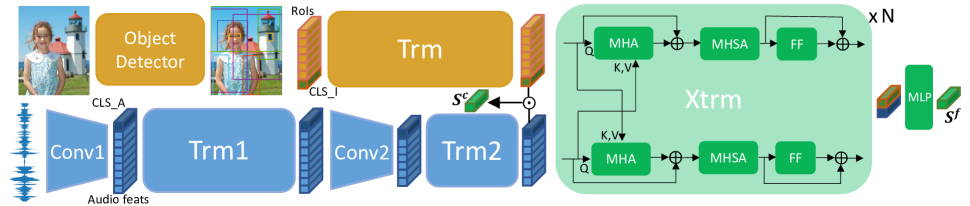
- The model uses a dual-branch architecture with separate audio and image encoders based on convolutional layers and Transformers.
- Audio features are processed through a two-stage Transformer stack: high-resolution features are downsampled and re-encoding for semantic abstraction.
- A CLS token is used to represent the entire audio and image sequence for coarse similarity computation via dot product.
- Fine-grained similarity is computed using a cross-modal Transformer that attends across both modalities jointly.
- The coarse and fine similarity scores are derived from shared representations, enabling unified training and inference.
- A coarse-to-fine (CTF) training strategy is employed to jointly optimize both retrieval modes.
Experimental results
Research questions
- RQ1Can a unified Transformer model achieve both fast and accurate speech-image retrieval?
- RQ2How well do self-supervised speech representations from visual grounding capture phonetic and semantic structure?
- RQ3Does the model outperform prior methods on benchmark speech-image retrieval datasets?
- RQ4Can the model generalize to zero-shot evaluation on phonetic and semantic tasks?
Key findings
- FaST-VGS achieves state-of-the-art R@10 of 83.7% on SpokenCOCO and 89.5% on FACC when fine-tuned on both datasets.
- On FACC, the model outperforms MILAN (a prior SOTA) when trained on SpokenCOCO and fine-tuned on FACC, despite using less data.
- On the ZeroSpeech 2021 semantic task, FaST-VGS achieves a score of 23.55 on Librispeech, significantly outperforming the baseline (15.09).
- For the ABX phonetic task, FaST-VGS outperforms the high-budget VG baseline in all four evaluations, though it underperforms the best non-VG models.
- The model achieves 79.9% R@10 for image-to-speech retrieval on FACC and 87.0% on SpokenCOCO, demonstrating strong cross-attention performance.
Read this paper
Open the full text in the Nubint reader and ask about any passage as you read.
Read this paper on NubintThis review was generated by AI from the original paper. Please check the paper before citing it.