
[Paper Review] FastEmit: Low-latency Streaming ASR with Sequence-level Emission Regularization
FastEmit is a sequence-level emission regularization method for streaming end-to-end ASR that directly optimizes transducer forward-backward probabilities to reduce latency without requiring word alignments. It achieves 150–300ms latency reduction and improves WER from 4.4%/8.9% to 3.1%/7.5% on LibriSpeech, with minimal hyperparameter tuning and no additional training or inference cost.
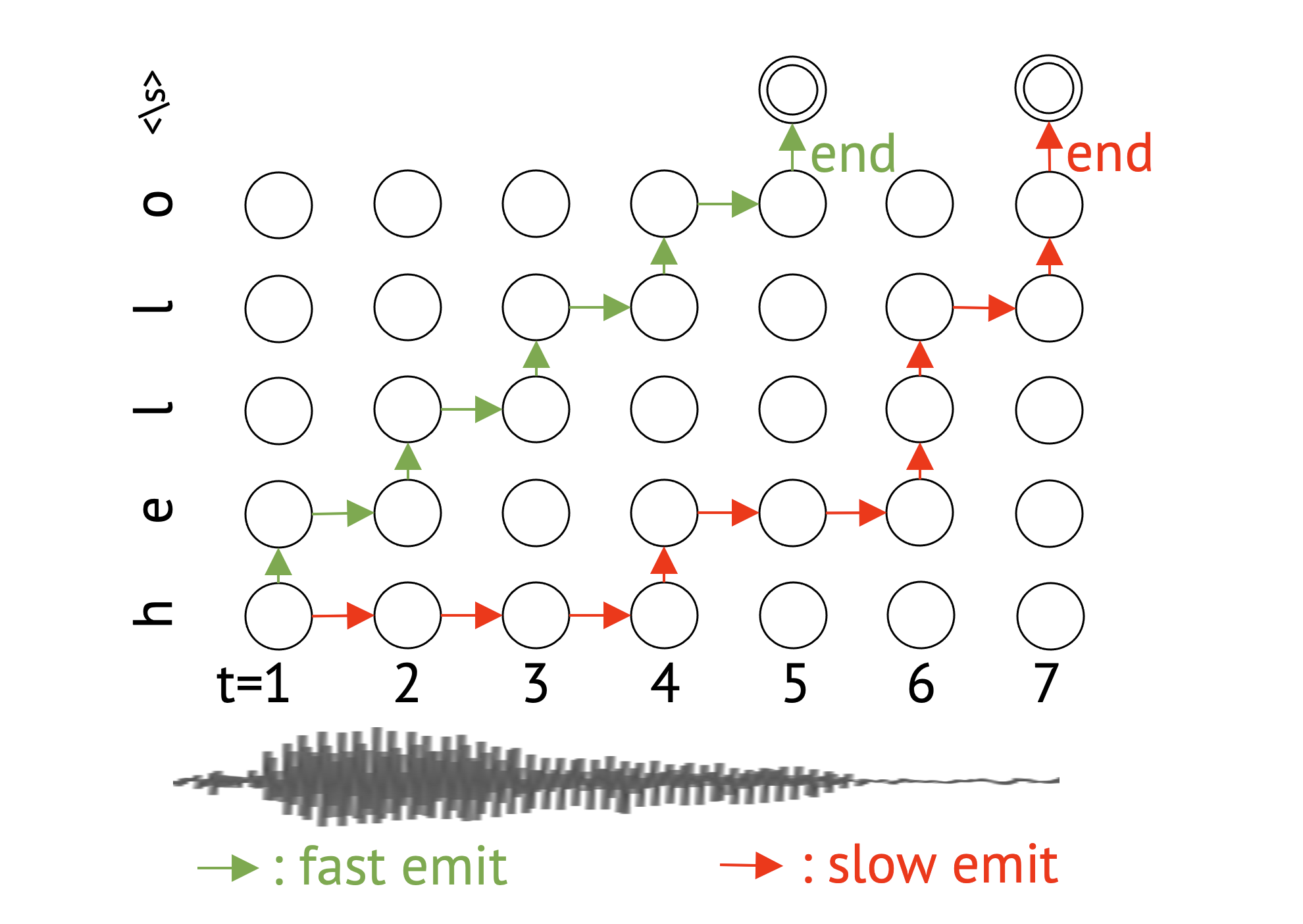
Streaming automatic speech recognition (ASR) aims to emit each hypothesized word as quickly and accurately as possible. However, emitting fast without degrading quality, as measured by word error rate (WER), is highly challenging. Existing approaches including Early and Late Penalties and Constrained Alignments penalize emission delay by manipulating per-token or per-frame probability prediction in sequence transducer models. While being successful in reducing delay, these approaches suffer from significant accuracy regression and also require additional word alignment information from an existing model. In this work, we propose a sequence-level emission regularization method, named FastEmit, that applies latency regularization directly on per-sequence probability in training transducer models, and does not require any alignment. We demonstrate that FastEmit is more suitable to the sequence-level optimization of transducer models for streaming ASR by applying it on various end-to-end streaming ASR networks including RNN-Transducer, Transformer-Transducer, ConvNet-Transducer and Conformer-Transducer. We achieve 150-300 ms latency reduction with significantly better accuracy over previous techniques on a Voice Search test set. FastEmit also improves streaming ASR accuracy from 4.4%/8.9% to 3.1%/7.5% WER, meanwhile reduces 90th percentile latency from 210 ms to only 30 ms on LibriSpeech.
Motivation & Objective
- Address the challenge of high emission latency in streaming end-to-end ASR models despite accurate transducer training.
- Overcome accuracy degradation caused by per-token or per-frame emission penalties in existing methods like Early/Late Penalties and Constrained Alignments.
- Develop a regularization method that operates at the sequence level, aligning with transducer optimization to improve latency without sacrificing accuracy.
- Enable plug-and-play integration across diverse streaming ASR architectures, including RNN-T, Transformer-T, ConvNet-T, and Conformer-T.
- Achieve low-latency inference with minimal hyperparameter tuning and no additional computational cost during training or inference.
Proposed method
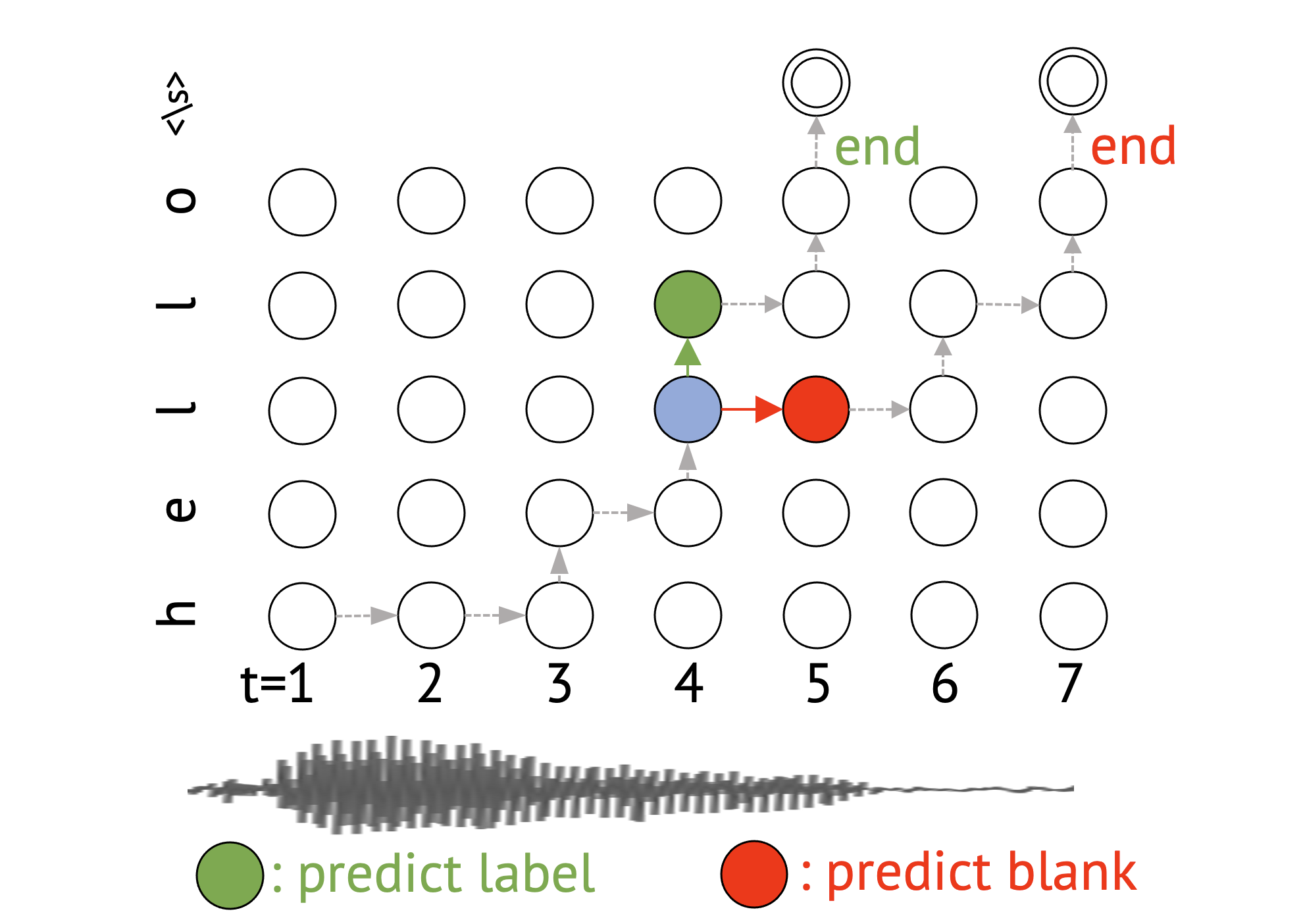
- Introduce a sequence-level regularization loss that modifies the transducer forward-backward algorithm to suppress blank token emissions across the entire sequence.
- Apply a regularization term proportional to the negative log-probability of non-blank tokens in the lattice, encouraging earlier emission of target words.
- Balance the standard transducer loss with the emission regularization loss using a single hyperparameter λ.
- Train the model end-to-end using the combined loss, where the regularization acts directly on the sequence-level probability distribution.
- Ensure compatibility with any transducer-based model by avoiding dependency on external word alignments or pre-trained models.
- Use minimal hyperparameter tuning—only λ is adjusted—enabling easy deployment across different models and datasets.
Experimental results
Research questions
- RQ1Can sequence-level emission regularization reduce latency in streaming ASR without degrading recognition accuracy?
- RQ2How does FastEmit compare to per-token or per-frame regularization methods like Early/Late Penalties and Constrained Alignments in terms of WER and latency?
- RQ3Does FastEmit generalize across diverse streaming ASR architectures such as RNN-T, Transformer-T, ConvNet-T, and Conformer-T?
- RQ4What is the optimal balance between latency reduction and accuracy preservation using the hyperparameter λ?
- RQ5Can FastEmit be applied without requiring word-level alignments or additional training/inference costs?
Key findings
- FastEmit reduces 90th percentile latency from 210ms to 30ms on LibriSpeech while improving WER from 4.4% to 3.1% on the test-clean set and from 8.9% to 7.5% on the test-other set.
- On a Voice Search test set, FastEmit achieves 150–300ms latency reduction across RNN-T, Transformer-T, and Conformer-T models, outperforming CA and MaskFrame baselines in WER-latency trade-off.
- The method improves recognition accuracy on LibriSpeech by reducing deletion errors, likely due to mitigating vanishing gradient issues in long-form transduction.
- Hyperparameter tuning shows that λ=0.01 for ContextNet and λ=0.004 for Conformer yield optimal latency-accuracy balance, with further increases in λ causing WER degradation.
- FastEmit generalizes effectively across multiple architectures, including RNN-Transducer, Transformer-Transducer, ConvNet-Transducer, and Conformer-Transducer.
- The method requires no external alignment data and incurs no additional training or inference cost, making it highly deployable in production settings.
Read this paper
Open the full text in the Nubint reader and ask about any passage as you read.
Read this paper on NubintThis review was generated by AI from the original paper. Please check the paper before citing it.