
[Paper Review] Fate of homogeneous $\mathbb{Z}_2$-symmetric scalar condensates
This paper investigates the late-time evolution of a homogeneous Z₂-symmetric scalar condensate in an expanding FLRW universe, using nonequilibrium quantum field theory via the Closed-Time-Path formalism. It derives coupled coarse-grained equations for the condensate, radiation, and spacetime, showing that the condensate always leaves a nonvanishing relic abundance due to its decay rate decreasing faster than the Hubble parameter at low temperatures, even in the perturbative regime where parametric resonance is inefficient.
Dark matter, if represented by a $\mathbb{Z}_2$-symmetric scalar field, can manifest as both particles and condensates. In this paper, we study the evolution of an oscillating homogeneous condensate of a $\mathbb{Z}_2$-symmetric scalar field in a thermal plasma in an FLRW universe. We focus on the perturbative regime where the oscillation amplitude is sufficiently small so that parametric resonance is inefficient. This perturbative regime necessarily comprises the late stage of the condensate decay and determines its fate. The coupled coarse-grained equations of motion for the condensate, radiation, and spacetime are derived from first principles using nonequilibrium quantum field theory. We obtain analytical expressions for the relevant microscopic quantities that enter the equations of motion and solve the latter numerically. We find that there is always a nonvanishing relic abundance for a condensate with a $\mathbb{Z}_2$ symmetry that is not spontaneously broken. This is because its decay rate decreases faster than the Hubble parameter at late times due to either the amplitude dependence or the temperature dependence in the condensate decay rate. Consequently, accounting for the condensate contribution to the overall dark matter relic density is essential for $\mathbb{Z}_2$ scalar singlet dark matter.
Motivation & Objective
- To understand the fate of a homogeneous Z₂-symmetric scalar condensate in the early universe, particularly in the late-time perturbative regime where nonperturbative effects are negligible.
- To derive the coupled equations of motion for the condensate, radiation, and spacetime from first principles using nonequilibrium quantum field theory.
- To determine whether the condensate can fully decay into radiation or if it leaves a relic abundance, especially in the absence of parametric resonance.
- To compute the decay rate of the condensate including both amplitude- and temperature-dependence, going beyond the high-temperature approximation used in prior works.
Proposed method
- Derives the non-local condensate equation of motion from the Closed-Time-Path (CTP) formalism, incorporating self-energy corrections from interactions with the thermal plasma.
- Applies multi-scale analysis to Markovianize the non-local equation, yielding coupled coarse-grained equations for the condensate envelope, radiation energy density, and scale factor evolution.
- Computes the relevant microscopic self-energies (four-vertex and sunset types) explicitly using thermal field theory techniques in real-time formalism.
- Solves the resulting coupled system of equations numerically, tracking the time evolution of the condensate amplitude, radiation energy density, and Hubble parameter.
- Incorporates both amplitude-dependent and temperature-dependent decay rates, avoiding the high-temperature approximation used in previous studies.
- Uses the Markovian approximation under the assumption that the mass and amplitude of the condensate vary slowly over the correlation time of the self-energies.
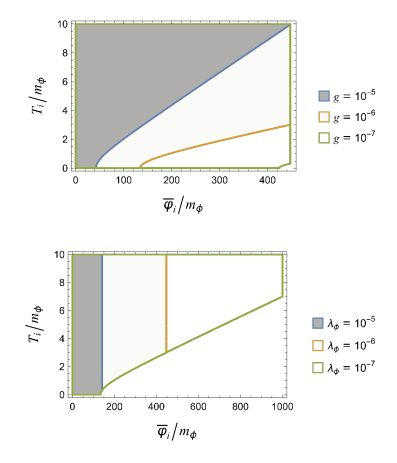
Experimental results
Research questions
- RQ1Does a Z₂-symmetric scalar condensate in the early universe fully decay into radiation, or does it leave a nonvanishing relic abundance?
- RQ2How does the decay rate of the condensate depend on its amplitude and the plasma temperature, and how does this affect its late-time evolution?
- RQ3Can the high-temperature approximation for the decay rate lead to incorrect conclusions about the completeness of condensate decay?
- RQ4What is the role of the time-dependent dissipation rate in determining the final relic density of the condensate?
- RQ5How do the coupled equations of motion for the condensate, radiation, and spacetime evolve numerically in the perturbative regime?
Key findings
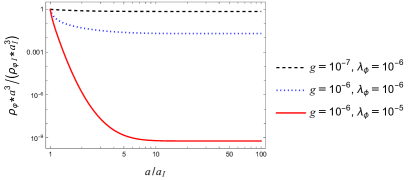
- The condensate always leaves a nonvanishing relic abundance because its decay rate decreases faster than the Hubble parameter at late times due to amplitude- and temperature-dependent suppression.
- The high-temperature approximation used in prior works can be misleading, as it may predict complete decay; this paper shows that such decay is not realized when temperature and amplitude dependence are properly included.
- The decay rate is both amplitude-dependent and temperature-dependent, leading to a time-varying dissipation rate that suppresses late-time decay.
- Numerical solutions of the coupled coarse-grained equations confirm that the condensate undergoes a 'freeze-out' at late times, analogous to thermal freeze-out but driven by decreasing decay rate.
- The relic density of the condensate is sensitive to initial conditions, unlike standard thermal freeze-out, and must be accounted for in Z₂ scalar singlet dark matter models.
- The derived equations are applicable to perturbative dark matter production and reheating processes, provided all plasma particles are in thermal equilibrium.
Read this paper
Open the full text in the Nubint reader and ask about any passage as you read.
Read this paper on NubintThis review was generated by AI from the original paper. Please check the paper before citing it.