
[Paper Review] Fault Diagnosis on Induction Motor using Machine Learning and Signal Processing
This study proposes a machine learning and signal processing framework for fault diagnosis in three-phase induction motors using MATLAB Simulink. It generates 150,000 data points—including healthy and four fault types (open circuit, short circuit, overload, broken rotor bars)—applies FFT for feature extraction, and evaluates multiple models, with the Decision Tree achieving 92% accuracy, demonstrating high interpretability and robustness for industrial fault classification.
The detection and identification of induction motor faults using machine learning and signal processing is a valuable approach to avoiding plant disturbances and shutdowns in the context of Industry 4.0. In this work, we present a study on the detection and identification of induction motor faults using machine learning and signal processing with MATLAB Simulink. We developed a model of a three-phase induction motor in MATLAB Simulink to generate healthy and faulty motor data. The data collected included stator currents, rotor currents, input power, slip, rotor speed, and efficiency. We generated four faults in the induction motor: open circuit fault, short circuit fault, overload, and broken rotor bars. We collected a total of 150,000 data points with a 60-40% ratio of healthy to faulty motor data. We applied Fast Fourier Transform (FFT) to detect and identify healthy and unhealthy conditions and added a distinctive feature in our data. The generated dataset was trained different machine learning models. On comparing the accuracy of the models on the test set, we concluded that the Decision Tree algorithm performed the best with an accuracy of about 92%. Our study contributes to the literature by providing a valuable approach to fault detection and classification with machine learning models for industrial applications.
Motivation & Objective
- To develop a reliable, automated system for early detection of induction motor faults to prevent unplanned downtime in industrial settings.
- To address the high failure rate of induction motors—35–40% due to electrical faults—by enabling predictive maintenance through data-driven methods.
- To evaluate and compare the performance of multiple machine learning models in classifying diverse fault types using real-time motor parameters.
- To enhance fault detection accuracy by integrating signal processing (FFT) with machine learning on simulated motor data.
- To provide a practical, interpretable, and robust solution suitable for Industry 4.0 applications using MATLAB Simulink
Proposed method
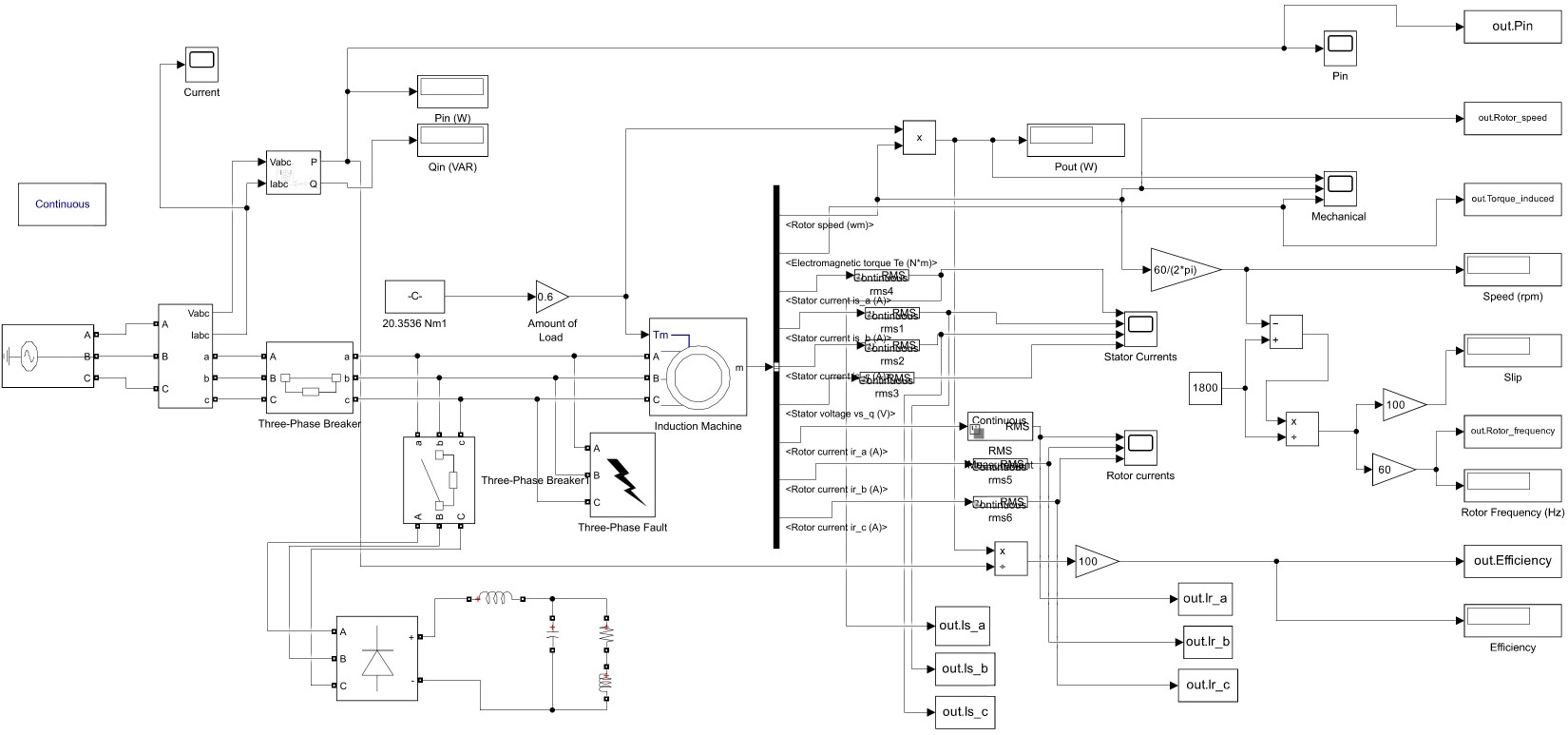
- A three-phase induction motor model was developed in MATLAB Simulink with sensors to monitor stator current, rotor current, input power, slip, rotor speed, and efficiency.
- Four fault types—open circuit, short circuit, overload, and broken rotor bars—were simulated using dedicated blocks (e.g., three-phase breaker, fault block, RLC circuit for harmonics).
- A total of 150,000 data points were collected with a 60-40% split between healthy and faulty conditions, ensuring balanced training and testing.
- Fast Fourier Transform (FFT) was applied to extract frequency-domain features, identifying harmonic distortions indicative of specific faults.
- The Classification Learner app in MATLAB was used to train and compare multiple models: Decision Tree, Support Vector Machine, Logistic Regression, and Naive Bayes.
- Model performance was evaluated using accuracy, precision, recall, and F1 score, with feature importance and confusion matrices used to interpret results.
Experimental results
Research questions
- RQ1Which machine learning model achieves the highest accuracy in classifying multiple types of induction motor faults using simulated data?
- RQ2How effective is FFT-based signal processing in enhancing the discriminative power of motor current and power signals for fault detection?
- RQ3To what extent do feature importance rankings in Decision Trees reflect the physical significance of motor parameters in fault diagnosis?
- RQ4How does the model’s robustness to noise and outliers compare across different algorithms in real-world industrial data scenarios?
- RQ5Can a hybrid approach of signal processing and interpretable machine learning enable reliable, real-time fault diagnosis suitable for Industry 4.0 systems?
Key findings
- The Decision Tree algorithm achieved the highest test accuracy of 92%, outperforming Support Vector Machine, Logistic Regression, and Naive Bayes.
- The confusion matrix revealed 100% accuracy for classifying open-circuit and short-circuit faults, indicating high distinctiveness in their signal signatures.
- Feature importance analysis confirmed that stator current, rotor current, and input power were the most influential variables in fault classification.
- The Decision Tree model demonstrated strong robustness to noise and outliers, making it suitable for real-world industrial environments with imperfect data.
- FFT-based preprocessing successfully extracted fault-specific frequency components, especially for broken rotor bar faults, which introduced harmonic distortions.
- The absence of redundant features in the dataset was confirmed via plot matrix analysis, eliminating the need for PCA and preserving model interpretability.
Read this paper
Open the full text in the Nubint reader and ask about any passage as you read.
Read this paper on NubintThis review was generated by AI from the original paper. Please check the paper before citing it.