
[Paper Review] Federated Learning and Blockchain-enabled Fog-IoT Platform for Wearables in Predictive Healthcare
The paper proposes a fog-IoT platform that combines federated learning and private blockchain to secure data privacy, integrity, and adaptability for wearable IoT in predictive healthcare, validated on a HAR dataset using 1D CNN across a Raspberry Pi testbed.
Over the years, the popularity and usage of wearable Internet of Things (IoT) devices in several healthcare services are increased. Among the services that benefit from the usage of such devices is predictive analysis, which can improve early diagnosis in e-health. However, due to the limitations of wearable IoT devices, challenges in data privacy, service integrity, and network structure adaptability arose. To address these concerns, we propose a platform using federated learning and private blockchain technology within a fog-IoT network. These technologies have privacy-preserving features securing data within the network. We utilized the fog-IoT network's distributive structure to create an adaptive network for wearable IoT devices. We designed a testbed to examine the proposed platform's ability to preserve the integrity of a classifier. According to experimental results, the introduced implementation can effectively preserve a patient's privacy and a predictive service's integrity. We further investigated the contributions of other technologies to the security and adaptability of the IoT network. Overall, we proved the feasibility of our platform in addressing significant security and privacy challenges of wearable IoT devices in predictive healthcare through analysis, simulation, and experimentation.
Motivation & Objective
- Address data privacy and service integrity challenges in wearable IoT for predictive healthcare.
- Develop a scalable, adaptive fog-IoT architecture leveraging federated learning and private blockchain.
- Evaluate a low-cost testbed to assess model accuracy and security implications in distributed healthcare analytics.
Proposed method
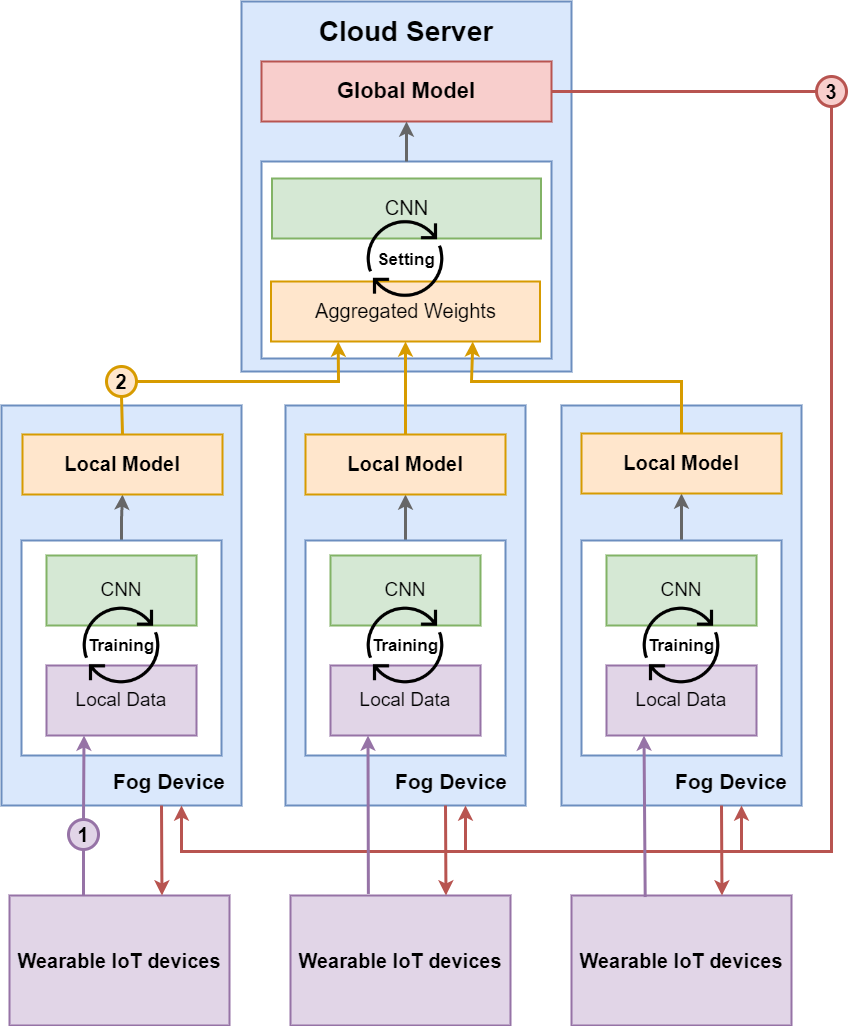
- Utilize a fog-IoT architecture to move training to fog devices while wearable devices act as clients.
- Implement federated learning to aggregate locally trained CNN models into a global HAR model.
- Incorporate a private blockchain to manage training data and model versioning in a tamper-resistant hyperledger.
- Use a 1D CNN trained on HAR data to simulate predictive healthcare monitoring.
- Deploy a Raspberry Pi-based testbed with 10 fog nodes to emulate distributed learning and evaluation.
- Compare global model accuracy to the average local model accuracy to assess FL effectiveness.

Experimental results
Research questions
- RQ1Can federated learning with edge-to-fog training preserve patient data privacy while maintaining predictive model integrity in a wearable IoT setting?
- RQ2Does integrating private blockchain enhance security and traceability of locally trained models and global aggregation in a fog-IoT Healthcare platform?
- RQ3What is the impact of the proposed scaling scheme on global model performance compared to averaging local models?
Key findings
- Local models achieved 90.43% testing accuracy on HAR data.
- The global model accuracy peaks at 91.75%, exceeding the average local model accuracy as the number of clients increases.
- The scaling scheme gives the best local model the highest weight, improving global model performance.
- The federated learning setup maintains classifier integrity while reducing raw data exposure to the central server.
- Private blockchain provides tamper-proof logging and access control for training models and federated updates.
Read this paper
Open the full text in the Nubint reader and ask about any passage as you read.
Read this paper on NubintThis review was generated by AI from the original paper. Please check the paper before citing it.