
[Paper Review] Federated Learning for Connected and Automated Vehicles: A Survey of Existing Approaches and Challenges
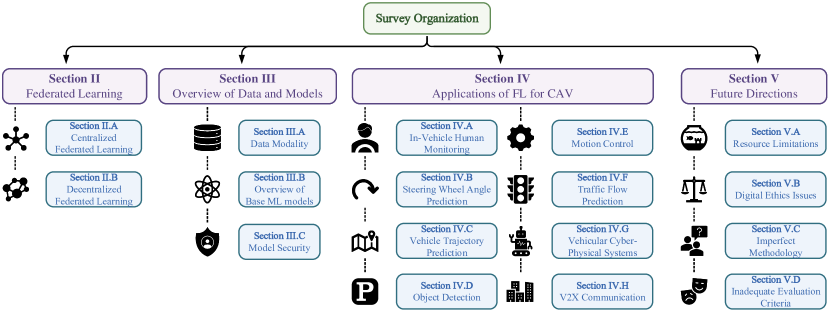
This survey proposes a comprehensive review of federated learning (FL) for connected and automated vehicles (CAV), analyzing centralized and decentralized FL frameworks, data modalities, security techniques, and applications. It identifies key challenges such as communication overhead, privacy, system heterogeneity, and model convergence, while highlighting FL's potential to enhance privacy-preserving, collaborative model training in CAVs.
Machine learning (ML) is widely used for key tasks in Connected and Automated Vehicles (CAV), including perception, planning, and control. However, its reliance on vehicular data for model training presents significant challenges related to in-vehicle user privacy and communication overhead generated by massive data volumes. Federated learning (FL) is a decentralized ML approach that enables multiple vehicles to collaboratively develop models, broadening learning from various driving environments, enhancing overall performance, and simultaneously securing local vehicle data privacy and security. This survey paper presents a review of the advancements made in the application of FL for CAV (FL4CAV). First, centralized and decentralized frameworks of FL are analyzed, highlighting their key characteristics and methodologies. Second, diverse data sources, models, and data security techniques relevant to FL in CAVs are reviewed, emphasizing their significance in ensuring privacy and confidentiality. Third, specific applications of FL are explored, providing insight into the base models and datasets employed for each application. Finally, existing challenges for FL4CAV are listed and potential directions for future investigation to further enhance the effectiveness and efficiency of FL in the context of CAV are discussed.
Motivation & Objective
- To analyze centralized and decentralized federated learning (FL) frameworks for connected and automated vehicles (CAV).
- To review diverse data sources, machine learning models, and data security techniques relevant to FL in CAVs.
- To explore specific FL applications in CAVs, including base models, datasets, and use cases.
- To identify critical challenges in FL for CAVs, such as communication efficiency, privacy, and system heterogeneity.
- To propose future research directions for improving FL's effectiveness and efficiency in CAV environments.
Proposed method
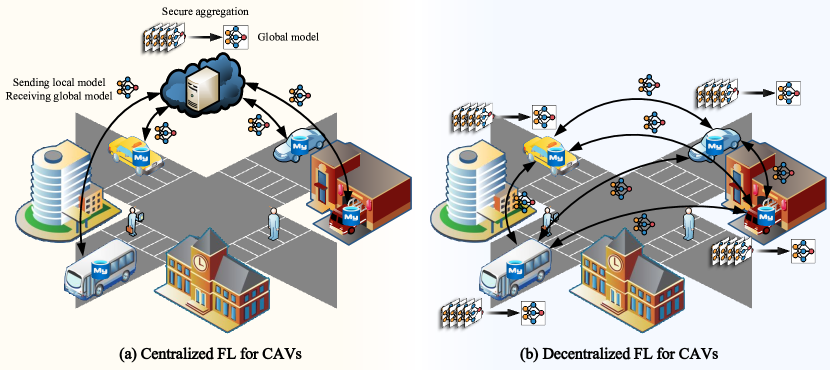
- Categorizes FL frameworks into centralized and decentralized architectures, evaluating their communication and privacy trade-offs.
- Reviews data modalities from CAVs, including sensor data (LiDAR, cameras), V2X communications, and ECU data, for model training.
- Analyzes privacy-preserving techniques such as secure aggregation, differential privacy, and homomorphic encryption in FL for CAVs.
- Evaluates FL applications in CAVs, including perception, planning, control, driver behavior modeling, anomaly detection, and predictive maintenance.
- Proposes cooperative FL and reinforcement learning-based client selection to optimize resource utilization and reduce communication load.
- Introduces trust-aware deep reinforcement learning for client selection and mitigation of straggler effects in heterogeneous CAV networks.
Experimental results
Research questions
- RQ1How can federated learning be effectively adapted to the unique data, communication, and privacy constraints of connected and automated vehicles?
- RQ2What are the key differences and trade-offs between centralized and decentralized FL frameworks in CAV environments?
- RQ3How can system heterogeneity, including varying device capabilities and network conditions, be mitigated in FL for CAVs?
- RQ4What mechanisms ensure data integrity and fairness in FL when vehicles with diverse privacy requirements participate?
- RQ5How can FL frameworks be evaluated and optimized for new vehicles joining the network and for robust diagnostics against faulty or malicious updates?
Key findings
- Federated learning significantly reduces communication overhead by transmitting only model parameters (gradients or weights) instead of raw data, improving network efficiency in CAVs.
- FL preserves local data privacy by ensuring that raw vehicle data never leave the vehicle, addressing GDPR and other privacy regulations.
- Decentralized FL architectures reduce reliance on central servers and improve resilience, especially in high-latency or disconnected V2X environments.
- Straggler devices—due to poor connectivity or low processing power—can delay training, but adaptive strategies and client selection models can mitigate this issue.
- Trust-aware deep reinforcement learning improves client selection and model convergence by prioritizing reliable, high-quality data contributors.
- Challenges such as catastrophic forgetting and inefficient resource utilization remain open problems, requiring further research in dynamic, heterogeneous CAV networks.
Read this paper
Open the full text in the Nubint reader and ask about any passage as you read.
Read this paper on NubintThis review was generated by AI from the original paper. Please check the paper before citing it.