
[Paper Review] FedHealth: A Federated Transfer Learning Framework for Wearable Healthcare
FedHealth combines federated learning and transfer learning to train personalized wearable healthcare models without sharing raw data, achieving higher accuracy in smartphone-based activity recognition (≈5.3% improvement over non-federated baselines).
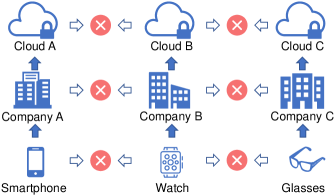
With the rapid development of computing technology, wearable devices such as smart phones and wristbands make it easy to get access to people's health information including activities, sleep, sports, etc. Smart healthcare achieves great success by training machine learning models on a large quantity of user data. However, there are two critical challenges. Firstly, user data often exists in the form of isolated islands, making it difficult to perform aggregation without compromising privacy security. Secondly, the models trained on the cloud fail on personalization. In this paper, we propose FedHealth, the first federated transfer learning framework for wearable healthcare to tackle these challenges. FedHealth performs data aggregation through federated learning, and then builds personalized models by transfer learning. It is able to achieve accurate and personalized healthcare without compromising privacy and security. Experiments demonstrate that FedHealth produces higher accuracy (5.3% improvement) for wearable activity recognition when compared to traditional methods. FedHealth is general and extensible and has the potential to be used in many healthcare applications.
Motivation & Objective
- Address data islanding in wearable healthcare by enabling privacy-preserving model training across organizations.
- Provide personalized model learning for individual users through transfer learning.
- Leverage federated learning to aggregate knowledge while preserving data privacy.
- Demonstrate effectiveness in smartphone activity recognition and show extensibility to other healthcare tasks.
Proposed method
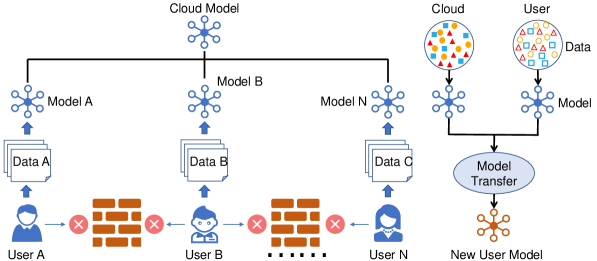
- Train a cloud (server) model f_S using public/server data via standard deep learning objective.
- Distribute f_S to users via homomorphic encryption and have users train local models f_u on their data.
- Aggregate encrypted user models to update the server model f_S' without exposing raw data.
- Perform transfer learning to personalize models for each user by freezing lower layers and adapting higher layers, with an alignment (CORAL) loss to reduce domain divergence.
- Use CORAL loss to align second-order statistics between source (server) and target (user) weights during personalization.
- Outline iterative, continuous updates as new user data arrive to progressively improve personalization.
Experimental results
Research questions
- RQ1How can federated learning be combined with transfer learning to address data islanding while maintaining privacy in wearable healthcare?
- RQ2Can a cloud model be leveraged and refined to provide personalized models for individual users without sharing raw data?
- RQ3What is the impact on recognition accuracy when applying federated transfer learning to smartphone-based activity recognition compared with traditional approaches?
Key findings
- FedHealth yields the best accuracy across all subjects in the smartphone activity recognition experiment.
- Compared to the NoFed setting (server model only), FedHealth improves average accuracy by about 5.3%.
- FedHealth outperforms traditional methods (KNN, SVM, RF) on all subjects.
- Transfer learning within FedHealth improves performance over non-transfer baselines by around 4 percentage points on average.
- The framework supports extensions with alternative transfer learning strategies (fine-tuning, MMD) and remains effective.
- Federated learning with encrypted parameter sharing maintains privacy while enabling knowledge aggregation.
Read this paper
Open the full text in the Nubint reader and ask about any passage as you read.
Read this paper on NubintThis review was generated by AI from the original paper. Please check the paper before citing it.