
[Paper Review] FeedRec: News Feed Recommendation with Various User Feedbacks
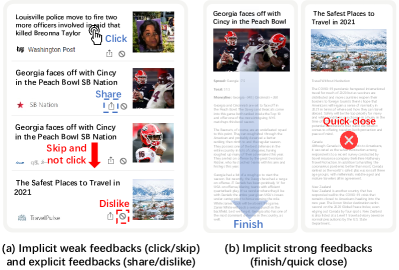
FeedRec proposes a unified framework for news feed recommendation that leverages diverse user feedbacks—such as clicks, skips, shares, dislikes, finish actions, and quick closes—to enhance user interest modeling and engagement-aware training. By using strong-to-weak attention distillation and multi-feedback training, it improves both click prediction and user engagement metrics on real-world data.
Accurate user interest modeling is important for news recommendation. Most existing methods for news recommendation rely on implicit feedbacks like click for inferring user interests and model training. However, click behaviors usually contain heavy noise, and cannot help infer complicated user interest such as dislike. Besides, the feed recommendation models trained solely on click behaviors cannot optimize other objectives such as user engagement. In this paper, we present a news feed recommendation method that can exploit various kinds of user feedbacks to enhance both user interest modeling and model training. We propose a unified user modeling framework to incorporate various explicit and implicit user feedbacks to infer both positive and negative user interests. In addition, we propose a strong-to-weak attention network that uses the representations of stronger feedbacks to distill positive and negative user interests from implicit weak feedbacks for accurate user interest modeling. Besides, we propose a multi-feedback model training framework to learn an engagement-aware feed recommendation model. Extensive experiments on a real-world dataset show that our approach can effectively improve the model performance in terms of both news clicks and user engagement.
Motivation & Objective
- To address the limitations of click-only feedback in modeling complex user interests such as likes and dislikes.
- To improve user interest modeling by incorporating various feedback types, including explicit and implicit signals of varying intensities.
- To develop a training framework that optimizes for user engagement beyond click-through rate.
- To model the relatedness between different feedback types and distill accurate positive/negative interests from noisy implicit feedbacks.
Proposed method
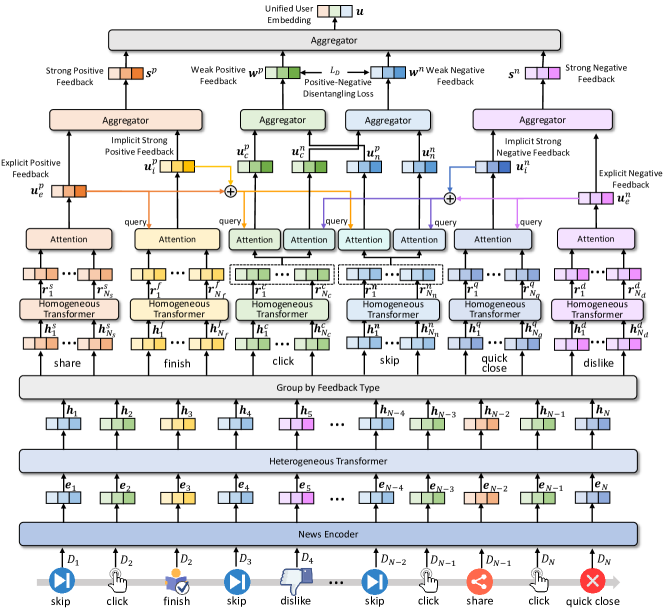
- A unified user modeling framework integrates multiple feedback types—click, skip, share, dislike, finish, and quick close—into a single representation.
- A strong-to-weak attention network uses representations from stronger feedbacks (e.g., dislike, finish) to distill accurate positive and negative interests from weaker feedbacks (e.g., click, skip).
- Heterogeneous and homogeneous Transformers model cross-feedback and intra-feedback relationships, respectively.
- A multi-feedback training framework jointly optimizes for click prediction, finish prediction, and dwell time prediction to learn engagement-aware representations.
- Feedback embeddings, dwell time embeddings, position embeddings, and time interval embeddings are used to enrich news encoder representations.
- Loss functions are weighted using learnable coefficients (α, β, γ) to balance click, finish, and positive-negative disentanglement objectives.
Experimental results
Research questions
- RQ1How can diverse user feedbacks with varying intensities be effectively integrated into a unified user modeling framework?
- RQ2Can strong feedbacks (e.g., dislike, finish) be leveraged to improve the accuracy of positive and negative interest inference from weak feedbacks (e.g., click)?
- RQ3To what extent does multi-feedback training improve engagement beyond click-based optimization?
- RQ4Which feedback types and embeddings contribute most significantly to model performance?
Key findings
- The proposed strong-to-weak attention mechanism significantly improves model performance by enabling more accurate distillation of user interests from noisy implicit feedbacks.
- Jointly training on click, finish, and dwell time prediction tasks leads to better performance than click-only training, indicating improved engagement awareness.
- Feedback embedding is the most important feature, followed by dwell time embedding, both of which provide critical signals for user satisfaction and interest inference.
- The optimal dwell time threshold for identifying quick closes is 10 seconds, balancing the capture of negative signals without misclassifying positive ones.
- The best performance is achieved with loss coefficients α=0.2 (finish), β=0.15 (dwell time), and γ=0.2 (positive-negative disentanglement), indicating balanced optimization across tasks.
Read this paper
Open the full text in the Nubint reader and ask about any passage as you read.
Read this paper on NubintThis review was generated by AI from the original paper. Please check the paper before citing it.